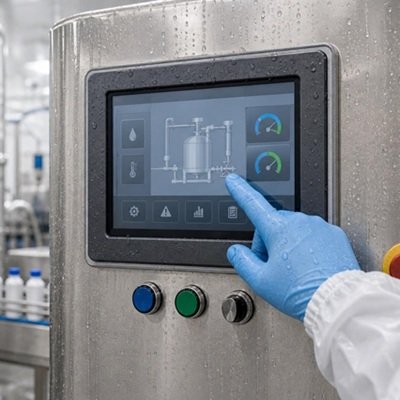
Industrielle Touchscreens müssen in Umgebungen zuverlässig funktionieren, in denen herkömmliche Consumer-Displays möglicherweise an ihre Grenzen stoßen. Regen, Feuchtigkeit, Staub, Temperaturschwankungen, Vibrationen und wiederholter physischer Kontakt können die Touchscreen-Leistung und die Lebensdauer beeinträchtigen.
Für Gerätehersteller und OEM/ODM-Einkäufer erfordert die Auswahl des richtigen wasserdichten kapazitiven Touchscreens mehr als die Auswahl einer Displaygröße oder die Prüfung, ob ein Produkt Multi-Touch-Funktionalität unterstützt.
Eine zuverlässige industrielle Touchscreen-Lösung muss geeigneten Umweltschutz, langlebige Sensormaterialien, optische Leistung, elektrische Kompatibilität und langfristige Komponentenzuverlässigkeit kombinieren.
Mit über 15 Jahren F&E-Erfahrung in TFT-, OLED- und Touch-Technologie bietet Qihantech maßgeschneiderte industrielle Display- und kapazitive Touch-Lösungen für anspruchsvolle Hardware-Anwendungen, einschließlich medizinischer Geräte, industrieller Automatisierung, Luft- und Raumfahrt sowie verteidigungsbezogener Systeme.
Dieser Leitfaden erläutert die technischen Faktoren, die Beschaffungsmanager, Produktingenieure und OEM-Einkäufer vor der Auswahl eines wasserdichten projiziert-kapazitiven (PCAP) Touchscreens bewerten sollten.
1. Verständnis der wasserdichten kapazitiven Touchscreen-Technologie
Ein projiziert-kapazitiver Touchscreen erkennt Touch-Eingaben durch Messung von Änderungen in einem elektrischen Feld, das von leitfähigen Elektroden innerhalb des Touch-Sensors erzeugt wird.
Im Gegensatz zu herkömmlichen resistiven Touchscreens unterstützt die PCAP-Technologie Multi-Touch-Bedienung, glatte Glasoberflächen und flexible industrielle Integration.
Die wasserdichte Leistung hängt jedoch sowohl vom Touchscreen-Design als auch vom umgebenden Gerätegehäuse ab.
Ein kapazitiver Touch-Sensor allein macht eine komplette Display-Baugruppe nicht wasserdicht.
Hauptkomponenten eines industriellen kapazitiven Touchscreens
Eine typische industrielle Touchscreen-Baugruppe kann Folgendes umfassen:
- Deckglas: Schützt den darunterliegenden Sensor vor Kratzern, Stößen und Umwelteinflüssen.
- ITO-Leitglas: Bildet transparente leitfähige Elektroden für die kapazitive Touch-Erkennung.
- Leitfähige Silberpaste: Stellt elektrische Verbindungen zwischen Sensor-Elektroden und zugehörigen Schaltkreisen her.
- Isolationsmaterialien: Isolieren leitfähige Muster elektrisch und tragen zum Schutz der Sensorstruktur bei.
- Touch-Controller: Verarbeitet Kapazitätsänderungen und wandelt sie in Touch-Koordinaten um.
- TFT-LCD- oder OLED-Display: Bietet die visuelle Schnittstelle hinter dem Touch-Sensor.
- Optische Bonding-Schicht: Verbindet das Display und die Deckglas-Baugruppe und reduziert interne Reflexionen.
Für wasserdichte industrielle Anwendungen müssen diese Komponenten als integriertes System funktionieren.
2. IP65 vs. IP67 vs. IP68: Auswahl der richtigen Wasserdichtigkeitsklasse
Schutzarten (IP-Schutzarten) sind in IEC 60529 definiert und beschreiben den Grad des Schutzes, den ein Gehäuse gegen feste Fremdkörper und Wasser bietet.
Für industrielle Touchscreen-Anwendungen werden häufig IP65, IP67 und IP68 in Betracht gezogen.
| IP-Schutzart | Schutzeigenschaften | Typische Anwendungen |
|---|---|---|
| IP65 | Staubdicht; geschützt gegen Wasserstrahlen | Fabriksteuerungstafeln, Außenkioske |
| IP67 | Staubdicht; geschützt gegen vorübergehendes Eintauchen unter festgelegten Testbedingungen | Außenüberwachungsgeräte, tragbare Instrumente |
| IP68 | Staubdicht; geschützt gegen Eintauchen unter herstellerspezifischen Bedingungen über IPX7 hinaus | Geräte, die einen erweiterten Eintauchschutz erfordern |
IP65 Kapazitive Touchscreens
Ein Touchscreen-Gehäuse mit IP65-Bewertung ist üblicherweise für industrielle Geräte geeignet, die Staub, Spritzwasser und Wasserstrahlen ausgesetzt sind.
Typische Anwendungen umfassen Fertigungssteuerungstafeln, Außenterminals und industrielle Instrumentierung.
IP67-kapazitive Touchscreens
IP67-Schutz ist relevant, wenn Geräte vorübergehendem Wassereintauchen ausgesetzt sein können.
Er kann für tragbare industrielle Messinstrumente, Feldüberwachungssysteme und ausgewählte Außengeräte geeignet sein.
IP68-kapazitive Touchscreens
IP68 ist für Anwendungen vorgesehen, die Eintauchschutz unter speziell vereinbarten Testbedingungen erfordern.
Die tatsächliche Tiefe und Dauer müssen mit dem Hersteller bestätigt werden.
OEM-Beschaffungstipp: Bestätigen Sie stets, ob die IP-Schutzart für die Frontplatte, das komplette Gehäuse oder das vollständig montierte Gerät gilt. Eine IP67-Bewertung für die Frontplatte bedeutet nicht automatisch, dass das gesamte Produkt IP67-zertifiziert ist.
Darüber hinaus belegt eine IP67- oder IP68-Bewertung nicht automatisch die Konformität mit der IP65-Wasserstrahlprüfung. Wenn beide Bedingungen relevant sind, fordern Sie die entsprechenden Prüfnachweise an.
3. IK-Stoßfestigkeit: Schutz von Touchscreens gegen physische Beschädigung
Industrielle Touchscreens können mechanischen Stößen durch Werkzeuge, Ausrüstung, versehentliche Kollisionen oder wiederholte Handhabung ausgesetzt sein.
Die IK-Bewertung, definiert durch IEC 62262, gibt den Grad des Schutzes an, den ein Gehäuse gegen externe mechanische Stöße bietet.
| IK-Schutzart | Aufprallenergie | Anwendungsüberlegungen |
|---|---|---|
| IK07 | 2 J | Moderate mechanische Beanspruchung |
| IK08 | 5 J | Industrielle Bedienpanels |
| IK09 | 10 J | Anspruchsvollere industrielle Installationen |
| IK10 | 20 J | Öffentlich zugängliche und hochbeanspruchte Umgebungen |
Auswahl Industrielles Touchscreen-Deckglas
Bei der Auswahl des Deckglases sollten Glasdicke, Veredelungsprozess, Kantenbehandlung, Montagedesign und die erforderliche Aufprallleistung berücksichtigt werden.
Die anpassbaren Touchscreen-Konfigurationen von Qihantech können auf projektspezifische Deckglasanforderungen abgestimmt entwickelt werden, einschließlich Optionen für gehärtetes Glas und ausgewähltes chemisch verstärktes Glas.
Die endgültige Materialauswahl sollte das mechanische Design der Anwendung und die validierten Aufprallanforderungen widerspiegeln.
Technische Überlegung: Ein dickeres Deckglas kann die mechanische Robustheit verbessern, jedoch auch die Touch-Empfindlichkeit beeinträchtigen. Der Controller, das Elektrodendesign und die Firmware müssen für den gesamten Deckglasstapel optimiert werden.
4. Optisches Bonding vs. Luft-Bonding: Was ist besser für Außenanzeigen?
Optisches Bonding ist eine wichtige Überlegung bei der Auswahl industrieller TFT-LCD-Anzeigen für Außen- oder Hochfeuchtigkeitsumgebungen.
Zwei gängige Montageansätze sind Luft-Bonding und vollständiges optisches Bonding.

Luft-BondingDeckglas und Display durch einen Luftspalt getrennt.

Vollständiges optisches BondingOptisch klarer Klebstoff füllt den Raum zwischen den Display-Schichten.
Luft-Bonding
Beim Luft-Bonding bleibt ein Spalt zwischen der Touchscreen-Deckglasbaugruppe und dem Display erhalten.
Zu den Vorteilen gehören eine relativ unkomplizierte Montage und potenziell niedrigere Herstellungskosten.
Der Luftspalt führt jedoch zu zusätzlichen Reflexionsgrenzflächen und kann die Wahrscheinlichkeit interner Kondensation erhöhen, wenn Feuchtigkeit in die Baugruppe eindringt.
Vollständiges optisches Bonding mit LOCA oder OCA
Beim vollständigen optischen Bonding wird der Raum zwischen Display und Touch-Baugruppe mit einem optisch klaren Verbundmaterial gefüllt.
Gängige Technologien umfassen:
- LOCA (Flüssiger optisch klarer Klebstoff): Ein flüssiger Klebstoff, der während des Bondings dosiert und ausgehärtet wird.
- OCA (Optisch klarer Klebstoff): Eine vorgeformte Klebefolie, die zwischen optischen Schichten aufgebracht wird.
- OCR (Optisch klares Harz): Ein weiter gefasster Begriff, der häufig für optisch klare Harz-Verbundmaterialien verwendet wird, einschließlich bestimmter flüssiger Systeme.
Zu den Vorteilen können reduzierte interne Reflexionen, verbesserter wahrgenommener Kontrast, verringertes Risiko interner Kondensation und verbesserte mechanische Integration gehören.
| Vergleich | Luft-Bonding | Vollständiges optisches Bonding |
|---|---|---|
| Interne Reflexionen | Höher | Niedriger |
| Lesbarkeit im Freien | Stärker von Umgebungsbedingungen abhängig | Oft verbessert |
| Risiko interner Kondensation | Größer, wenn Feuchtigkeit in den Luftspalt eindringt | Reduziert innerhalb der gebondeten Grenzfläche |
| Montagekomplexität | Niedriger | Höher |
| Herstellungskosten | Generally lower | Generally higher |
| Typical suitability | Indoor industrial equipment | Outdoor and demanding industrial equipment |
For outdoor instruments, full optical bonding is often the preferred engineering approach when readability and environmental durability are priorities.
Nevertheless, optical bonding does not replace enclosure sealing, gasket design, or IP testing.
5. Why Premium Touch Sensor Materials Matter for Long-Term Reliability
The reliability of an industrial capacitive touchscreen depends heavily on its conductive and insulating materials.
Poor material uniformity, unstable electrical resistance, and inadequate adhesion can contribute to touch sensitivity variation, signal instability, or premature failure.
Qihantech’s premium material specification approach emphasizes three critical elements: ITO conductive glass, conductive silver paste, and insulation materials.
High-Performance ITO Conductive Glass
Indium Tin Oxide (ITO) is widely used to create transparent conductive patterns for capacitive touch sensors.
Important quality indicators include sheet resistance uniformity, surface roughness, environmental stability, and adhesion performance.
Based on the supplied premium material specification comparison:
| Performance Index | Premium-Spezifikation | Referenzvergleich auf Marktniveau |
|---|---|---|
| Sheet resistance uniformity | ±1,5 Ω/sq maximal; Chargenabweichung ≤0,8 Ω/sq | ±6–10 Ω/sq; bis zu 10 Ω Abweichung pro Scheibe |
| Surface roughness (AFM-Ra) | 0,8–1,2 nm | 3,5–6 nm |
| 85°C/85% RH damp heat, 1,000 hours | Vernachlässigbare Widerstandsdrift | Greater drift and potential touch failure risk |
| Film adhesion and abrasion, 1,000 cycles | ≤6 % Widerstandsänderung | Größer als 18 % Widerstandsänderung |
Improved resistance uniformity can support consistent electrical behavior across the sensor surface, while a smoother conductive film may benefit subsequent coating and patterning processes.
For industrial OEM projects, these properties are especially relevant when consistent touch performance is required across multiple production batches.
Premium Conductive Silver Paste
Conductive silver paste forms electrical pathways between the touch sensor electrodes and the flexible circuit or other interconnection structures.
The supplied material comparison identifies premium ASAHI silver paste as a selected material option.
Its listed performance targets include:
- Damp heat aging resistance change of ≤10%.
- Cross-cut adhesion grade 5B under ASTM D3359.
- Low and stable ITO contact resistance after aging.
Stable conductivity and strong adhesion are important for reducing electrical discontinuities and long-term signal degradation.
High-Insulation Protective Materials
Insulation materials protect conductive patterns and reduce the risk of unwanted electrical leakage.
The supplied DEXERIALS premium insulation material comparison identifies the following targets:
| Performance Parameter | Premium-Spezifikation | Referenzvergleich auf Marktniveau |
|---|---|---|
| Volume resistivity | ≥10¹² Ω·cm | 10⁹–10¹⁰ Ω·cm |
| Step coverage | Konforme, pinholefreie Beschichtung | Greater risk of poor coverage |
| Pencil hardness | ≥3H | 1H–2H |
High volume resistivity and uniform insulation coverage can improve electrical isolation between conductive structures.
These characteristics are particularly important for industrial touchscreens exposed to high humidity and prolonged operating periods.
Technical data note: The premium and market-level figures above are reproduced from the supplied material comparison. They should be treated as supplier-provided specifications and reference comparisons, not independently verified industry-wide averages. The stated 30% conduction-resistance and 40% anti-interference improvements require defined test methods and supporting reports before publication as validated performance claims.
6. Operating Temperature and Humidity Requirements
Industrial displays are often deployed in environments with significant temperature variations.
For outdoor instrumentation and industrial control systems, a project operating temperature requirement of −30°C to +85°C may be appropriate.
However, the touchscreen sensor, display module, controller, adhesives, and other components must each be evaluated against the required conditions.
Low-Temperature Performance
Low temperatures can affect LCD response time, adhesive properties, and the behavior of electronic components.
Applications operating below freezing may require specially selected liquid crystal materials, display heaters, or thermal management solutions.
High-Temperature Performance
Elevated temperatures can affect LCD lifetime, OLED aging, adhesive stability, and controller reliability.
Temperature qualification should therefore cover the complete touchscreen display assembly rather than individual components alone.
High-Humidity Environments
High humidity can contribute to corrosion, electrical leakage, and deterioration of sensitive interfaces.
For industrial touchscreen qualification, engineers may consider damp heat testing, temperature cycling, insulation resistance testing, and functional verification after environmental exposure.
An 85°C/85% RH test is a useful accelerated reliability assessment, but passing a particular duration does not independently establish a specific outdoor service life.
7. Sunlight-Readable Industrial Displays: Brightness, AG, AR, and AF Coatings
Outdoor touchscreen readability depends on more than LCD brightness.
Ambient light reflection, cover glass treatment, display contrast, and optical bonding all influence the operator’s ability to read the screen.


High-Brightness TFT LCD Displays
For outdoor applications, display brightness requirements may range from approximately 800 to 1,500 nits or higher, depending on ambient illumination and optical design.
The appropriate brightness should be selected using actual application conditions rather than a fixed universal threshold.
Anti-Glare (AG) Coating
AG treatments diffuse reflected light, helping reduce distracting glare.
However, excessive surface haze can reduce perceived image sharpness, so the AG specification should be balanced against display resolution and optical clarity.
Anti-Reflection (AR) Coating
AR coatings reduce reflections at optical surfaces, improving perceived contrast under strong ambient light.
AR coatings are especially useful when combined with full optical bonding.
Anti-Fingerprint (AF) Coating
AF coatings help reduce fingerprint visibility and make the cover glass easier to clean.
This is valuable for frequently operated industrial control panels and public-facing equipment.
For outdoor OEM projects, Qihantech can support evaluation of AG, AR, and AF surface treatments according to application-specific requirements.
8. Waterproof Touchscreens With Gloves and Wet-Finger Operation
Industrial operators may need to use touchscreen interfaces while wearing gloves or working in wet conditions.
These operating scenarios create additional challenges for projected capacitive touch technology.
Water droplets can alter the local capacitive field, potentially causing false touch detection or reduced touch sensitivity.
Gloves can also reduce the coupling between the operator’s finger and the sensor.
Optimizing Wet-Touch Performance
Water-tolerant PCAP touchscreen designs may require optimized electrode patterns, controller algorithms, noise filtering, and firmware tuning.
Glove Touch Functionality
Glove operation depends on several factors, including glove thickness, glove material, cover glass thickness, and controller sensitivity.
For equipment manufacturers, the most reliable approach is to validate touch operation using the actual gloves and environmental conditions expected in the field.
10-Point Multi-Touch Support
Qihantech’s customizable PCAP touch solutions can be specified for 10-point multi-touch operation where the selected sensor and controller support it.
This functionality is useful for industrial HMI applications requiring multi-finger gestures, zooming, or more complex graphical interfaces.
OEM Validation Tip: Request touch accuracy, false-touch rejection, wet-finger performance, and glove-operation tests using the final mechanical assembly.
9. Choosing the Right Touchscreen Interface: USB, I²C, or RS232
Interface compatibility is an important consideration when integrating a capacitive touchscreen into an industrial device.
| Schnittstelle | Key Characteristics | Typische Anwendungen |
|---|---|---|
| USB | Common host interface; convenient integration with supported operating systems | Industrial PCs, kiosks, embedded computers |
| I²C | Compact serial interface suitable for embedded integration | Custom control boards, embedded HMI systems |
| RS232 | Serial communication option requiring compatible controller and protocol support | Legacy industrial equipment, specialized control systems |
USB Capacitive Touch Panels
USB touchscreen interfaces are commonly used with industrial PCs and embedded systems.
They can simplify integration where suitable drivers and standard touch input support are available.
I²C PCAP Touchscreens
I²C is frequently used in compact embedded devices where the touch controller communicates directly with the main processor.
RS232 Touchscreen Solutions
RS232 may be relevant for legacy equipment or specialized industrial control architectures.
Because modern PCAP controllers do not universally provide native RS232 output, interface availability should be confirmed during the design stage.
Qihantech supports OEM touchscreen interface customization based on controller selection, host compatibility, and project requirements.
10. Custom Capacitive Touchscreen Design for OEM/ODM Manufacturers
Standard touchscreen modules are not always suitable for specialized industrial equipment.
OEM buyers may require non-standard dimensions, customized glass outlines, special mounting structures, or unique electrical interfaces.
Qihantech provides industrial touchscreen and display customization services for integration into customer-specific hardware.
Available Customization Considerations

Custom Cover Glass and Sensor Layouts
Application-specific glass dimensions, cover lens outlines, printed borders, sensor patterns, and mechanical mounting requirements.

Custom Interface and FPC Design
Flexible printed circuit layouts, connector positioning, touch controller selection, and host interface integration.

Integrated TFT LCD and Touch Assemblies
Touchscreen integration with selected industrial TFT LCD or OLED modules, including optical bonding and surface treatment options.
Custom PCAP touch overlays and semi-finished touchscreen assemblies can also support OEM customers that perform final mechanical integration in their own production facilities.
11. Typical Applications for Waterproof Industrial Touchscreens

Industrial Automation
Factory control panels, machinery interfaces, and production monitoring terminals.

Outdoor Measurement Instruments
Portable electrical testers, environmental monitors, and field inspection equipment.

Medizinische Geräte
Diagnostic systems, medical instrumentation, and frequently cleaned operator interfaces.

Aerospace and Specialized Equipment
Rugged display interfaces designed around demanding environmental and integration requirements.
Each industry may require additional qualification beyond basic touchscreen functionality.
For example, medical equipment may require evaluation against applicable IEC 60601 standards, while aerospace and defense-related applications may involve project-specific environmental, electromagnetic compatibility, and reliability requirements.
Material selection alone does not establish compliance with these industry standards.
12. B2B Purchasing Checklist: How to Evaluate an Industrial Touchscreen Manufacturer
Before placing a bulk order, procurement managers should request sufficient engineering information to verify the supplier’s suitability.
| Evaluation Category | Questions to Ask the Manufacturer |
|---|---|
| Environmental protection | Is the IP rating verified for the final assembly? |
| Mechanical strength | What impact tests and cover glass options are available? |
| Display readability | What are the brightness, reflectance, and optical bonding specifications? |
| Touch performance | Does the design support wet touch, gloves, and required multi-touch operation? |
| Temperature range | Are the complete module’s operating and storage ranges documented? |
| Sensor materials | Are ITO resistance uniformity and insulation performance controlled? |
| Electrical interface | Are USB, I²C, or other required interfaces supported? |
| Quality assurance | Are environmental and production test reports available? |
| Customization | Can the supplier modify the cover glass, FPC, and display assembly? |
| Long-term supply | What are the component lifecycle, change-notification, and replacement policies? |
Request Samples Before Mass Production
For high-reliability applications, buyers should evaluate engineering samples in the final equipment configuration.
A practical qualification program may include environmental exposure, optical inspection, electrical performance measurement, mechanical testing, and functional touch testing.
Documenting acceptance criteria before testing helps reduce disagreements and costly design changes during production.
13. Why Choose Qihantech for Industrial Touchscreen OEM/ODM Projects?
Qihantech specializes in industrial TFT LCD displays, OLED displays, and capacitive touchscreen solutions, supported by more than 15 years of R&D experience in display and touch technologies.
Our OEM/ODM approach focuses on aligning the display and touchscreen design with each customer’s electrical, mechanical, optical, and environmental requirements.
Key areas of customization include premium touch sensor material selection, custom PCAP sensor layouts, cover glass specifications, AG/AR/AF surface treatments, touch controller integration, and display bonding configurations.
For industrial equipment manufacturers, this integrated approach helps simplify product development and supports more consistent touchscreen integration across the equipment lifecycle.
Whether you are developing an outdoor measurement instrument, industrial control panel, medical device, or specialized rugged display system, Qihantech can help evaluate a touchscreen configuration suited to your application.
Frequently Asked Questions About Waterproof Capacitive Touchscreens
1. What is the difference between IP65 and IP67 capacitive touchscreens?
IP65 indicates protection against dust ingress and water jets, while IP67 includes protection against temporary immersion under specified test conditions. The correct rating depends on the equipment’s exposure conditions and final enclosure design.
2. Can a capacitive touchscreen work with wet fingers or gloves?
Yes. Properly engineered PCAP touchscreens can support wet-finger and glove operation. Performance depends on the sensor design, touch controller, firmware, cover glass, and operating conditions.
3. Is optical bonding necessary for outdoor industrial displays?
Optical bonding is not mandatory for every outdoor display, but it can significantly improve optical performance by reducing internal reflections. It also eliminates the air gap between bonded layers, reducing the opportunity for condensation at that interface.
4. What brightness is recommended for an outdoor TFT LCD touchscreen?
Outdoor displays commonly require higher brightness than indoor modules. Depending on ambient illumination and optical construction, specifications of approximately 800–1,500 nits or higher may be considered. Final selection should be based on sunlight readability testing.
5. Can industrial capacitive touchscreens operate from −30°C to +85°C?
Some specially designed industrial touchscreen assemblies can be engineered for this range. However, the TFT LCD or OLED module, controller, adhesives, and associated components must all be qualified for the required operating conditions.
6. What makes premium ITO conductive glass important?
ITO sheet resistance uniformity, surface quality, adhesion, and environmental stability influence touch sensor consistency and long-term electrical performance. These characteristics are important for industrial equipment requiring reliable touch operation.
7. Can Qihantech customize waterproof capacitive touchscreens for OEM projects?
Qihantech offers OEM/ODM touchscreen customization covering sensor dimensions, cover glass, interfaces, surface treatments, and integration with industrial display modules. Waterproof performance requirements should be defined and validated for each final product design.
8. What information should buyers provide when requesting a custom industrial touchscreen?
Buyers should provide the required display size, resolution, cover glass dimensions, interface type, operating temperature, IP and IK requirements, touch functionality, optical bonding preference, and expected order quantities.
Conclusion: Select Industrial Touchscreens Based on Total System Reliability
Choosing a waterproof capacitive touchscreen for outdoor or industrial equipment requires a system-level engineering approach.
IP and IK ratings, premium sensor materials, optical bonding, display brightness, environmental resistance, and touch controller compatibility all contribute to the final product’s performance.
For OEM/ODM buyers, the best touchscreen solution is not necessarily the one with the highest individual specification. It is the solution that satisfies the equipment’s actual operating requirements, qualification criteria, and long-term supply needs.
With over 15 years of experience in TFT LCD, OLED, and touch technology, Qihantech supports industrial equipment manufacturers with customized touchscreen and display solutions designed for demanding applications.
Looking for a custom waterproof capacitive touchscreen or industrial TFT LCD display?
Contact Qihantech to discuss your project specifications, display integration requirements, and OEM/ODM customization options.