Die langfristige Zuverlässigkeit eines industriellen kapazitiven Touchscreens hängt von mehr als der Dicke des Deckglases, der Leistung des Touch-Controllers oder der Display-Helligkeit ab. Die Qualität der Materialien im Inneren des Touch-Sensors spielt ebenfalls eine entscheidende Rolle für die elektrische Stabilität, die Umweltbeständigkeit und die Fertigungskonsistenz.
Für Gerätehersteller kann die Auswahl eines projiziert-kapazitiven (PCAP) Touchscreens allein auf Basis von Größe, Auflösung, Schnittstelle und Preis wichtige materialbedingte Risiken übersehen.
Zwei Touchpanels können identisch erscheinen und dieselbe Multi-Touch-Funktionalität bieten, doch ihre leitfähigen Filme, elektrischen Verbindungen und Isolierschichten können sich nach längerer Exposition gegenüber Hitze, Feuchtigkeit oder mechanischer Belastung unterschiedlich verhalten.
Diese Unterschiede sind besonders relevant für medizinische Instrumente, industrielle Steuerungssysteme, Außengeräte, Marineelektronik und andere Anwendungen, bei denen ein Touchscreen-Ausfall zu kostspieliger Wartung oder Geräteausfallzeiten führen kann.
Mit über 15 Jahren F&E-Erfahrung in TFT-LCD-, OLED- und Touch-Technologie konzentriert sich Qihantech auf industrielle Display- und kapazitive Touchscreen-OEM/ODM-Lösungen für anspruchsvolle Hardware-Umgebungen.
Dieser Leitfaden erläutert die drei Kernmaterialkategorien, die in industriellen kapazitiven Touch-Sensoren verwendet werden, vergleicht die gelieferten Premium-Materialspezifikationen mit Referenzalternativen und beschreibt, was OEM-Käufer vor der Freigabe eines Touchscreen-Lieferanten überprüfen sollten.
1. Welche Materialien bestimmen die Zuverlässigkeit von kapazitiven Touchscreens?
Ein projiziert-kapazitiver Touchscreen erkennt Berührungen durch Änderungen der Kapazität über eine strukturierte leitfähige Sensoranordnung.
Obwohl der Touch-Controller diese Änderungen in Koordinaten umwandelt, hängen die elektrischen Eigenschaften des Sensors von den Materialien und Fertigungsprozessen ab, die zur Herstellung der leitfähigen Elektroden und der zugehörigen Schaltkreise verwendet werden.
Drei Materialkategorien sind besonders wichtig:
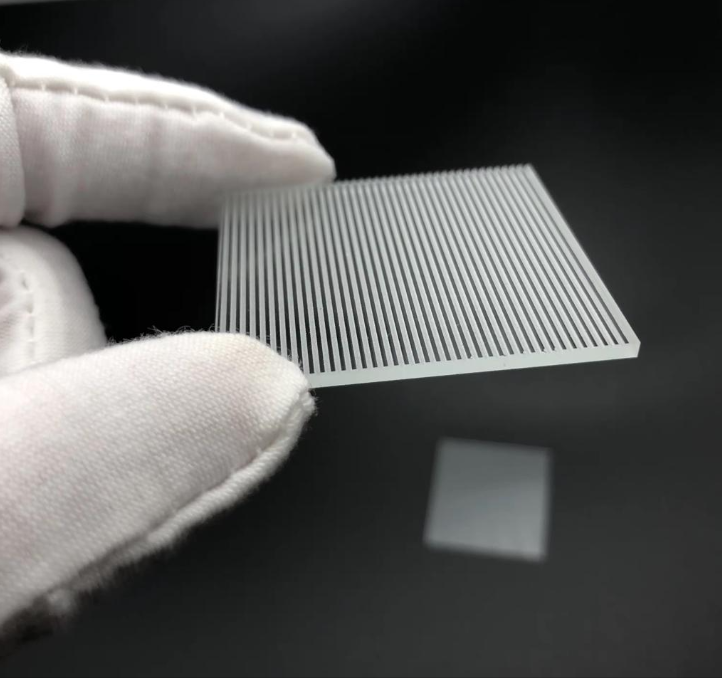
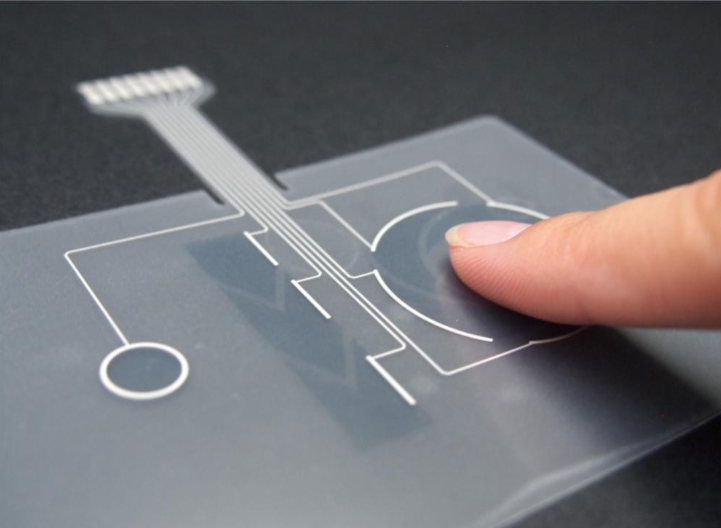
Bildet transparente Elektroden für die kapazitive Erfassung. Gleichmäßigkeit des Schichtwiderstands, Beschichtungsqualität und Umweltstabilität beeinflussen die elektrische Konsistenz.
2. Leitfähige Silberpaste
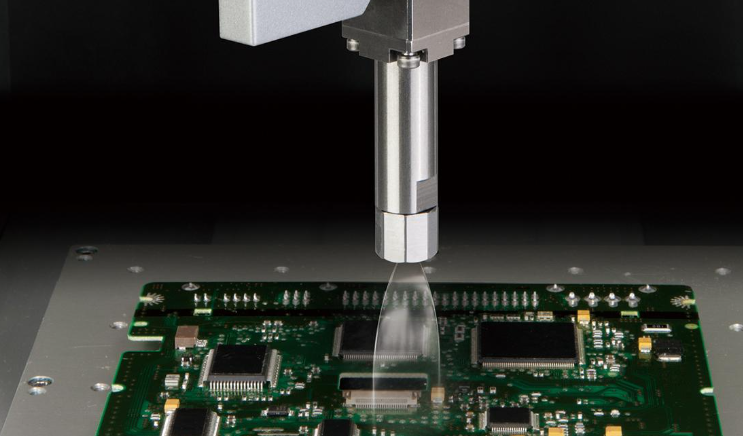
Erzeugt leitfähige Leiterbahnen und Verbindungen zwischen Sensorstrukturen und externen Schaltkreisen. Haftung, Kontaktwiderstand und Alterungsverhalten beeinflussen die Verbindungszuverlässigkeit.
3. Isolationsmaterialien
Isolieren leitfähige Strukturen elektrisch und helfen, Leckströme oder ungewollte elektrische Verbindungen zu verhindern. Hoher spezifischer Widerstand und gleichmäßige Beschichtungsabdeckung sind essenziell.
Diese Materialien müssen als Teil eines vollständigen Touch-Sensors zusammenwirken.
Selbst wenn einzelne Materialien ihre Spezifikationen erfüllen, können Elektrodenstrukturierung, Druck, Aushärtung, Laminierung, Versiegelung und Controller-Konfiguration dennoch die Zuverlässigkeit des endgültigen Touchscreens beeinflussen.
2. Premium- vs. konventionelle Materialien für kapazitive Touchscreens: Spezifikationsvergleich
Die folgende Tabelle fasst die gelieferten Premium-Spezifikationen und Referenzvergleichswerte für drei Materialkategorien zusammen.
Leistungsvergleich der Kernmaterialien
| Material / Leistungsindikator | Premium-Spezifikation | Referenzvergleich auf Marktniveau |
|---|---|---|
| ITO-leitfähiges Glas | ||
| Gleichmäßigkeit des Schichtwiderstands | ±1,5 Ω/sq maximal; Chargenabweichung ≤0,8 Ω/sq | ±6–10 Ω/sq; bis zu 10 Ω Abweichung pro Scheibe |
| Oberflächenrauheit (AFM-Ra) | 0,8–1,2 nm | 3,5–6 nm |
| 85 °C/85 % RH Feuchte-Wärme (1.000 h) | Vernachlässigbare Widerstandsdrift | Starke Drift und erhöhtes Ausfallrisiko |
| Filmhaftung & Abrieb (1.000 Zyklen) | ≤6 % Widerstandsänderung | Größer als 18 % Widerstandsänderung |
| Leitfähige Silberpaste | ||
| Beständigkeit gegen Feuchte-Wärme-Alterung | ≤10 % Widerstandsänderung | Größer als 30 % Widerstandsänderung |
| Gitterschnitt-Haftung (ASTM D3359) | 5B-Gütegrad | 2B–3B-Gütegrad |
| ITO-Kontaktstabilität | Niedriger, stabiler Widerstand nach Alterung | Ansteigender Kontaktwiderstand |
| Isolationsmaterial | ||
| Spezifischer Volumenwiderstand | ≥10¹² Ω·cm | 10⁹–10¹⁰ Ω·cm |
| Stufenabdeckung | Konforme, pinholefreie Beschichtung | Schlechte Abdeckung, höheres Pinhole-Risiko |
| Bleistifthärte | ≥3H | 1H–2H |
Datenqualifizierung: Diese Zahlen stammen aus dem bereitgestellten Materialvergleich von Qihantech und sollten als spezifizierte Materialziele und illustrative Referenzwerte beschrieben werden. Sie stellen keine verifizierten branchenweiten Durchschnittswerte dar. Prüfberichte, Materialgüten, Probenahmepläne und identische Testbedingungen sind erforderlich, bevor direkte quantitative Lieferantenleistungsaussagen getroffen werden können. Der Schichtwiderstandsvergleich erfordert zudem einen definierten nominalen Schichtwiderstand und eine definierte Messmethode.
Der Vergleich hebt drei technische Prioritäten hervor: Konsistenz der leitfähigen Schicht, stabile elektrische Verbindungen und robuste elektrische Isolierung.
3. ITO-Leitfähiges Glas: Warum die Gleichmäßigkeit des Schichtwiderstands wichtig ist
Indiumzinnoxid (ITO) ist ein transparentes leitfähiges Material, das häufig in projiziert-kapazitiven Touchsensoren verwendet wird.
In glasbasierten PCAP-Sensordesigns bilden strukturierte ITO-Schichten Elektroden, die an der kapazitiven Erfassung beteiligt sind.
Die leitfähige Schicht muss geeignete elektrische Eigenschaften bieten und gleichzeitig ausreichende Transparenz sowie Haftung zum Substrat gewährleisten.
Gleichmäßigkeit des Schichtwiderstands
Der Schichtwiderstand wird üblicherweise in Ohm pro Quadrat (Ω/sq) angegeben.
Er beschreibt den elektrischen Widerstand einer dünnen leitfähigen Schicht unabhängig von den Abmessungen einer quadratischen Messfläche.
Der Elektrodenwiderstand im fertigen Touchscreen hängt jedoch auch von der Strukturgeometrie, Leiterbahnlänge, Breite und den elektrischen Verbindungen ab.
Die bereitgestellte Premium-ITO-Spezifikation gibt Folgendes an:
- Maximale Abweichung des Schichtwiderstands: ±1,5 Ω/sq.
- Ziel für die Variation innerhalb einer Charge: ≤0,8 Ω/sq.
Der Referenzvergleich listet Abweichungen von etwa ±6–10 Ω/sq auf.
Für Touchscreen-Hersteller kann eine verbesserte Gleichmäßigkeit des Schichtwiderstands ein konsistenteres Elektrodenverhalten über die Sensorfläche und zwischen Produktionschargen unterstützen.
Warum dies für industrielle Anwendungen wichtig ist
Variationen des Elektrodenwiderstands können die Signalausbreitung, die Controller-Kalibrierung und das Verhalten komplexer Sensorstrukturen beeinflussen.
Obwohl ein moderner Touch-Controller bestimmte elektrische Variationen kompensieren kann, erleichtern vorhersehbare Sensoreigenschaften die technische Integration und die Produktionsqualitätskontrolle.
Für großformatige industrielle PCAP-Touchpanels können gleichmäßige leitfähige Schichten besonders wertvoll sein, da sich Elektrodenpfade über eine erhebliche Erfassungsfläche erstrecken können.
OEM-Einkaufstipp: Fordern Sie einen Bericht zur Verteilung des Schichtwiderstands an, der das nominale Ziel, Messpositionen, Chargenvariation und Akzeptanzkriterien zeigt, anstatt sich nur auf eine einzelne Haupttoleranz zu verlassen.
4. ITO-Oberflächenrauheit: Unterstützung von Beschichtungs- und Strukturqualität
Die Oberflächenrauheit ist ein weiterer wichtiger Parameter bei der Bewertung von leitfähigem ITO-Glas.
Der bereitgestellte Vergleich spezifiziert eine Oberflächenrauheit von Premium-ITO von 0,8–1,2 nm, gemessen mittels Rasterkraftmikroskopie (AFM-Ra).
Der Bereich des Referenzmaterials beträgt 3,5–6 nm.
Bereitgestellter Vergleich der ITO-Oberflächenrauheit
Illustrative Bereichsendpunkte für AFM-Ra aus dem vom Nutzer bereitgestellten Materialvergleich, kein unabhängig validierter Marktbenchmark.
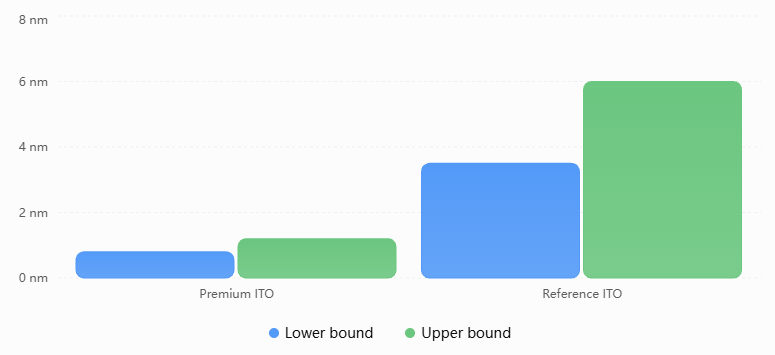
Eine glattere leitfähige Oberfläche kann zu konsistenteren nachfolgenden Beschichtungs- und Strukturierungsprozessen beitragen.
Mögliche technische Vorteile sind eine verbesserte Grenzflächenkonsistenz, reduzierte lokale Oberflächenunregelmäßigkeiten und eine besser vorhersehbare Wechselwirkung mit angrenzenden Schichten.
Die Oberflächenrauheit allein bestimmt jedoch nicht die Touchscreen-Empfindlichkeit, optische Klarheit oder Lebensdauer.
Diese Ergebnisse hängen von der vollständigen Sensorarchitektur und dem Herstellungsprozess ab.
Was Ingenieure überprüfen sollten
AFM-Rauheitsergebnisse sollten die Scan-Größe, Probenahmepositionen, Messmethode und relevanten Prozessbedingungen enthalten.
Vergleiche sind am aussagekräftigsten, wenn die Materialien mit konsistenten Testverfahren bewertet werden.
5. ITO-Feuchte-Wärme- und Abriebbeständigkeit: Bewertung der Langzeitstabilität
Industrielle Touchscreens können jahrelang in Betrieb bleiben und dabei Temperaturänderungen, Feuchtigkeit, mechanischer Belastung und kontinuierlichem Betrieb ausgesetzt sein.
Aus diesem Grund ist die anfängliche elektrische Leistung nur ein Teil des Materialauswahlprozesses.
85°C/85% RH Feuchte-Wärme-Prüfung
Eine übliche beschleunigte Umgebungsbewertung setzt Materialien für eine definierte Dauer 85°C und 85% relativer Luftfeuchtigkeit aus.
Die bereitgestellte Premium-Spezifikation gibt einen vernachlässigbaren ITO-Widerstandsdrift nach 1.000 Stunden Feuchte-Wärme-Exposition an.
Ein stabiler Widerstandswert nach der Prüfung deutet darauf hin, dass die leitfähige Schicht ihre elektrischen Eigenschaften unter den spezifizierten Bedingungen beibehalten hat.
Eine vernachlässigbare Widerstandsdrift sollte jedoch durch eine quantitative Akzeptanzgrenze gestützt werden.
For example, a procurement specification should define the allowed percentage resistance change and the measurement points.
Film Adhesion and Abrasion
The supplied premium comparison lists a resistance change of ≤6% after 1,000 abrasion cycles, compared with greater than 18% for the reference material.
These values suggest a difference in the stability of the conductive layer under the stated test conditions.
Nevertheless, abrasion results depend on applied force, abrasion medium, stroke length, environmental conditions, and test apparatus.
A result stated only as 1,000 cycles is insufficient to establish a universal material performance ranking.
Relevance to Industrial Equipment
Stable conductive film performance is relevant to applications such as:
- Industrial human-machine interfaces operating continuously.
- Medical and laboratory instrumentation.
- Outdoor monitoring and control equipment.
- Marine electronics exposed to humid environments.
- Long-lifecycle embedded touch systems.
For OEM projects, material-level damp heat results should be supplemented by testing of the finished sensor and integrated display assembly.
6. Conductive Silver Paste: The Importance of Stable Electrical Connections
Conductive silver paste is another important material used in many capacitive touch sensor designs.
Depending on the sensor architecture, printed conductive traces help connect transparent electrodes with external electrical circuits.
The quality of these conductive paths influences contact stability and long-term reliability.
Qihantech’s supplied premium material specification identifies ASAHI conductive silver paste as a selected material.
Beständigkeit gegen Feuchte-Wärme-Alterung
The comparison specifies a premium resistance change of ≤10% after damp heat aging, against a reference value greater than 30%.
Resistance Change After Damp Heat Aging

Supplied comparison values. Actual test temperature, humidity, duration, substrate, curing process, and conductor geometry should be confirmed before quantitative benchmarking.
Lower resistance drift can indicate greater electrical stability under comparable aging conditions.
Stable interconnections are important because resistance changes at conductive paths may increase electrical variability and, in severe cases, contribute to touch signal problems.
Cross-Cut Adhesion: ASTM D3359
The supplied material comparison reports a 5B adhesion grade for premium conductive silver paste and a 2B–3B reference level.
ASTM D3359 describes tape-based adhesion testing methods used for certain coating systems.
A 5B classification indicates that no coating detachment was observed within the rating criteria of the applicable test method.
For touchscreen engineering, good adhesion can reduce the risk of conductive trace damage during appropriate processing and service conditions.
However, ASTM D3359 results depend on the substrate, coating system, film thickness, and test method. A silver paste adhesion result should not be generalized to every substrate or manufacturing process.
ITO-Kontaktstabilität
The electrical interface between conductive paste and the ITO structure is another potential reliability concern.
Stable contact resistance can help maintain predictable electrical connections over time.
For OEM qualification, testing should consider contact resistance before and after environmental aging, thermal cycling, and other relevant stresses.
What About the Claimed 30% Conductive Resistance Improvement?
The supplied material information describes a potential 30% reduction in conduction resistance using a high-purity ASAHI silver paste formulation.
This should be treated as a supplier-provided comparative claim until supporting test data confirm the reference formulation, measurement method, conductor geometry, and curing conditions.
The practical engineering objective is not simply to achieve the lowest resistance value, but to maintain sufficiently low and stable resistance throughout the expected service life.
7. Premium Insulation Materials: Preventing Leakage and Electrical Instability
Insulation materials are used to electrically separate conductive structures within a capacitive touch sensor.
They can also protect selected conductive regions from environmental and process-related exposure.
The supplied premium comparison identifies DEXERIALS insulation materials as a selected option, with emphasis on volume resistivity, coating coverage, and hardness.
Volume Resistivity: Why ≥10¹² Ω·cm Matters
Volume resistivity measures a material’s resistance to electric current passing through its bulk.
It is commonly expressed in Ω·cm.
The supplied premium material target is:
Premium insulation material specification
≥10¹² Ω·cm
Volume resistivity target
Reference material comparison: 10⁹–10¹⁰ Ω·cm
Higher volume resistivity can support electrical isolation between conductive features, helping reduce unwanted leakage currents under appropriate conditions.
However, the measured insulation resistance of the final sensor also depends on material thickness, geometry, surface contamination, humidity, and applied voltage.
Step Coverage and Pinhole Control
Step coverage describes how consistently a coating covers changes in surface geometry, including conductor edges and patterned features.
Poor coverage may leave thin regions, gaps, or pinholes that compromise electrical isolation.
The premium comparison specifies conformal, pinhole-free coating coverage.
For industrial touchscreen production, coating quality should be evaluated through appropriate inspection methods and electrical testing.
Bleistifthärte
The supplied premium insulation target is ≥3H, compared with 1H–2H for the reference materials.
Pencil hardness can provide a comparative indication of a coating’s resistance to surface marking or damage under a defined test.
It is not equivalent to impact resistance, abrasion lifetime, or the hardness of the finished cover glass.
Insulation and Electromagnetic Interference
The supplied material notes also reference an approximately 40% improvement in anti-electromagnetic interference performance.
Because EMI susceptibility depends on sensor geometry, grounding, shielding, controller configuration, and system integration, this figure should not be presented as a demonstrated system-level improvement without comparable EMC test results.
Premium insulation materials can contribute to electrical isolation and design robustness, but EMI performance must be validated in the complete touch system.
8. How Core Material Quality Affects Industrial Touchscreen Applications
Different industries place different demands on conductive films, printed traces, and insulation layers.
The engineering value of premium materials depends on how these properties address the application’s actual failure risks.
Industrial Automation
Continuous operation and extended equipment lifecycles make electrical stability, production consistency, and environmental aging important selection factors.
Medical and Healthcare Equipment
Stable sensing performance supports reliable operation, while the final cover glass, coatings, and seals must be separately evaluated for cleaning and chemical exposure.
Outdoor Smart Energy and EV Charging
Temperature variation and humidity place additional importance on conductive material stability and insulation performance.
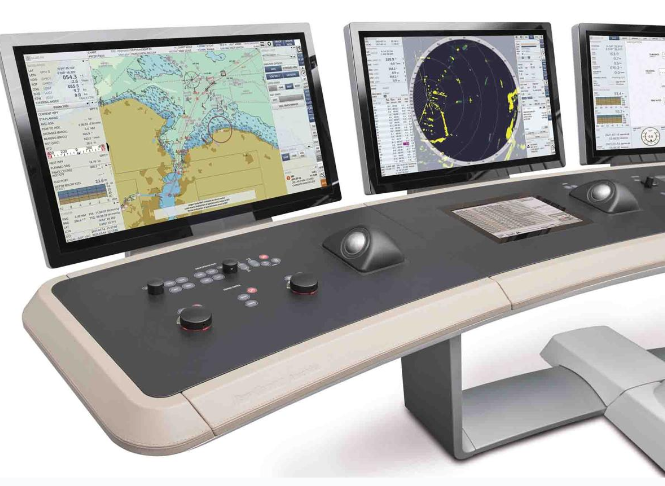
Marine and Maritime Equipment
Moisture-resistant sensor materials are valuable, but saltwater protection also depends on sealing, connector protection, and corrosion-resistant enclosure design.
Portable Field Testing Instruments
Consistent sensor materials help maintain predictable electrical characteristics, while drop resistance and battery efficiency require separate mechanical and electrical optimization.
Premium sensor materials provide a foundation for reliable touchscreen engineering, but they do not replace system-level testing.
9. Material Quality vs. Touchscreen Price: What OEM Buyers Should Consider
For B2B buyers, touchscreen procurement often involves balancing initial component cost against reliability, service requirements, and supply continuity.
Lower-priced capacitive touch panels may meet the requirements of less demanding applications.
However, products intended for continuous industrial operation or difficult-to-access installations may justify additional investment in material qualification and process control.
Total Cost of Ownership
A broader cost analysis should consider:
- Initial touchscreen assembly cost.
- Engineering integration and qualification expenses.
- Yield and quality consistency across production batches.
- Field failure and warranty exposure.
- Equipment downtime and replacement costs.
- Component lifecycle and material change management.
The lowest quoted unit price does not necessarily represent the lowest total ownership cost.
Conversely, a premium material specification should only justify a higher price when its performance is relevant to the application and supported by suitable evidence.
Questions Procurement Teams Should Ask
Does the supplier control the critical material specifications? Are ITO resistance measurements recorded by batch? Are conductive paste adhesion and contact resistance verified? Can insulation material performance be traced to approved specifications? Are changes to material suppliers or process parameters communicated before production?
These questions provide a more useful foundation for purchasing decisions than unqualified descriptions such as high quality or industrial grade.
10. Recommended Material Reliability Testing for Industrial PCAP Touchscreens
A well-structured qualification program should assess both initial material quality and stability after relevant environmental exposure.
| Test Category | Engineering Objective | Key Information to Request |
|---|---|---|
| ITO Sheet Resistance | Evaluate electrical uniformity | Nominal resistance, mapping, tolerances |
| AFM Surface Roughness | Evaluate film surface consistency | Scan size, sampling method, Ra results |
| Damp Heat Aging | Evaluate humidity and thermal stability | Temperature, RH, duration, resistance drift |
| Adhesion Testing | Evaluate coating or trace attachment | Test method, substrate, rating |
| Abrasion Testing | Evaluate resistance to defined wear | Load, medium, cycles, resistance change |
| Spezifischer Volumenwiderstand | Evaluate insulation properties | Test voltage, conditions, resistivity |
| Thermal Cycling | Evaluate repeated temperature stress | Temperature limits, cycles, acceptance criteria |
| Functional Touch Testing | Verify sensor operation after aging | Touch accuracy, noise, false touches |
| EMC Evaluation | Assess system-level interference performance | Applicable standard and test configuration |
Three Levels of Quality Verification
- Raw Material QualificationVerify ITO film, silver paste, and insulation properties against approved incoming material specifications.
- Touch Sensor Process QualificationAssess patterned electrodes, printed conductive traces, insulation coverage, bonding interfaces, and electrical continuity after manufacturing.
- Finished Touchscreen Assembly QualificationVerify functional touch performance after environmental, mechanical, and electrical stress testing using representative production assemblies.
For critical projects, test acceptance criteria should be agreed upon before sample approval and documented within the relevant engineering specifications.
11. Selecting an Industrial Capacitive Touchscreen OEM/ODM Manufacturer
Touchscreen material quality is only one part of supplier qualification.
For industrial equipment manufacturers, a suitable OEM/ODM partner should be able to integrate material selection with display engineering, touch controller design, mechanical construction, and production quality requirements.
Key OEM Supplier Evaluation Criteria
| Evaluation Area | What to Verify |
|---|---|
| Material selection | Approved ITO, silver paste and insulation specifications |
| Sensor design | Electrode layout, sensing performance, controller compatibility |
| Display integration | TFT LCD/OLED selection, optical bonding |
| Cover glass | Thickness, strengthening, AG/AR/AF options |
| Electrical interface | USB, I²C or project-specific interface support |
| Environmental reliability | Test methods and acceptance criteria |
| Manufacturing controls | Traceability, inspection and process documentation |
| Customization | Sensor size, FPC layout, glass shape and interface |
| Long-term supply | Component availability, change control and lifecycle support |
Why Engineering Collaboration Matters
Early technical discussions allow the touchscreen manufacturer to identify possible conflicts between material selection, environmental requirements, cost, and integration constraints.
For example, a large industrial touch panel may benefit from a carefully designed electrode structure and consistent conductive film properties.
A compact portable instrument may prioritize low power consumption and mechanical robustness.
A wet-environment operator panel may require controller tuning and enclosure sealing in addition to stable sensor materials.
These differences should guide the selection process.
12. Qihantech’s Approach to Industrial Capacitive Touchscreen OEM/ODM Solutions
Qihantech specializes in industrial TFT LCD displays, OLED displays, and projected capacitive touchscreen solutions, with more than 15 years of R&D experience in display and touch technology.
Our OEM/ODM approach focuses on matching the touchscreen architecture and material requirements to the customer’s specific equipment design.
Areas of customization include:
- Industrial PCAP touch sensor designs and custom dimensions.
- Material selection based on electrical and environmental requirements.
- Custom cover glass thickness, geometry, and decorative printing.
- AG, AR, and AF surface treatment options.
- Optical bonding with suitable TFT LCD or OLED modules.
- Touch controller and interface integration.
- Mechanical and electrical integration for industrial equipment.
Where premium ITO glass, ASAHI conductive silver paste, or DEXERIALS insulation materials are specified, material selection and availability should be confirmed for the individual project.
Final performance remains subject to design validation, material approval, and applicable qualification testing.
For OEM buyers, this engineering-led approach supports clearer technical specifications and more predictable integration into the finished equipment.
Frequently Asked Questions About Capacitive Touchscreen Materials
1. What are the main materials used in an industrial capacitive touchscreen?
Important sensor materials include transparent conductive layers such as ITO, conductive interconnection materials such as silver paste, and insulating layers. The complete touchscreen also includes cover glass, a touch controller, electrical interfaces, and often an integrated TFT LCD or OLED display.
2. Why is ITO sheet resistance uniformity important?
Sheet resistance uniformity helps maintain consistent electrical characteristics across the conductive film. This can support predictable sensor behavior, controller calibration, and manufacturing consistency, particularly in larger or more complex touch sensor designs.
3. What does 85°C/85% RH testing measure?
It is an accelerated damp heat exposure used to evaluate how materials or assemblies behave under elevated temperature and humidity. Engineers may compare electrical resistance, insulation properties, adhesion, and functionality before and after testing.
4. Why is conductive silver paste used in capacitive touch sensors?
Conductive silver paste provides electrical connections within selected touchscreen sensor architectures. Its resistance, adhesion, and environmental stability influence the reliability of these conductive pathways.
5. What is the significance of 5B adhesion under ASTM D3359?
A 5B classification indicates the highest adhesion rating within the applicable ASTM D3359 classification, with no observed detachment under the specified test conditions. Results should be interpreted with reference to the substrate, coating, and exact procedure.
6. How does insulation material affect touchscreen reliability?
Insulation materials separate conductive structures and help prevent electrical leakage. High resistivity, suitable coating coverage, and environmental stability are important for maintaining electrical isolation.
7. Do premium materials guarantee a longer touchscreen lifespan?
No. Premium material characteristics can reduce certain reliability risks, but actual lifespan depends on the complete product design, manufacturing controls, operating conditions, and qualification results.
8. Can Qihantech customize capacitive touchscreen materials for industrial OEM projects?
Qihantech provides OEM/ODM capacitive touchscreen and display customization. Material choices, sensor structure, interfaces, cover glass, and environmental requirements can be evaluated for individual projects, subject to feasibility and validation.
Conclusion: Material Quality Is the Foundation of Reliable Industrial Touchscreens
Industrial capacitive touchscreen reliability begins with the electrical and physical properties of the sensor materials.
High-uniformity ITO conductive glass supports consistent electrode characteristics. Stable conductive silver paste helps maintain reliable electrical connections. High-resistivity insulation materials provide the electrical isolation needed within complex sensor structures.
Together, these materials contribute to the foundation of a reliable projected capacitive touch sensor.
However, material specifications should always be evaluated alongside manufacturing processes, touch controller design, display integration, environmental qualification, and long-term supply requirements.
For OEM buyers, the most effective purchasing approach is to compare measurable specifications, request appropriate test evidence, and evaluate the finished touchscreen under conditions representative of the intended application.
Qihantech — Custom Industrial TFT LCD, OLED, and Capacitive Touchscreen Solutions
With over 15 years of experience in display and touch technology, Qihantech supports industrial equipment manufacturers with custom capacitive touchscreen and display integration solutions.
Looking for reliable industrial capacitive touchscreens for your next OEM/ODM project?
ContactQihantech to discuss your sensor material requirements, custom display specifications, engineering validation needs, and production plans.