
Medical equipment increasingly relies on touchscreen interfaces to simplify device operation, display patient information, and support clinical workflows. From patient monitors and infusion pumps to portable ultrasound systems and diagnostic instruments, touchscreen performance is an important consideration in modern medical device design.
However, medical touchscreens operate under conditions that differ significantly from those of consumer electronics.
Healthcare professionals frequently wear latex or nitrile examination gloves, clean equipment surfaces with disinfectants, and interact with medical interfaces while managing multiple clinical tasks.
These requirements create challenges for conventional touchscreen technologies.
Projected Capacitive Touch (PCAP) technology has become a leading choice for modern medical touch modules because it combines responsive operation, multi-touch capability, a durable cover-glass architecture, and customizable touch sensitivity.
Compared with traditional resistive touchscreens, PCAP can provide a more flexible interface platform for modern medical equipment.
But can capacitive touchscreens really work with medical gloves? Are they easier to clean? And what should medical device OEMs consider when choosing a custom PCAP touch panel?
This guide explores the technical differences between PCAP and resistive touch technology, explains important engineering considerations, and introduces how QIHAN supports medical touchscreen OEM/ODM projects.
1. What Is PCAP Touch Technology?
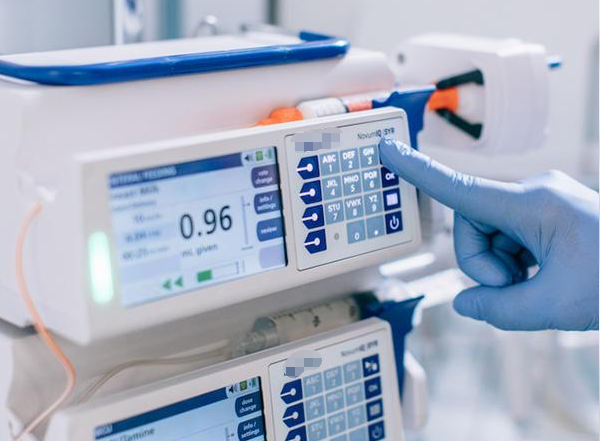
Projected Capacitive Touch, commonly called PCAP or PCT, is a touchscreen sensing technology that detects changes in capacitance when a finger or compatible conductive object approaches the touch surface.
Unlike resistive touchscreens, which require physical pressure to connect conductive layers, PCAP panels use patterned electrodes and electronic touch controllers to determine touch positions.
A typical PCAP touchscreen consists of several components:
- Cover Glass: Protects the underlying touch sensor and provides the external interaction surface.
- Touch Sensor: Contains patterned conductive electrodes that detect changes in capacitance.
- Touch Controller IC: Processes capacitance signals and calculates touch coordinates.
- Optical Adhesive: Bonds layers or integrates the touchscreen with an LCD module.
- FPC and Interface: Connects the touchscreen assembly to the medical device’s control system.
PCAP technology supports advanced interface functions, including multi-touch gestures, smooth scrolling, and customizable touch detection.
These features make it suitable for medical equipment requiring intuitive touchscreen operation.
2. PCAP vs. Resistive Touchscreens: Key Differences for Medical Applications
Both projected capacitive and resistive touchscreens are used in medical and industrial electronic equipment.
However, their operating principles and mechanical structures create important differences in performance.
| Merkmal | PCAP Touchscreen | Resistive Touchscreen |
|---|---|---|
| Touch Principle | Detects capacitive changes | Detects physical pressure |
| Medical Glove Operation | Possible with suitable tuning and compatible gloves | Generally supports most glove types |
| Multi-Touch | Supports multi-touch | Usually single-touch |
| Surface Structure | Can use continuous protective glass | Typically uses a flexible top layer |
| Optische Klarheit | Generally higher, depending on construction | May have additional optical losses |
| Touch Sensitivity | Light-touch operation | Requires applied pressure |
| Cleaning Design | Smooth cover glass can simplify wiping | Depends on overlay and bezel design |
| Mechanical Wear | No pressure-actuated top membrane | Top membrane experiences repeated mechanical deflection |
| Water Interference | Requires water rejection and firmware optimization | Often less sensitive to capacitive water interference |
| Cost | Typically higher | Often lower |
| Typische Anwendungen | Modern medical HMI, patient monitors, diagnostic equipment | Legacy medical devices, basic controls, glove-heavy applications |
Key takeaway: PCAP technology is generally preferable for medical devices requiring modern graphical interfaces, multi-touch, and a rigid glass surface. Resistive touch remains a valid choice where glove independence, pressure-based input, or cost is the primary design requirement.
3. Why PCAP Touchscreens Are Preferred in Modern Medical Devices
3.1 Medical Glove Touch Operation: A Critical Requirement
One of the most important considerations in medical touchscreen design is whether healthcare professionals can operate the display while wearing gloves.
Doctors, nurses, laboratory technicians, and clinical operators commonly wear disposable gloves to support infection prevention procedures.
Typical glove materials include:
- Nitrile examination gloves
- Latex examination gloves
- Vinyl medical gloves
- Specialized protective gloves
Traditional capacitive touchscreens are often associated with bare-finger operation.
However, modern industrial PCAP systems can be engineered for operation through certain glove materials by optimizing touch sensitivity, sensor structure, and controller firmware.
How Does PCAP Work Through Medical Gloves?
When a user touches a PCAP screen, the controller detects a change in the sensor’s capacitive field.
A medical glove creates an additional insulating layer between the finger and the touchscreen sensor.
This reduces the strength of the detectable signal.
To support glove operation, engineers can optimize:
- Touch controller sensitivity and signal processing.
- Sensor electrode geometry.
- Cover-glass thickness.
- Touch detection thresholds and firmware.
- Electrical grounding and electromagnetic noise suppression.
For example, a PCAP panel optimized for thin nitrile examination gloves may provide reliable touch detection under defined operating conditions.
However, glove compatibility depends on glove material, thickness, fit, moisture, and the complete touchscreen assembly.
Engineering note: PCAP glove operation is not guaranteed by the term “glove touch” alone. Medical equipment manufacturers should request testing with the actual glove types used in the intended clinical environment.
QIHAN’s capacitive touch panel portfolio includes glove-touch support and customization of touch controller ICs, cover glass, and mechanical structures.
3.2 Smooth Glass Surfaces Support Medical Cleaning Requirements
Medical equipment is frequently cleaned and disinfected, making touchscreen surface design an important consideration.
PCAP technology can use a continuous protective glass surface without the flexible pressure-sensitive outer membrane required by conventional resistive touch technology.
A properly integrated glass-front design can reduce mechanical features that trap contaminants.
For medical equipment manufacturers, this can support:
- Easier wiping of the display surface.
- Smooth, uninterrupted front-panel designs.
- Integration with sealed device enclosures.
- Reduced mechanical wear associated with pressure-based touch operation.
- Custom cover-glass coatings and surface treatments.
However, a glass surface is not automatically compatible with all medical disinfectants.
Repeated exposure to alcohol-based solutions, quaternary ammonium compounds, hydrogen peroxide cleaners, or other agents may affect printed borders, optical coatings, adhesives, and sealing materials.
Medical OEMs should establish cleaning protocols and validate the complete assembled device against the intended disinfectants, concentrations, contact times, and cleaning cycles.
3.3 Multi-Touch Supports Modern Medical User Interfaces
Modern medical devices increasingly integrate graphical user interfaces that present multiple measurement channels, waveforms, and configuration menus.
PCAP technology supports multi-touch interaction, enabling interface designers to implement functions such as:
- Pinch-to-zoom for compatible medical images.
- Scrolling through patient information.
- Navigating complex menu structures.
- Adjusting graphical parameters.
- Interacting with on-screen controls.
For example, an ultrasound device may benefit from multi-touch gestures for image navigation or zooming, provided that the interface is designed and validated for the intended clinical workflow.
Multi-touch functionality should not be enabled indiscriminately for safety-critical controls.
Medical device developers must consider accidental activation, unintended gestures, and software safeguards in the overall usability engineering process.
3.4 High Optical Transparency Supports Display Readability
Modern patient monitors and medical diagnostic devices require clear visibility of numerical information, waveforms, and graphical interfaces.
PCAP structures can offer high optical transparency, especially when combined with appropriate cover glass and optical bonding.
An optimized optical stack can help reduce reflections and improve perceived display contrast.
Typical design options include:
- Optical bonding using OCA or OCR.
- Anti-glare surface treatments.
- Anti-reflective coatings.
- Anti-fingerprint surface coatings.
- Customized cover-glass thickness.
QIHAN provides optical bonding and cover-glass customization for integrated TFT LCD and touch display modules.
The final optical performance should be validated using the selected LCD, cover lens, adhesive system, and device enclosure.
3.5 Mechanical Durability for Frequently Operated Equipment
Medical touchscreens may experience frequent interaction throughout their service life.
PCAP technology does not require a flexible top membrane to deform during every touch operation.
This can reduce wear associated with pressure-actuated resistive touchscreen layers.
A rigid glass cover can also provide a durable user interface surface when designed with appropriate thickness, edge protection, and mounting support.
However, overall durability depends on cover-glass material, impact resistance, surface treatment, adhesive design, and enclosure integration.
A touchscreen advertised with a particular surface hardness should not automatically be assumed to meet medical device impact or chemical-resistance requirements.
4. Medical PCAP Touchscreen Applications
PCAP technology is suitable for a range of medical electronic devices requiring responsive, clear, and customizable touchscreen interfaces.
Patient Monitoring Systems
Patient monitors display vital signs, waveforms, alarm information, and configurable monitoring settings.
PCAP touchscreens can support simplified menu navigation and clear graphical interaction. Glove-touch functionality is especially relevant when operators need to access controls while wearing examination gloves.
Infusion Pumps and Therapy Equipment
Infusion pumps and therapeutic instruments require reliable user interfaces for displaying settings, status information, and operating instructions.
PCAP offers a smooth glass-based interface, while device developers must validate touch accuracy, accidental activation prevention, and usability of safety-critical controls.
Portable Ultrasound Equipment
Portable ultrasound systems may combine imaging, settings, and patient data within a compact touchscreen interface.
PCAP technology can enable multi-touch navigation and compact display integration. Custom bonding and cover-glass designs can help adapt the module to portable equipment dimensions.
Laboratory and Diagnostic Instruments
Clinical laboratory analyzers and point-of-care testing instruments require interfaces that operators can use during routine testing workflows.
A customized PCAP touch module can combine glove-touch capability, a smooth front surface, and an embedded display in a compact equipment design.
5. Engineering Challenges: What Medical OEMs Must Validate
Although PCAP technology offers significant advantages, medical applications require careful system-level engineering.
5.1 Glove Material and Thickness
Different glove materials and thicknesses can influence capacitive signal strength.
A touchscreen that works with a thin nitrile glove may not perform identically with thicker or layered gloves.
OEM engineers should establish the expected glove conditions before selecting a touch controller.
5.2 Water Droplets and Cleaning Residue
Water and conductive liquid residues can interfere with PCAP sensing.
Depending on sensor design and firmware, the result may include missed touches, false touches, or inaccurate coordinate detection.
Water rejection algorithms and appropriate touch-controller configurations can improve performance.
However, reliable wet-touch operation must be demonstrated under the actual device conditions. A touchscreen intended for use after cleaning may require a different validation protocol from a touchscreen expected to operate while liquid remains on its surface.
5.3 Cover Glass Thickness
Thicker protective glass increases the distance between the user’s finger and the touch sensor.
This can reduce capacitive signal strength and make glove-touch detection more difficult.
Therefore, cover-glass thickness should be evaluated together with sensor geometry, controller sensitivity, and expected glove materials.
5.4 Electromagnetic Interference (EMI)
Medical devices may contain switching power supplies, motors, display backlight drivers, wireless modules, and other electronics that introduce electrical interference.
Such interference can affect PCAP touch detection.
Engineering solutions may include improved grounding, shielding, controller filtering, PCB layout optimization, and firmware adjustment.
The complete medical device must undergo appropriate electromagnetic compatibility testing.
5.5 Long-Term Supply and Component Consistency
For medical device OEMs, component changes can require additional engineering evaluation or product revalidation.
Procurement teams should therefore assess the manufacturer’s lifecycle management, controller IC availability, mechanical drawing control, and change-notification processes.
Stable production and controlled design revisions can be as important as initial touchscreen performance.
6. Medical PCAP Touchscreen Selection Checklist
The following checklist can help medical equipment manufacturers define their technical requirements.
| Spezifikation | Selection Consideration |
|---|---|
| Touch-Technologie | Projected Capacitive Touch (PCAP) |
| Handschuh-Touch | Validate latex, nitrile, or other specified gloves |
| Multi-Touch | Define required touch points and gestures |
| Deckglas | Thickness, strength, edge finish, chemical compatibility |
| Touch Structure | G+G, G+F, or G+FF |
| Schnittstelle | I2C, USB, or application-compatible option |
| Optisches Bonding | OCA/OCR, if required |
| Surface Treatment | AG, AR, AF, subject to cleaning validation |
| Wet-Touch Performance | Validate cleaning residues and moisture |
| EMI/EMC | Evaluate in the finished device |
| Betriebstemperatur | Based on the intended equipment environment |
| Integration | LCD matching, FPC, mechanical dimensions |
| Product Lifecycle | Supply planning and revision control |
| Documentation | Drawings, test results, traceability requirements |
For procurement managers, asking suppliers for complete engineering specifications and representative samples is more valuable than relying solely on promotional claims such as “medical-grade” or “glove compatible.”
7. QIHAN Custom PCAP Touchscreen Solutions for Medical Device OEMs
Medical equipment manufacturers often require touchscreen modules designed around specific mechanical dimensions, electronic architectures, and clinical operating conditions.
A standard consumer touchscreen may not meet the integration requirements of a dedicated patient monitor, diagnostic analyzer, or portable medical instrument.
QIHAN specializes in industrial TFT LCD displays, OLED modules, capacitive touch panels, resistive touch panels, and custom OEM/ODM display solutions.
Its touch product portfolio includes PCAP options for medical devices and industrial HMI applications, with customization available for display integration, touch structure, interface configuration, cover glass, and controller design.
QIHANTECH
+2
7.1 QIHAN Capacitive Touch Panel Capabilities
Based on QIHAN’s published CTP product information:
| Parameter | QIHAN Offering |
|---|---|
| Touch-Technologie | Capacitive Touch Panel / PCAP |
| Standardgrößen | 2.8″, 3.5″, 4.3″, 5.0″, 7.0″, 8.0″, 10.1″ |
| Structure Options | G+G, G+F, G+FF |
| Handschuh-Touch | Supported, subject to application validation |
| Communication Interfaces | I2C, USB |
| Deckglas | Anpassbar |
| Optisches Bonding | Unterstützt |
| Controller-IC | Anpassbar |
| FPC / Mechanical Design | Anpassbar |
| Special Shapes | Available through custom design |
| Integrated LCD + Touch | Unterstützt |
| OEM / ODM | Unterstützt |
Published specifications: QIHAN Capacitive Touch Panel (CTP). Final features depend on the selected module and project configuration.
7.2 Glove-Touch Customization for Medical Interfaces
QIHAN supports PCAP solutions designed for glove-touch operation.
For medical OEM projects, the engineering team can evaluate touch controller selection, sensitivity configuration, cover-glass design, and sensor integration based on application requirements.
Medical device manufacturers should provide representative glove samples or detailed glove specifications during development.
This allows touchscreen performance to be evaluated under realistic conditions before production approval.
7.3 Integrated TFT LCD and PCAP Touch Solutions
QIHAN also provides integrated TFT LCD and PCAP touchscreen modules.
For example, its published 5.7-inch TFT LCD touch display includes:
- 640 × 480 resolution.
- 700 cd/m² specified brightness.
- 1200:1 specified contrast ratio.
- ALL View display technology.
- PCAP multi-touch.
- Customizable touch driver IC.
This module is identified for medical, industrial HMI, and embedded applications.
QIHAN
These are published product specifications, not evidence of device-level medical certification or guaranteed glove compatibility for every configuration.
7.4 OEM/ODM Support From Prototype to Production
QIHAN’s OEM/ODM capabilities allow device manufacturers to customize both the LCD and touchscreen assembly rather than integrating unrelated standard components.
Customization areas include:
- Touch panel dimensions and structure.
- LCD brightness, resolution, and interface.
- Glove-touch requirements.
- Cover-glass size and printing.
- Optical bonding.
- Touch controller configuration.
- FPC layout and connector position.
- Mechanical integration.
For medical projects, final qualification requirements and available supporting documentation should be confirmed during engineering review.
Explore QIHAN’s Capacitive and Resistive Touch Panels, Medizinische Display-Lösungen, and OEM/ODM Customization Services.
8. PCAP vs. Resistive Touch: Which Is Better for Your Medical Device?
The right touchscreen depends on how the device will be operated.
PCAP is often the stronger choice for modern medical equipment that requires a clear graphical interface, multi-touch functionality, smooth glass-front construction, and configurable glove operation.
Resistive touchscreens remain useful where the user must operate the device with thick nonconductive gloves, a passive stylus, or simple pressure-based controls.
A well-designed medical touchscreen system should balance usability, optical performance, mechanical integration, cleaning requirements, and long-term reliability.
PCAP is a leading technology for medical touch modules, but the correct choice must be validated for the specific device and its intended use.
9. Frequently Asked Questions (FAQ)
Q1. What is a medical PCAP touchscreen?
A medical PCAP touchscreen is a projected capacitive touch panel integrated into medical equipment. It detects capacitive changes rather than relying on mechanical pressure and can support multi-touch, smooth glass surfaces, and customized glove-touch functionality.
Q2. Can PCAP touchscreens work with medical rubber gloves?
Yes, appropriately engineered PCAP touchscreens can operate with certain medical gloves, including latex and nitrile examination gloves. However, performance depends on glove material, thickness, touch controller tuning, sensor design, and cover glass. Compatibility must be tested under the intended operating conditions.
Q3. Is PCAP better than resistive touch for medical equipment?
PCAP is generally advantageous for modern graphical interfaces, multi-touch functionality, and rigid cover-glass designs. Resistive touch may be preferable for basic interfaces that require consistent pressure-based operation with a wide range of glove types or passive styluses.
Q4. Are PCAP touchscreens easier to clean?
A PCAP touchscreen can use a continuous glass front surface, which can simplify wiping and support sealed-front designs. However, actual cleaning performance depends on the enclosure, coatings, adhesives, and documented compatibility with the intended disinfectants.
Q5. Can PCAP touchscreens support both glove touch and water resistance?
Both capabilities can be engineered into PCAP systems, but optimizing one does not automatically guarantee the other. OEMs should test glove detection, moisture rejection, and false-touch behavior together in the final assembly.
Q6. What is the difference between G+G and G+F PCAP touchscreens?
G+G uses glass-based sensor construction and is often selected for robust cover-glass designs. G+F combines glass and film layers to support thinner or lighter structures. The appropriate choice depends on mechanical design, optical requirements, touch sensitivity, cost, and production considerations.
Q7. Can medical PCAP touchscreens be customized?
Yes. QIHAN offers customization of touch panel dimensions, G+G/G+F/G+FF structures, controller ICs, cover glass, interfaces, optical bonding, and integration with TFT LCD modules.
Q8. What interfaces are commonly available for PCAP touch panels?
I2C and USB are common touch-panel interfaces. QIHAN lists both options for its capacitive touch panel portfolio. The choice depends on the medical device’s processor, embedded operating system, electrical design, and software architecture.
Q9. Does a medical PCAP touchscreen need special certification?
There is no universal certification that automatically makes an individual PCAP sensor medical-grade. The applicable requirements depend on the finished medical device and its intended use. Medical OEMs may need to evaluate standards such as IEC 60601-1, IEC 60601-1-2, and IEC 62366-1 where applicable, along with the relevant regulatory framework.
Q10. How can medical OEMs choose a reliable PCAP touchscreen manufacturer?
Medical OEMs should assess engineering customization capabilities, glove-touch validation support, interface compatibility, mechanical design, optical bonding, production change control, component availability, and supporting technical documentation.
Conclusion: Building More Reliable Medical Touch Interfaces With PCAP Technology
Projected Capacitive Touch technology offers important advantages for modern medical equipment, including multi-touch interaction, high optical clarity, rigid glass-front construction, and the ability to engineer glove-compatible touch operation.
For patient monitors, portable ultrasound devices, diagnostic instruments, and medical control panels, PCAP can provide a flexible foundation for advanced graphical interfaces.
However, performance in real clinical environments depends on more than touchscreen technology alone.
Medical device manufacturers must evaluate glove materials, cleaning conditions, cover-glass construction, electromagnetic interference, software behavior, and long-term component availability.
With customizable capacitive touch panels, TFT LCD integration, cover-glass design, and OEM/ODM engineering support, QIHAN can help medical equipment manufacturers develop touchscreen assemblies around their specific requirements.
Looking for a custom medical PCAP touchscreen manufacturer?
Explore QIHAN’s Custom Capacitive Touch Panel Solutions oder contact our engineering team to discuss glove-touch requirements, display integration, and your next medical device project.
 English
 Português
 Français
 Deutsch
 Español
 Русский