
Display technology plays an important role in the usability, reliability, and lifecycle performance of modern telecommunications equipment. From network routers and optical communication terminals to base station controllers and industrial communication gateways, displays provide essential information about system status, network connectivity, configuration settings, and maintenance operations.
For equipment manufacturers, choosing between a TFT LCD display and an OLED display involves more than comparing visual quality. Brightness, viewing angles, mechanical thickness, power consumption, operating temperature, long-term reliability, and total integration costs all influence the final decision.
OLED displays offer exceptional contrast, true blacks, and potentially thinner module designs. TFT LCD displays, meanwhile, provide a broad range of sizes, brightness configurations, and cost options suitable for industrial applications.
However, telecommunications equipment often operates continuously, sometimes displaying the same network indicators, connection icons, or status messages for extended periods. This creates additional considerations, particularly regarding OLED burn-in and display aging.
This guide examines the differences between TFT LCD and OLED technology and explains how telecom equipment manufacturers can select the right display solution for their applications.
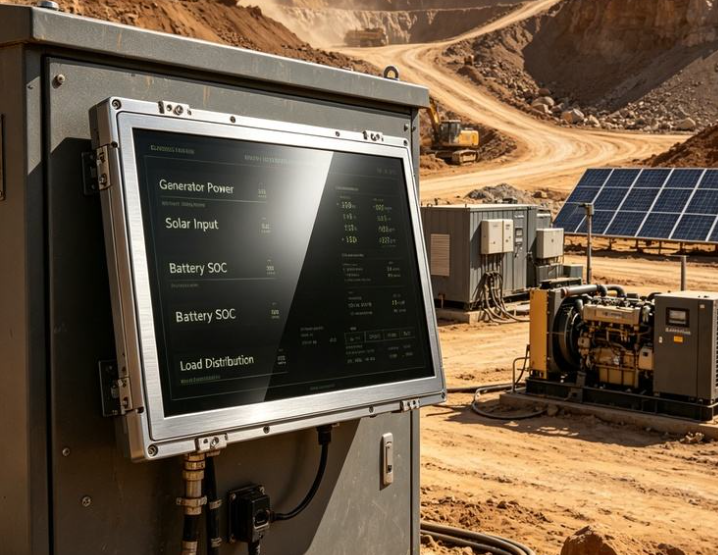
1. Why Display Selection Matters in Telecommunications Equipment
Telecommunications devices are designed to transmit, manage, and monitor data across complex networks. While some devices operate without local displays, many require integrated visual interfaces for installation, diagnostics, configuration, and maintenance.
Las aplicaciones típicas incluyen:
- Network routers and switches: Displaying IP addresses, connectivity, port activity, and device status.
- Optical network terminals (ONT/ONU): Showing connection status, signal information, and configuration menus.
- Base station controllers: Providing system monitoring, configuration, and alarm information.
- Industrial communication gateways: Displaying network protocols, connection parameters, and operating conditions.
- Network test instruments: Presenting diagnostic measurements, test results, and interactive menus.
- Portable communication equipment: Supporting battery monitoring, operating modes, and device settings.
Unlike consumer electronics, telecom equipment may need to operate continuously for several years, often with relatively static user interfaces.
A display that looks impressive during initial testing may not necessarily be the most suitable option for long-term operation.
Therefore, selecting a telecom equipment display requires balancing immediate visual performance with operating conditions, lifecycle requirements, and maintenance costs.
2. Understanding TFT LCD and OLED Display Technologies
What Is a Pantalla LCD TFT?
A Thin-Film Transistor Liquid Crystal Display (TFT LCD) uses a matrix of thin-film transistors to control individual pixels.
Because liquid crystals do not produce light themselves, most industrial TFT LCD modules use an LED backlight to illuminate the display.
Common TFT LCD configurations include TN, IPS, and VA technologies, each offering different viewing-angle, contrast, and response characteristics.
Key advantages of TFT LCD displays:
- Wide selection of display sizes and resolutions
- Multiple brightness and backlight options
- IPS configurations for wide viewing angles
- Mature supply chain and competitive pricing
- Suitable for fixed-status interfaces and continuous operation
- Available industrial touch integration
TFT LCD technology is widely used in industrial control panels, embedded HMI systems, network monitoring terminals, and communications equipment.
What Is an OLED Display?
An Organic Light-Emitting Diode (OLED) display uses organic electroluminescent materials that emit light when electrical current passes through them.
Unlike conventional TFT LCDs, OLED displays do not require a separate backlight.
Each pixel generates its own light, allowing individual pixels to turn off completely when displaying black.
Key advantages of OLED displays:
- Extremely high contrast ratios
- True black backgrounds
- Wide viewing angles
- Thin module construction
- Fast pixel response
- Potentially low power consumption with predominantly dark interfaces
These characteristics make OLED displays attractive for compact communication terminals, portable testing devices, and equipment that requires high-contrast status information.
However, OLED technology also introduces challenges related to organic material aging and long-term static image retention.
3. TFT LCD vs. OLED: Key Differences for Telecom Devices
Selecting the right display begins with understanding how each technology performs under real operating conditions.
| Comparison Factor | LCD TFT | OLED |
|---|---|---|
| Display principle | Liquid crystal with backlight | Píxeles autoemisivos |
| Contraste | Moderate to high, depending on panel | Extremely high |
| Black levels | Limited by backlight leakage | True black |
| Brillo | Broad range of industrial options | Depends on module and operating conditions |
| Ángulo de visión | Wide with IPS technology | Generalmente amplio |
| Module thickness | Includes backlight assembly | Can be thinner |
| Power consumption | Strongly affected by backlight brightness | Affected by pixel brightness and displayed content |
| Static image aging | Possible image sticking, generally lower permanent burn-in risk | Higher cumulative burn-in risk |
| Coste | Often more economical | May involve higher module costs |
| Disponibilidad a largo plazo | Broad industrial product selection | Depends on OLED type and supplier |
| Typical applications | Routers, gateways, HMI panels | Compact terminals, portable instruments |
Neither technology is universally superior.
For telecommunications equipment, the correct choice depends on how the display will be used, how frequently its content changes, and the environmental conditions it must withstand.
4. Display Readability: Brightness, Contrast, and Viewing Angles
Readability is one of the most important factors when selecting a display for telecommunications equipment.
Depending on the application, devices may be installed in server rooms, outdoor communication cabinets, industrial facilities, or portable field-service environments.
Each location presents different lighting conditions.
TFT LCD: Flexible Brightness for Different Environments
One of the strongest advantages of TFT LCD technology is the availability of different backlight configurations.
Industrial TFT LCD modules can be designed with brightness levels appropriate for indoor equipment or high ambient light environments.
Por ejemplo:
- Indoor server room equipment may require moderate brightness and adjustable backlighting.
- Outdoor communication cabinets may benefit from high-brightness TFT LCD modules and anti-reflective cover glass.
- Industrial communication controllers may require IPS panels to improve readability from different viewing positions.
For maintenance interfaces, an adjustable backlight can improve usability while reducing unnecessary energy consumption.
Optical bonding and anti-reflective treatments can also help manage unwanted reflections, although their effectiveness depends on the complete display assembly.
OLED: Excellent Contrast for Compact Status Displays
OLED technology is particularly effective when displaying bright information against dark backgrounds.
For example, a compact network terminal might display:
- Connection status
- IP address
- Signal strength
- Battery level
- Network error codes
- Device operating mode
An OLED screen can make these elements visually distinct without requiring backlight illumination.
However, OLED’s high contrast does not automatically guarantee better readability in direct sunlight.
Outdoor visibility still depends on peak brightness, reflectance, cover glass design, and the display’s thermal operating limits.
Engineering recommendation: For telecom devices installed in high ambient light, evaluate actual module luminance and reflectance rather than selecting display technology based on contrast specifications alone.
5. Long-Term Operation: OLED Burn-In vs. TFT LCD Reliability
Many telecommunications devices operate continuously, sometimes for 24 hours a day.
This creates one of the most important differences between TFT LCD and OLED technology.
Why OLED Burn-In Matters for Telecom Equipment
OLED pixels use organic materials that gradually degrade during operation.
The rate of aging depends on several factors, including:
- Pixel brightness
- Temperatura de funcionamiento
- Total operating time
- Displayed colors
- Static image duration
- Panel materials and driver architecture
When certain pixels remain illuminated more frequently than others, they may age at different rates.
Over time, this can produce permanent image retention, commonly known as OLED burn-in.
Consider a network management device that continuously displays the same status information:
- Power indicator in the upper-left corner
- Network connection icon
- Static menu bar
- Fixed company logo
- Alarm status field
If these graphics remain in the same positions for thousands of hours, the illuminated pixels may experience uneven aging.
The risk is especially relevant for network equipment using fixed-status interfaces.
Independent long-duration display testing has demonstrated that persistent static content can cause permanent OLED image retention. However, results from consumer panels should not be interpreted as a precise lifetime prediction for industrial OLED modules. RTINGS.com+1
How to Reduce OLED Burn-In Risk
When OLED technology is necessary, manufacturers can implement several preventive measures.
- Use automatic screen dimming: Reduce brightness during periods of inactivity.
- Apply pixel shifting: Periodically move static UI elements by a small number of pixels.
- Avoid excessive brightness: Use the lowest brightness that provides acceptable readability.
- Introduce display sleep modes: Turn the OLED panel off when it is not required.
- Optimize the interface: Reduce persistent bright graphics and use darker backgrounds where appropriate.
- Validate the application: Test representative UI content over the intended operating duty cycle.
These methods can reduce burn-in risk but cannot eliminate the underlying aging mechanism.
Is TFT LCD Better for Continuous Operation?
For equipment displaying relatively static information over long periods, an industrial TFT LCD is often the more practical choice.
TFT LCD technology does not rely on self-emissive organic pixels, so it does not exhibit the same OLED differential-aging mechanism.
However, TFT LCDs are not entirely immune to display degradation.
Potential long-term issues include:
- LED backlight brightness reduction
- Backlight color shift
- Temporary or persistent image sticking
- Thermal stress
- Polarizer deterioration
LCD image sticking can also occur when a fixed image remains displayed for extended periods. RTINGS.com+1
Therefore, manufacturers should evaluate the specified display lifetime, operating temperature, backlight aging characteristics, and intended usage conditions.
For continuously operating telecom equipment with static status screens, industrial TFT LCD technology is generally the lower-risk starting point, subject to module-specific reliability validation.
6. Display Thickness and Mechanical Integration
Modern telecommunications equipment increasingly emphasizes compact enclosures, high component density, and simplified mechanical design.
Display thickness can therefore influence product development.
OLED for Thin and Compact Equipment
Because OLED displays do not need a separate backlight assembly, they can offer a thinner display structure.
This is beneficial for applications such as:
- Handheld network analyzers
- Portable fiber-optic testing equipment
- Compact wireless communication terminals
- Battery-powered service instruments
A thinner module may help manufacturers optimize enclosure depth and internal component placement.
However, the final assembly thickness still depends on the display substrate, protective glass, touch layer, PCB, connector, and mounting structure.
TFT LCD for Flexible Industrial Integration
Although TFT LCDs include a backlight assembly, they offer significant flexibility in mechanical integration.
Manufacturers can choose different display sizes, orientations, connector layouts, and mounting configurations.
For rack-mounted communication equipment, enclosure depth may be less important than durability, replacement compatibility, and long-term supply.
In these applications, TFT LCD modules can provide an economical and practical solution.
7. Power Consumption: Which Display Is More Efficient?
Power efficiency is especially important in telecommunications infrastructure, where large numbers of devices may operate continuously.
However, the power consumption difference between OLED and TFT LCD depends strongly on the displayed content.
TFT LCD Power Characteristics
TFT LCD power consumption includes the display-driving electronics and backlight.
In most conventional TFT LCD modules, the backlight represents a significant portion of total display power.
Power consumption depends on:
- Display size
- Backlight brightness
- LED efficiency
- Driver IC design
- Backlight dimming strategy
Because the backlight illuminates the panel, conventional LCD power consumption generally changes less with displayed image content than OLED power consumption does.
OLED Power Characteristics
OLED power consumption depends on how many pixels are illuminated, their brightness, and their colors.
For example, an interface consisting mainly of black backgrounds and small status icons can be relatively energy-efficient.
However, interfaces with extensive bright backgrounds may consume more power.
Practical Power Comparison
| Interface Scenario | LCD TFT | OLED |
|---|---|---|
| Dark status screen | Backlight remains active unless dimmed | Potential power advantage |
| Bright full-screen interface | Power dominated by backlight settings | Potentially higher pixel power |
| Occasional status checks | Efficient with backlight control | Efficient with sleep modes |
| Continuous operation | Predictable backlight-driven load | Depends on content and brightness |
| Battery-powered terminal | Depends on module design | Can be advantageous for dark, intermittent UI |
For telecom equipment manufacturers, power consumption should be measured using representative interface content, real operating brightness, and the complete display subsystem.
8. Cost Comparison: Initial Price vs. Total Lifecycle Cost
Display procurement decisions should not be based entirely on module purchase price.
The true cost of a telecom display solution includes development, mechanical integration, power requirements, long-term reliability, and maintenance.
TFT LCD Cost Considerations
TFT LCD technology generally benefits from mature manufacturing processes and a broad supplier ecosystem.
Potential advantages include:
- Competitive pricing across many size categories
- Wide availability of standard modules
- Multiple controller and interface options
- Familiar integration methods
- Broad selection of industrial configurations
For communication equipment produced in moderate or large quantities, TFT LCD often provides a favorable balance between functionality and procurement cost.
OLED Cost Considerations
OLED may involve a higher initial module cost, depending on size, technology, production volume, and customization.
However, its advantages may justify the additional cost in applications requiring thin construction or high-contrast graphics.
The procurement decision should also account for operating conditions and potential replacement requirements.
For example, an OLED display installed in equipment with a fixed interface operating continuously may require closer lifecycle assessment than an OLED display used occasionally in a portable instrument.
9. Choosing the Right Display for Common Telecom Applications
Different communication devices have different display requirements.
Industrial Routers and Network Gateways
Suggested: TFT LCD
Often suitable for fixed network status, IP configurations, and continuous operation. LCD is a practical option when cost and static-image reliability are priorities.
Portable Network Testing Instruments
Suggested: OLED or TFT LCD
OLED can be effective for compact, dark-themed interfaces. TFT LCD may be preferable for larger menus, bright environments, or longer active sessions.
Outdoor Telecom Cabinet Controllers
Suggested: High-brightness industrial TFT LCD
A high-brightness LCD with appropriate cover-glass treatment is a strong candidate for outdoor maintenance interfaces. Environmental validation remains essential.
Rack-Mounted Network Equipment
Suggested: TFT LCD for graphical interfaces
Well suited to persistent status dashboards, alarms, and service menus. For minimal indicators, simpler non-graphical solutions may also be appropriate.
These recommendations are starting points rather than universal rules. The final selection should be based on a complete assessment of application requirements.
10. Touchscreen Integration for Telecom Maintenance Interfaces
Telecommunications equipment increasingly incorporates graphical interfaces for configuration and diagnostics.
This creates demand for integrated touch display modules.
Capacitive Touchscreens (PCAP)
Projected capacitive touch technology supports responsive interaction and multi-touch functionality when implemented with an appropriate controller.
It is suitable for modern telecom equipment featuring graphical menus, password entry, network configuration, and diagnostic interfaces.
However, engineers should evaluate electromagnetic interference, grounding, glove operation, and moisture conditions.
Resistive Touchscreens
Resistive touchscreens can be useful for industrial maintenance interfaces requiring operation with gloves or a stylus.
They can also be appropriate for simpler interfaces where multi-touch capability is unnecessary.
Choosing Touch Technology
For telecom HMI development, consider:
- Operating environment and potential moisture exposure
- Required touch accuracy
- Glove compatibility
- Electromagnetic compatibility
- Cover glass requirements
- Display controller compatibility
The choice of touch panel should be validated as part of the complete device assembly, especially in electrically noisy telecommunications environments.
11. Engineering Checklist for Telecom Display Selection
Before sourcing a TFT LCD or OLED module, equipment manufacturers should establish a clear technical specification.
| Parámetro | Questions for Engineering Teams |
|---|---|
| Display size | What active display area fits the enclosure? |
| Resolución | How much information must be displayed? |
| Brillo | Is the equipment used indoors or outdoors? |
| Ángulo de visión | From what positions will technicians read the screen? |
| Display content | Will the UI show static indicators or frequently changing content? |
| Duty cycle | Will the display operate continuously or intermittently? |
| Temperature | What operating and storage ranges are required? |
| Power budget | Is the device powered by mains, PoE, or battery? |
| Interfaz | SPI, RGB, LVDS, MIPI, or another interface? |
| Touch operation | Is capacitive or resistive touch required? |
| Reliability | What are the required service life and aging-test criteria? |
| Supply continuity | Will the module remain available throughout production and servicing? |
For a 24/7 application, engineers should also determine whether the display must remain illuminated continuously or can be activated only during maintenance.
That distinction can significantly influence display lifetime, energy consumption, and technology selection.
12. Custom TFT LCD and OLED Solutions from QIHAN
Choosing the correct display technology is only the first step. Equipment manufacturers must also ensure that the selected module integrates properly with the device’s electronics, mechanical structure, and operating environment.
QIHAN specializes in industrial TFT LCD, OLED, LCD modules, and touch display solutions for embedded equipment and OEM/ODM applications.
QIHAN provides customization services covering display size, resolution, brightness, interfaces, touch integration, cover glass, and mechanical configuration. qihantech.com+2
Custom Industrial TFT LCD Modules
For telecommunications equipment requiring continuous operation, QIHAN can help manufacturers evaluate TFT LCD modules according to:
- Display size and resolution requirements
- IPS or other suitable LCD panel technology
- High-brightness backlight options
- Interface and connector requirements
- Wide-temperature design requirements
- Mechanical integration and mounting constraints
Custom OLED Display Modules
For compact communication terminals and portable instruments, QIHAN offers OLED display solutions that can be evaluated for:
- Thin-profile product designs
- High-contrast status information
- Small graphical interfaces
- Low-power operating strategies
- Interface and controller compatibility
OLED module selection should include an assessment of the expected duty cycle, static content, and operating environment.
Integrated Touch Display Solutions
QIHAN also supports resistive and capacitive touch panel integration, optical bonding, cover glass customization, and display interface development.
Its OEM/ODM service model covers requirements evaluation, engineering development, prototype validation, and mass production support. QIHAN+1
For telecommunications equipment manufacturers, this enables display module specifications to be aligned with product-level integration requirements rather than relying entirely on standard off-the-shelf configurations.
13. Frequently Asked Questions (FAQ)
1. Is TFT LCD or OLED better for telecommunications equipment?
TFT LCD is often a better starting point for continuously operating telecommunications equipment with fixed status screens, particularly where long-term reliability, brightness options, and cost control are important.
OLED may be preferable for compact devices that benefit from high contrast, thin construction, and intermittent operation.
The appropriate choice depends on display content, operating conditions, and the required service life.
2. Is OLED suitable for 24/7 network monitoring devices?
OLED can operate continuously, but long-term static graphics create a risk of differential pixel aging and permanent burn-in.
For equipment that must display fixed icons or status information 24/7, manufacturers should carefully evaluate OLED lifetime characteristics and compare them with TFT LCD alternatives.
3. Does TFT LCD have burn-in problems?
TFT LCD does not experience the same organic pixel aging mechanism as OLED. However, LCDs can exhibit temporary or persistent image sticking under certain operating conditions.
Backlight degradation and other aging mechanisms should also be considered.
4. Which display is better for outdoor telecom equipment?
High-brightness industrial TFT LCDs are often suitable for outdoor telecom maintenance interfaces because they offer multiple luminance configurations.
However, outdoor readability depends on backlight brightness, surface reflections, viewing angle, and optical design.
Environmental protection must also be provided by the complete product enclosure.
5. Which consumes less power: TFT LCD or OLED?
The answer depends on display size, brightness, image content, and operating mode.
OLED can be efficient when displaying mostly black content with limited illuminated pixels.
TFT LCD power consumption is usually influenced primarily by backlight settings.
Manufacturers should compare actual module power consumption under representative operating conditions.
6. Can telecom equipment use a capacitive touchscreen with TFT LCD?
Yes. TFT LCD modules can be integrated with projected capacitive touch panels to support graphical configuration, diagnostics, and maintenance operations.
Touch controller compatibility, electromagnetic interference, and operating environment should be evaluated during product development.
7. What display interface is suitable for telecom equipment?
Common interfaces include SPI, RGB, LVDS, and MIPI DSI, depending on the display module and host processor.
SPI can be suitable for small displays with limited update requirements, while higher-bandwidth interfaces may be necessary for larger or higher-resolution graphical screens.
Interface selection should consider bandwidth, cable routing, electrical compatibility, and software support.
8. Can QIHAN customize TFT LCD and OLED modules for communication equipment?
Yes. QIHAN provides OEM/ODM display customization services for industrial and embedded applications, including display size, resolution, interface, brightness, touchscreen integration, and mechanical structure.
Telecom-specific project requirements can be reviewed with QIHAN’s engineering team to determine suitable configurations and validation needs.
Conclusion: Choosing the Right Display for Your Telecom Device
Both TFT LCD and OLED technologies offer important advantages for telecommunications equipment.
TFT LCD displays are often the more practical option for equipment requiring continuous operation, fixed status information, flexible brightness options, and economical long-term integration.
OLED displays are attractive for compact communication devices where high contrast, thin construction, and dark-background interfaces are important.
The key is to evaluate the display in the context of the complete product.
Display content, operating hours, environmental conditions, power budget, mechanical constraints, and expected service life should all be considered before selecting a display technology.
For telecom equipment manufacturers developing new products or upgrading existing display interfaces, working with an experienced OEM/ODM display manufacturer can help streamline display selection, integration, and validation.
Need a TFT LCD personalizado o Pantalla OLED for Your Telecom Equipment?
QIHAN provides OEM/ODM industrial TFT LCD, OLED, and touchscreen solutions for communication devices, embedded systems, and industrial equipment.
Whether you need a compact OLED status display, a high-brightness TFT LCD module, or a customized touch interface, our team can help evaluate a suitable display configuration based on your technical requirements.
 English
 Português
 Français
 Deutsch
 Español
 Русский