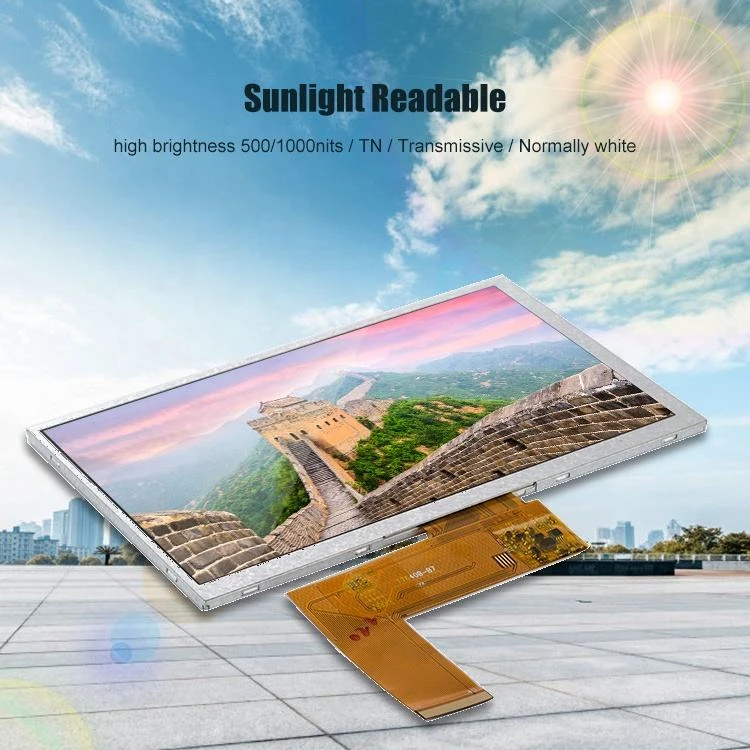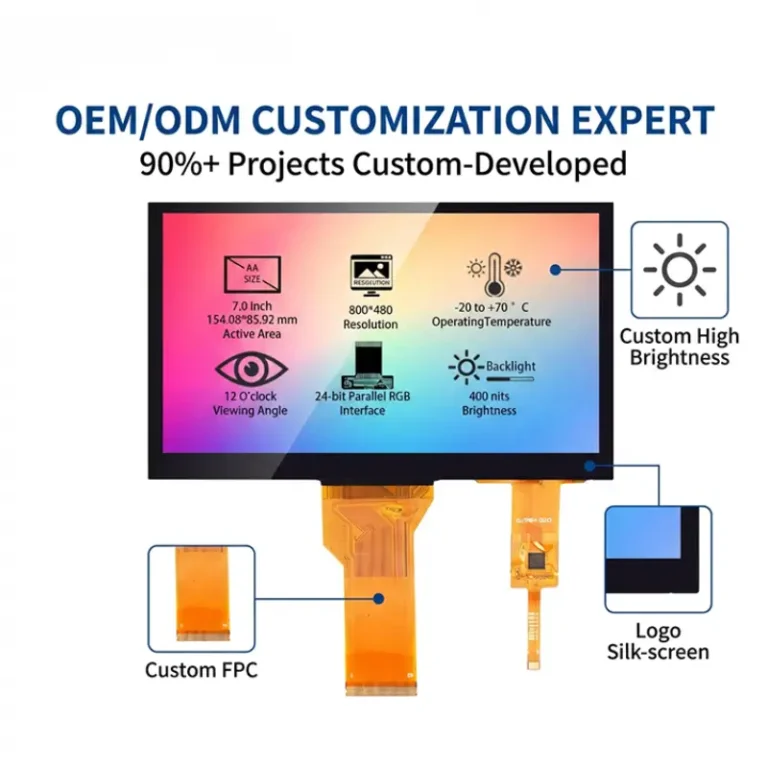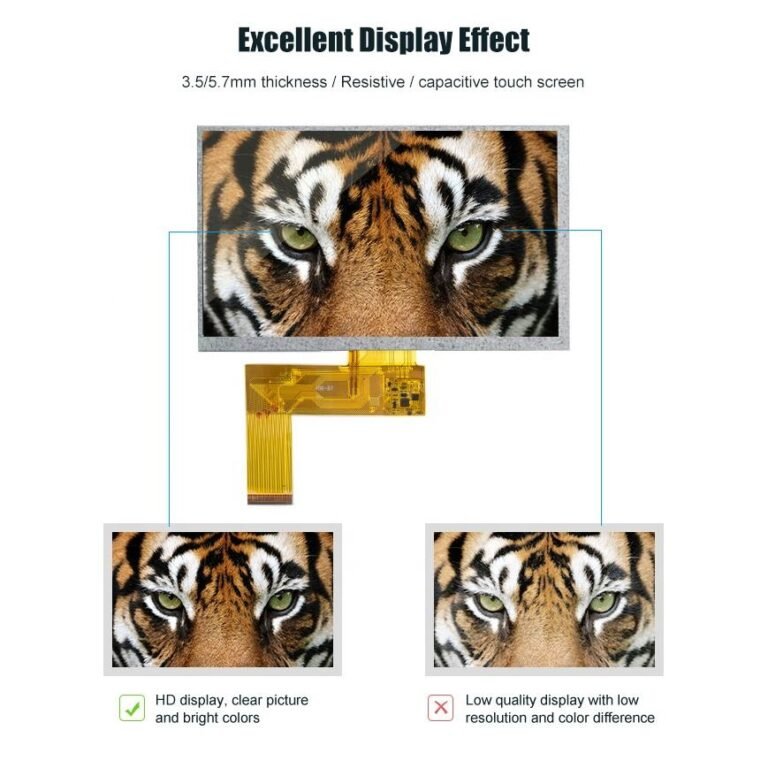
A TFT LCD that looks bright and colorful indoors can become difficult to read in direct sunlight. The problem is not resolution alone. Outdoor visibility depends on how much useful light reaches the viewer compared with the amount of ambient light reflected by the display, touch panel, adhesive, cover glass and enclosure.
For that reason, a sunlight readable TFT LCD display should be engineered as a complete optical system. Increasing backlight brightness can help, but brightness alone may increase power consumption and heat without solving reflections. High-brightness backlighting, suitable surface treatment, optical bonding, contrast performance and mechanical design must work together.
This guide explains how to evaluate those factors and choose a practical small-size industrial TFT LCD for outdoor equipment.
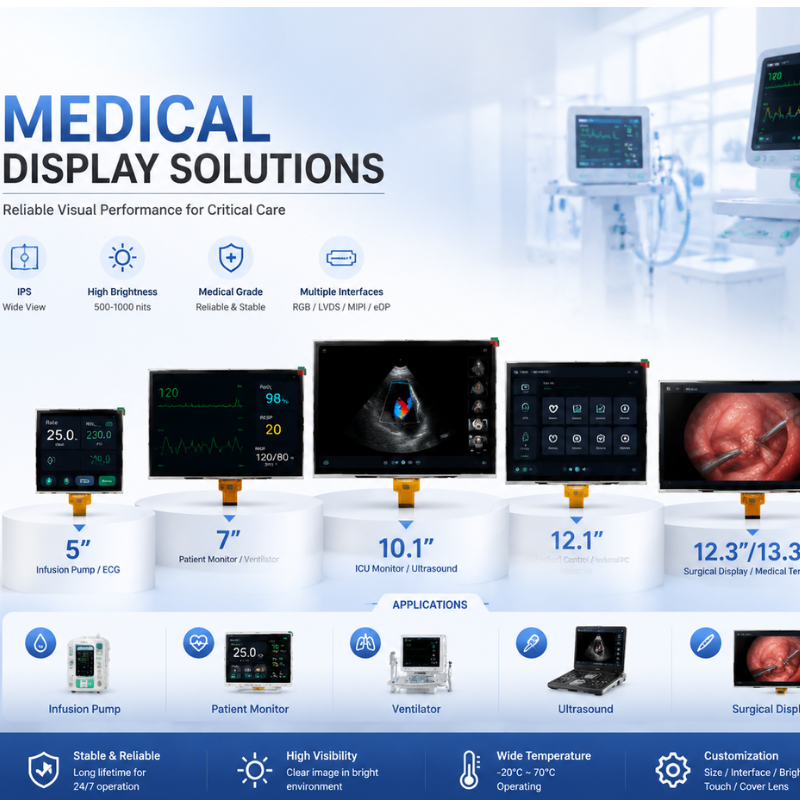
Quick Answer: What Makes a TFT LCD Sunlight Readable?
A sunlight readable TFT LCD combines sufficient luminance with low reflectance and stable contrast under strong ambient light.
For many outdoor products, the most effective solution uses three elements:
- A high-brightness TFT display selected for the real lighting environment.
- AR or carefully specified AG surface treatment to manage reflections.
- Optical bonding to remove the reflective air gap between the LCD, touch panel and cover lens.
The correct combination depends on whether the display is used in open shade, indirect daylight or continuous direct sun. Power availability, enclosure temperature, touch requirements and viewing distance are equally important.
What Makes a TFT LCD Display Sunlight Readable?
Sunlight readability describes whether users can quickly and accurately interpret screen content under bright ambient light. It is not defined by one universal luminance value.
When sunlight reaches a display, some light is reflected at every boundary between air, glass, adhesive, the touch sensor and the LCD. Those reflections reduce the visible difference between dark and bright pixels. The screen may still emit significant light, but the reflected light makes black areas appear gray and washes out the image.
This is why two displays with the same nominal luminance can perform differently outdoors. A well-bonded display with a low-reflection cover lens may remain clearer than a brighter air-bonded display with an untreated glossy surface.
A practical outdoor TFT LCD design should therefore address:
- Display luminance at the outside surface of the finished assembly
- Ambient contrast rather than indoor contrast alone
- Surface and internal reflections
- Backlight power and heat generation
- Optical losses through the touch panel and cover glass
- Viewing angle and orientation
- Polarizer compatibility with sunglasses
- Operating temperature and enclosure sealing
- Long-term backlight reliability
How Brightness and Contrast Affect Outdoor Visibility
Display brightness is normally expressed in candelas per square meter, commonly called nits. A higher nit value allows the display to compete more effectively with ambient light, but the measurement location matters.
Panel luminance is measured at the TFT LCD surface. System luminance is measured through the complete stack, including the touch panel, adhesive and cover glass. Optical layers absorb and reflect part of the light, so a panel rated at 1,000 nits may produce a lower value at the outer cover surface.
When comparing a high brightness TFT display, ask the supplier to clarify:
- Whether brightness is measured at the bare panel or finished cover surface
- Whether the value is typical or minimum luminance
- The measurement point and test conditions
- Luminance uniformity across the active area
- Brightness at maximum operating temperature
- Dimming range and control method
- Expected backlight lifetime at the specified drive current
Ambient Contrast Is More Useful Than Brightness Alone
Indoor contrast ratio is measured under controlled lighting and does not fully predict outdoor performance. In sunlight, reflected ambient light is added to both white and black screen areas. This reduces the effective contrast that the user sees.
A simplified way to think about ambient contrast is:
Ambient contrast = (display white luminance + reflected ambient light) ÷ (display black luminance + reflected ambient light)
As reflection increases, the difference between bright and dark content becomes smaller. Reducing reflection can therefore improve outdoor readability without relying entirely on a more powerful backlight.
The Cost of Increasing Brightness
Higher brightness is not free. A stronger LED backlight generally requires more electrical power and produces more heat. In a sealed enclosure, that heat may raise the LCD temperature, reduce LED life, increase battery capacity requirements or require additional thermal design.
The most efficient design is not automatically the brightest display available. It is the lowest-power optical stack that meets readability requirements in the product’s real environment.
AR and AG Coatings Explained
Anti-reflection and anti-glare treatments are often grouped together, but they solve different visual problems.
What Is an AR Display Treatment?
AR, or anti-reflection, treatment reduces mirror-like reflection from a glass or plastic surface. It is useful when the user can see clear reflections of the sky, nearby objects or their own face over the displayed content.
AR treatment can preserve image sharpness better than a high-haze surface. However, its performance depends on coating design, viewing angle, wavelength and the other layers in the optical stack.
What Is an AG Display Treatment?
AG, or anti-glare, treatment diffuses reflected light so that sharp reflections become softer and less distracting. This can improve viewing comfort for outdoor equipment and industrial control panels.
AG treatment must be specified carefully. Excessive haze may reduce perceived sharpness, lower contrast or create visible sparkle over small, high-density pixels. A sample should be evaluated with the actual TFT resolution, cover-glass thickness and user-interface design.
AR or AG: Which Should You Choose?
Choose AR when sharp, mirror-like reflections are the primary problem and image clarity is critical.
Choose AG when broad glare, operator comfort and resistance to visually distracting reflections are more important than maximum apparent sharpness.
Some outdoor displays use a balanced combination of AR, AG and AF anti-fingerprint treatment. The final decision should be based on measured reflectance, haze, clarity, color shift, cleanability and touch feel rather than the coating name alone.
How Optical Bonding Improves an Outdoor TFT LCD
In an air-bonded assembly, a gap remains between the TFT LCD and the touch panel or cover lens. Each air-to-material boundary reflects part of the incoming light. These internal reflections can make a display look gray and washed out in bright conditions.
An optical bonding display uses a transparent adhesive to fill that gap. Because the adhesive’s refractive index is closer to the adjacent optical materials than air, fewer internal reflections reach the viewer.
The main benefits can include:
- Better perceived contrast in bright ambient light
- Reduced internal reflections
- Improved visual integration between the screen and cover lens
- Reduced risk of condensation forming inside the optical gap
- Additional mechanical support between optical layers
Optical bonding is not the same as waterproofing. The enclosure, gasket, connector, pressure design and assembly process still determine the equipment’s ingress protection.
Bonding quality also matters. Adhesive selection, curing, bubble control, particle control, edge treatment and mura inspection should be matched to the display size, cover construction and operating-temperature range.
Choosing the Right Brightness: 800, 1,500 or 2,500 Nits?
There is no universal brightness threshold that makes every TFT LCD sunlight readable. The ranges below are practical starting points for engineering evaluation, not guarantees.
When Is an 800-Nit TFT Display Appropriate?
An 800-nit outdoor TFT LCD can be suitable for equipment used mainly in bright indoor environments, open shade, vehicle cabins or occasional daylight.
It becomes more effective when combined with low-reflection cover glass and optical bonding. It may not be sufficient for continuous direct-sun exposure if the front surface is highly reflective.
Typical starting applications include:
- Portable instruments used mainly in shade
- Outdoor terminals installed under a canopy
- Vehicle or machinery displays protected by a dashboard
- Industrial controls near open doors or windows
When Should You Consider Around 1,500 Nits?
A display near 1,500 nits is a stronger starting point for equipment that operates regularly outdoors or must remain readable in bright daylight.
At this level, thermal and power analysis become increasingly important. The finished cover-surface brightness should be confirmed after adding the touch panel, optical adhesive and cover lens.
Typical starting applications include:
- EV charging equipment
- Outdoor handheld instruments
- Construction and surveying equipment
- Agricultural machinery
- Marine and transportation controls
QIHAN publicly offers selected high-brightness configurations up to 1,800 nits. Available brightness depends on display size, panel platform, optical stack and project requirements.
When Might a 2,500-Nit Display Be Necessary?
A 2,500-nit TFT LCD may be considered for severe direct-sun environments, large optical losses, long viewing distances or safety-critical information that must remain immediately visible.
This level should not be specified automatically. It can introduce significantly higher power consumption, heat and backlight stress. In some designs, reducing front-surface reflectance and adding optical bonding may deliver a better result than increasing luminance from 1,500 to 2,500 nits.
If 2,500 nits is a firm requirement, confirm supplier capability for the exact size and request system-level luminance, thermal and lifetime data. QIHAN should evaluate such a requirement on a project-specific basis; it should not be assumed to be available for every small-size TFT LCD.
Brightness Selection Table
| Use environment | Practical evaluation range | Optical recommendations | Main design concern |
|---|---|---|---|
| Bright indoor or open shade | 500–800 nits | AG or AR cover treatment | Avoid unnecessary power use |
| Intermittent outdoor daylight | 800–1,000 nits | AR/AG plus optional optical bonding | Reflections and battery life |
| Regular bright outdoor use | 1,000–1,500 nits | Optical bonding and low-reflection cover lens | Thermal management |
| Strong or prolonged direct sun | 1,500–2,500 nits, subject to validation | Optical bonding, optimized AR and enclosure shading | Heat, power and backlight lifetime |
These ranges are starting points only. Final selection should be based on prototype testing under representative sunlight, temperature and viewing conditions.
Do Not Ignore the User Interface
Optical hardware cannot fully compensate for a low-contrast user interface. Outdoor software should use strong differences between foreground and background colors, sufficiently large text and icons, and clear warning states.
Avoid thin fonts, subtle gray-on-gray combinations and critical information communicated only through small color differences. Test the real interface rather than a full-white screen or a colorful demonstration image.
Automatic brightness control can also improve usability. An ambient-light sensor allows the backlight to increase outdoors and reduce brightness indoors, helping balance readability, heat and power consumption.
Recommended Applications for Outdoor TFT LCD Displays
Outdoor Industrial Equipment
Small sunlight readable TFT LCD displays are used in controllers, portable diagnostic tools, field instruments and process equipment where operators must read measurements and system status in changing light.
EV Charging and Energy Equipment
Charging stations, solar controllers and energy-storage equipment may require high brightness, clear status information and a durable cover lens for outdoor installation.
Construction and Agricultural Machinery
Displays used in machinery must handle sunlight, vibration, dust, temperature variation and operation with gloves. Optical performance should be evaluated together with touch-panel and enclosure requirements.
Marine and Transportation Systems
Marine, railway and vehicle displays may experience direct sun, reflections, vibration and wide temperature changes. Viewing angle, polarizer orientation and visibility through polarized sunglasses should be checked during prototype testing.
Portable Medical and Measurement Devices
Outdoor medical equipment, inspection tools and handheld meters benefit from high contrast and controlled reflections. Cleanability, glove operation and battery life may be as important as maximum brightness.
A Practical RFQ Checklist for a Sunlight Readable TFT LCD
Sending only a diagonal size and target brightness is not enough for an accurate display recommendation. Include the following information in your request for quotation:
- Required active area, resolution and module outline
- Maximum available installation space
- Outdoor use profile: shade, indirect daylight or direct sun
- Required brightness at the panel or finished cover surface
- Typical and maximum ambient temperature
- Operating and storage temperature ranges
- Touch-panel requirement and glove or water operation
- Cover-lens material, thickness, printing and shape
- AR, AG or AF surface-treatment requirements
- Optical bonding requirement
- Viewing direction and polarized-sunglasses requirement
- Host processor and display interface
- Supply voltage and maximum power budget
- Enclosure sealing and impact requirements
- Expected annual volume and project lifetime
This information allows the display manufacturer to balance optical performance, mechanical compatibility, thermal behavior, cost and supply stability.
How to Validate an Outdoor Display Prototype
Laboratory specifications should be followed by testing with a representative prototype.
Evaluate the complete assembly, not only the bare LCD. The prototype should include the production-intent touch panel, adhesive, cover lens, printed border and enclosure geometry.
Test the display in at least these conditions:
- Indoor lighting at minimum and maximum brightness.
- Open shade with the production user interface.
- Direct sun at expected viewing angles.
- Maximum operating temperature after thermal stabilization.
- Use with the polarized sunglasses expected in the target market.
Record outer-surface luminance, visible reflections, color and contrast changes, housing temperature, electrical power and any image non-uniformity. Where possible, compare bonded and air-bonded samples under the same conditions.
Why Work with QIHAN on a Small-Size Outdoor TFT LCD?
QIHAN is a manufacturer and supplier of small and medium-sized industrial TFT LCD, OLED, LCD module and touch-display solutions.
For outdoor display projects, QIHAN can support selected high-brightness TFT configurations, transflective options, optical bonding, touch integration and custom cover glass with AR, AG or AF treatment.
QIHAN also provides project-based support for display size, resolution, interface, brightness, FPC, cover lens and driver-board requirements. Available specifications and customization options should be confirmed for the selected panel and order conditions.
Frequently Asked Questions
Is a 1,000-nit TFT LCD always sunlight readable?
No. A reflective air-bonded stack may remain difficult to read even with a strong backlight. Outdoor visibility depends on ambient contrast, front-surface reflection, optical bonding, user-interface design and viewing conditions as well as luminance.
Does optical bonding increase display brightness?
Optical bonding does not directly create more backlight output. It reduces internal reflections and optical interfaces, which can improve perceived contrast and make the image appear clearer in bright ambient light.
Is anti-glare the same as anti-reflection?
No. Anti-glare treatment diffuses reflected light, while anti-reflection treatment reduces mirror-like surface reflection. The appropriate option depends on the display resolution, viewing environment and required image clarity.
Is 2,500 nits better than 1,500 nits?
Not automatically. A 2,500-nit display can provide more light, but it also creates greater power and thermal demands. A 1,500-nit optically bonded display with optimized AR treatment may outperform a brighter but highly reflective assembly in the real application.
Can optical bonding make the finished product waterproof?
No. Optical bonding removes the internal air gap and may reduce condensation risk, but waterproofing depends on the complete enclosure and sealing design.
What information does QIHAN need to recommend an outdoor TFT LCD?
Provide the required size, resolution, interface, brightness measurement point, lighting conditions, temperature range, touch requirement, cover-lens design, optical-bonding requirement and estimated volume. A mechanical drawing and interface details will improve the accuracy of the recommendation.
Build Outdoor Readability into the Complete Display Stack
A successful sunlight readable TFT LCD display is not simply an indoor panel with a stronger backlight. It is a coordinated optical, electrical, thermal and mechanical system.
Begin with the real lighting environment. Reduce reflections, choose only the brightness required, account for losses through the touch and cover layers, and validate the final user interface in a production-intent prototype.
QIHAN can help evaluate a small-size industrial TFT LCD, high-brightness backlight, optical bonding and custom cover-lens solution for your outdoor equipment.
Send your outdoor display requirements to QIHAN.