
Modern 4G and 5G base station infrastructure requires efficient monitoring, reliable diagnostics, and simplified maintenance. From base station controllers and integrated outdoor cabinets to BBU (Baseband Unit) service interfaces and RRU (Remote Radio Unit) maintenance terminals, local displays can help field engineers access essential equipment information.
Although many base stations rely primarily on remote network management systems, selected equipment designs also incorporate local human-machine interfaces (HMIs) for troubleshooting, configuration, and status monitoring.
For these applications, choosing the right ecrã TFT LCD industrial requires more than selecting a screen size or resolution.
Telecommunications equipment can operate in electrically noisy environments, experience demanding temperature conditions, and remain in service for many years. Consequently, display modules must be evaluated for electromagnetic compatibility, interface integration, readability, mechanical durability, and long-term component availability.
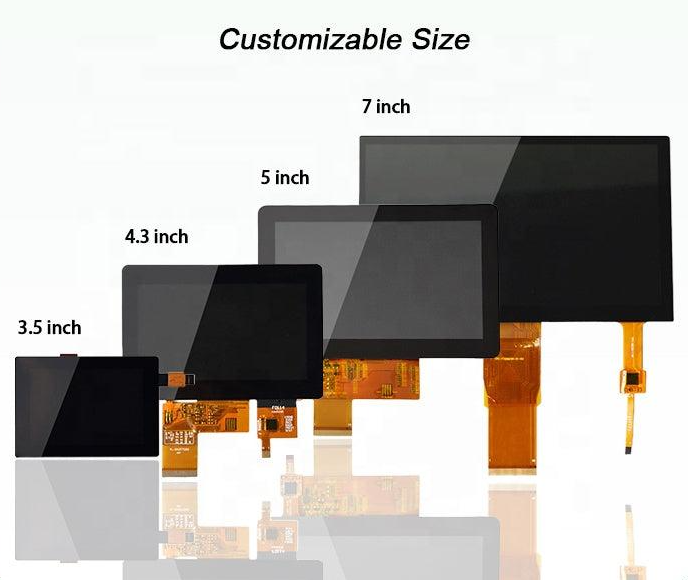
For telecom OEM manufacturers, 3.5-inch to 7-inch industrial TFT LCD modules provide a practical range of options for compact maintenance panels and graphical control interfaces.
This guide explains how to select TFT LCD displays for base station controllers and BBU/RRU maintenance applications, including display size, EMI/EMC considerations, communication interfaces, outdoor visibility, and lifecycle management.
1. Where Are TFT LCD Displays Used in Base Station Equipment?
Base station equipment consists of several interconnected systems responsible for radio communication, baseband processing, power management, and network connectivity.
Not every base station component requires a built-in display. Many conventional BBU and RRU designs use LEDs, management ports, and remote software interfaces instead of graphical LCD screens.
However, equipment manufacturers may integrate TFT LCD modules into controllers, monitoring panels, service terminals, and specialized base station assemblies where local visualization provides operational value.
Base Station Controller and Cabinet Monitoring Panels
Integrated base station cabinets frequently contain power equipment, communication modules, environmental monitoring systems, and auxiliary controllers.
A local industrial LCD can provide a centralized interface for displaying:
- Power supply and backup battery status
- Network connection information
- Equipment operating conditions
- Cabinet temperature and humidity
- Alarm messages and error codes
- Maintenance and configuration menus
For compact controllers, a 3.5-inch TFT LCD may be sufficient for basic status information.
Larger 5-inch or 7-inch screens can support more detailed graphical interfaces and touchscreen operation.
BBU Local Maintenance Interfaces
The BBU performs baseband processing functions within a radio access network architecture.
While many BBU products do not include an integrated LCD, OEMs developing specialized baseband controllers or associated service panels may implement local graphical interfaces.
Potential functions include:
- Equipment operating status
- Module identification
- Optical link status
- Alarm information
- Network configuration
- Diagnostic information
A graphical maintenance panel can help technicians access selected equipment information without relying exclusively on an external computer.
However, the available data depends on the BBU’s management architecture and software interfaces.
RRU/RRH Service and Diagnostic Terminals
Remote Radio Units, also called Remote Radio Heads (RRHs) in certain architectures, are commonly installed near antennas or integrated into radio equipment assemblies.
Because they are often deployed in exposed or space-constrained locations, integrated LCD displays are not standard across all RRU designs.
Nevertheless, a dedicated service terminal or auxiliary maintenance interface can be useful for certain applications.
Such interfaces may provide information about:
- Radio unit status
- Optical communication links
- Power conditions
- Hardware fault codes
- Equipment identification
- Available diagnostic parameters
For compact service devices, the display solution must balance readability, dimensions, power consumption, and environmental reliability.
Outdoor Integrated 4G/5G Base Station Cabinets
Outdoor base station cabinets may require local monitoring and configuration functions.
These devices can be exposed to direct sunlight, temperature fluctuations, moisture, and electromagnetic interference.
Industrial TFT LCD modules with suitable brightness, optical treatment, and wide-temperature options can help meet these requirements.
The final display choice should account for whether the panel is installed inside a protected cabinet or directly exposed to outdoor conditions.
2. What Information Should a Base Station Maintenance Display Show?
A maintenance display should prioritize information that helps engineers identify equipment conditions and perform necessary service operations.
For telecommunications applications, interface design is as important as display hardware.
Equipment Status and Alarm Monitoring
A local display may show operating indicators such as:
- RUN: Normal / Fault
- ALM: Active / Inactive
- Power: Normal / Abnormal
- Module Status: Online / Offline
- System Temperature
- Active Error Codes
Critical alarms should be visually distinct from routine operating information.
Color-coded indicators, clear text labels, and consistent icon placement can make troubleshooting more efficient.
Optical Fiber and Network Link Status
Communication infrastructure depends on reliable connections between processing units, radio equipment, and transport networks.
Where supported by the host equipment, the display may provide:
- Optical port connection status
- Link availability
- Synchronization information
- Network addressing
- Communication errors
For maintenance personnel, concise presentation is generally more useful than displaying excessive technical details on a small screen.
Environmental and Power Monitoring
Outdoor base station systems may incorporate environmental sensors and intelligent power management modules.
A maintenance panel can display information such as cabinet temperature, humidity, supply voltage, and backup battery status.
For example:
| Parâmetro | Example Display |
|---|---|
| System Status | Normal |
| Optical Link | Connected |
| Cabinet Temperature | 38°C |
| Humidity | 52% RH |
| Power Input | Normal |
| Active Alarms | 0 |
The information above is illustrative interface content, not actual measurements from a deployed base station.
Antenna Monitoring and Configuration Data
Some systems support remote antenna monitoring and electrical tilt control through dedicated equipment and management interfaces.
When supported by the system architecture, a maintenance screen may display antenna tilt settings, identification information, or available positioning data.
However, antenna electrical tilt, mechanical orientation, and azimuth are different parameters. Their availability depends on the connected antenna control and sensing systems.
Local Configuration and Service Menus
For equipment with local control capabilities, a TFT LCD touchscreen can simplify authorized maintenance operations.
Common functions may include reviewing system information, navigating diagnostic menus, checking module parameters, and performing permitted configuration adjustments.
Because many telecom devices operate in security-sensitive environments, maintenance interfaces should also support appropriate access restrictions and authentication through the host system.
3. Choosing the Right Display Size: 3.5″, 5″ or 7″ LCD TFT?
Display size directly affects interface usability, enclosure design, and equipment cost.
For compact base station controllers and maintenance panels, 3.5-inch, 5-inch, and 7-inch TFT LCD modules represent three practical size categories.
3.5-Inch TFT LCD: Compact Status Monitoring
A 3.5-inch TFT LCD is suitable for devices with limited installation space and relatively simple interfaces.
Typical applications:
- Compact base station controllers
- Power monitoring modules
- Network status terminals
- Small diagnostic instruments
Recommended design priorities:
- Compact mechanical dimensions
- Clear text and alarm indicators
- Low-power operation
- MCU or other host-compatible interfaces
- Reliable operation under expected temperatures
A 3.5-inch display works well when the interface primarily presents operating status, a limited number of parameters, and simple menus.
5-Inch TFT LCD: Balanced Maintenance Interface
A 5-inch TFT LCD offers additional screen space for more complex information.
It can support graphical menus, multiple status indicators, and touchscreen interaction without requiring a large front panel.
Typical applications:
- BBU-associated maintenance terminals
- Integrated base station controllers
- Communication cabinet monitoring panels
- Industrial network management interfaces
For equipment manufacturers, a 5-inch IPS TFT LCD can provide a useful balance between readability, functionality, and mechanical integration.
7-Inch TFT LCD: Graphical Control and Diagnostics
A 7-inch TFT LCD is appropriate for equipment requiring more detailed graphical interfaces.
The larger display area can support multiple status panels, parameter tables, diagnostic graphics, and touch-based navigation.
Typical applications:
- Integrated base station cabinet HMIs
- Centralized equipment monitoring panels
- Advanced communication control terminals
- Field maintenance devices with detailed menus
A 7-inch IPS display may also improve readability when technicians need to view multiple parameters simultaneously.
TFT LCD Size Comparison
| Selection Factor | 3.5-Inch TFT LCD | 5-Inch TFT LCD | 7-Inch TFT LCD |
|---|---|---|---|
| Typical function | Basic status display | Maintenance interface | Graphical control panel |
| Example resolution | 320 × 480 | 800 × 480 | 1024 × 600 |
| Tecnologia de visualização | TFT / IPS | IPS TFT | IPS TFT |
| Interface options | MCU, SPI, RGB | RGB, MIPI, LVDS | RGB, LVDS, MIPI |
| Integração tátil | Optional | Optional PCAP | Optional PCAP |
| Space requirement | Compact | Medium | Larger |
| Best suited for | Status and alarms | Configuration and diagnostics | Detailed monitoring and control |
Resolutions and interfaces are illustrative configuration examples. Actual availability depends on the selected display module.
For telecom OEM projects, screen size should be selected based on the information users need to see, the required viewing distance, and the available installation space.
4. EMI and EMC Considerations for Telecom LCD Modules
Electromagnetic compatibility is a critical consideration when integrating TFT LCD displays into telecommunications equipment.
Base station systems may contain RF circuits, high-speed digital electronics, switching power supplies, and multiple communication interfaces.
These components can create electromagnetic interference that affects nearby electronic systems.
Why EMI Matters for Industrial TFT LCD Displays
Electromagnetic disturbances may affect display systems through radiated coupling, conducted noise, shared power supplies, or poorly designed signal connections.
Potential symptoms include:
- Display flickering
- Unstable image output
- Communication errors
- Touchscreen malfunction
- Unexpected display controller resets
- Signal integrity problems
A display system can also contribute electromagnetic emissions of its own, particularly through high-speed digital interfaces and poorly controlled cabling.
Consequently, EMC design must address both immunity and emissions.
EMI Shielding Options for Industrial Displays
Depending on the application, several shielding approaches may be considered.
ITO Shielding Layers
Transparent conductive coatings, including indium tin oxide (ITO), can be incorporated into selected display or cover structures for electromagnetic shielding.
However, shielding performance depends on sheet resistance, grounding, construction, and frequency.
Metal Frames and Shielding Structures
Metal housings, frames, or shielding covers may help control electromagnetic coupling around display electronics.
Their effectiveness depends on the continuity of the shielding structure and its connection to the appropriate reference ground.
Shielded Cables and Connectors
Proper cable routing, connector shielding, and signal return paths can reduce unwanted coupling.
These considerations are especially important when the display is installed at a distance from the main controller.
FPC Routing and Grounding Design
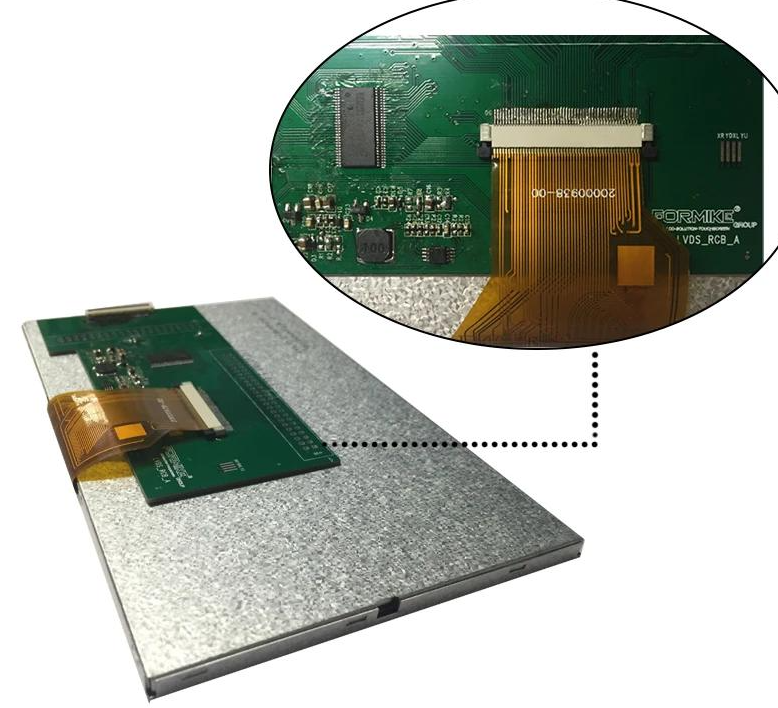
Flexible printed circuits (FPCs) connect display modules to the host electronics.
FPC length, pin assignment, grounding arrangement, and signal routing can influence signal integrity and electromagnetic behavior.
For high-speed display interfaces, engineers should consider:
- Controlled impedance where applicable
- Suitable signal return paths
- Differential pair routing
- Connector reliability
- Separation from noisy power circuits
- Grounding and shielding strategy
A customized FPC layout can also help integrate the display into a space-constrained telecom enclosure.
EMC Testing and Validation
International EMC standards provide methods for evaluating equipment under defined electromagnetic conditions.
For example, IEC 61000-4-3 addresses immunity to radiated radio-frequency electromagnetic fields.
However, the applicable standards, test levels, and acceptance criteria depend on the complete equipment and its intended market.
A display with shielding features should not automatically be considered compliant with a telecom system’s EMC requirements.
Engineering recommendation: Evaluate EMI/EMC performance at the complete equipment level, including the display, controller board, power supply, interconnects, enclosure, and software operating modes.
For telecom OEMs, early coordination between the display supplier and system engineering team can reduce redesign risks.
5. Selecting the Right LCD Interface: RGB, LVDS, MIPI, UART or RS485?
Interface compatibility is another essential factor when selecting a base station controller display.
The appropriate interface depends on the host processor, required resolution, update rate, cable length, and software architecture.
RGB Interface
RGB interfaces transmit pixel data and synchronization signals from a display controller to the LCD module.
They are commonly used in embedded systems with a suitable LCD controller.
Vantagens:
- Established integration approach
- Suitable for various embedded platforms
- Supports graphical user interfaces
Considerations:
Parallel RGB connections require multiple signal lines, making PCB routing and interconnect design important.
LVDS Interface
Low-Voltage Differential Signaling (LVDS) is used in various industrial display systems.
It can transmit display information over differential signal pairs.
Vantagens:
- Suitable for selected medium and larger display modules
- Reduced signal count compared with some parallel interfaces
- Differential signaling can improve noise tolerance when properly implemented
Considerations:
LVDS integration requires compatible host electronics, suitable cable design, and correct electrical specifications.
MIPI DSI Interface
MIPI Display Serial Interface (DSI) is widely used in compact electronic products and embedded display systems.
It supports high-speed image transfer with relatively compact interconnections.
Vantagens:
- Efficient high-speed display interface
- Suitable for compact PCB designs
- Commonly available on modern embedded processors
Considerations:
MIPI DSI requires compatible hardware, initialization sequences, and appropriate high-speed routing.
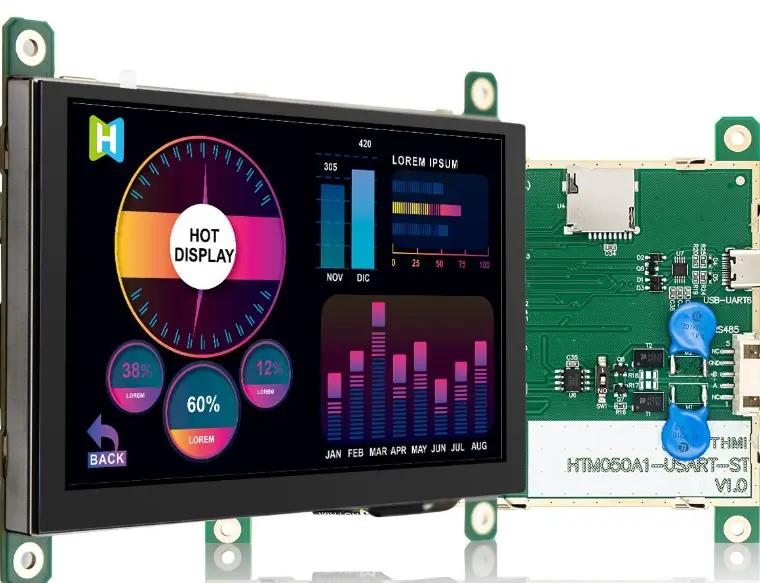
UART-Based Smart Display Modules
For some communication controllers, a smart display module can simplify GUI development.
Unlike a basic TFT LCD panel, a smart display incorporates additional processing or control functionality.
The host system can send commands or application data through UART rather than directly transmitting every display pixel.
This architecture may reduce the graphics processing workload on the host controller.
It can be suitable for applications requiring:
- Status pages
- Simple graphical menus
- Alarm indicators
- Configuration interfaces
- Parameter monitoring
The actual development effort depends on the smart display platform, command set, memory resources, and user interface complexity.
RS232, RS485 and CAN-Based HMI Solutions
Some industrial control systems use RS232, RS485, or CAN-based communications.
These are not normally native video interfaces for a bare TFT LCD panel.
Instead, they can be implemented through a smart HMI or controller board that receives communication data and generates the display output.
For telecom equipment manufacturers, this distinction is important when evaluating module architecture and integration cost.
Display Interface Selection Guide
| Interface | Typical Integration | Key Consideration |
|---|---|---|
| MCU / SPI | Small embedded displays | Bandwidth and update rate |
| RGB | Direct connection to LCD controller | Signal count and routing |
| LVDS | Compatible industrial display systems | Differential signaling and cable design |
| MIPI DSI | Modern embedded processors | High-speed hardware compatibility |
| UART | Smart display modules | Command protocol and firmware |
| RS232 / RS485 | Controller-based HMI | Protocol conversion and system architecture |
| CAN | Industrial smart HMI | Controller integration and message handling |
For projects without an existing graphical display controller, a smart display solution may be worth evaluating alongside a conventional TFT LCD module.
6. Outdoor Readability and Wide-Temperature Operation
Outdoor base station equipment may operate under strong sunlight, high internal cabinet temperatures, and cold weather conditions.
These factors can significantly influence display selection.
High-Brightness TFT LCD for Outdoor Cabinets
Standard indoor LCD modules may become difficult to read under strong ambient illumination.
Outdoor-facing applications may therefore require high-brightness TFT LCD modules.
For some telecom equipment projects, 800–1500 nits may be an appropriate evaluation range.
However, no single brightness specification guarantees outdoor readability.
Visibility also depends on:
- Ambient light intensity
- Display surface reflectance
- Cover glass construction
- Ângulo de visão
- User interface contrast
- Colagem ótica
Displays installed inside shaded cabinets may require less brightness than those directly exposed to sunlight.
Anti-Glare and Anti-Reflective Cover Glass
Anti-glare (AG) treatments reduce sharp reflections by scattering incident light.
Anti-reflective (AR) coatings reduce reflected light at optical surfaces.
Both approaches can improve usability, but their effects differ.
For interfaces displaying small technical parameters, excessive AG haze may reduce apparent sharpness.
Therefore, surface treatments should be selected according to the complete optical requirements.
Optical Bonding for Improved Visibility
Optical bonding replaces an air gap between display layers with a transparent adhesive.
This can reduce internal reflections and improve perceived contrast.
For outdoor telecom maintenance panels, optical bonding may also help reduce condensation risks within the bonded interface when supported by appropriate enclosure design.
However, bonding performance and durability must be validated for the selected materials and operating environment.
Wide-Temperature TFT LCD Modules
Outdoor telecom equipment can experience significant temperature variations.
Depending on the installation environment, industrial display projects may require operating ranges such as -30°C to +70°C or wider.
At low temperatures, liquid crystal response may slow.
At high temperatures, LCD optical characteristics, backlight aging, and adhesive reliability may be affected.
A display module’s operating temperature range should always be verified from its datasheet.
Touchscreen and Environmental Protection
For maintenance devices operated by field technicians, glove touch and moisture tolerance may also be important.
Projected capacitive touchscreens can be configured for certain glove and wet-touch applications, subject to controller and sensor validation.
Resistive touchscreens may be appropriate where operation with gloves or a stylus is important.
For outdoor equipment, the final enclosure may also require an IP65, IP66, or other ingress protection rating.
An LCD module alone does not establish the IP rating of the finished telecom equipment. Protection depends on the complete enclosure, sealing design, and validation testing.
7. Why a 5–10 Year Display Supply Lifecycle Matters
Telecommunications infrastructure often remains operational for many years.
While electronic components may be replaced or upgraded during that period, equipment manufacturers typically aim to minimize unnecessary hardware redesigns.
For industrial TFT LCD displays, long-term supply stability is therefore an important procurement consideration.
The Risks of Unexpected LCD Discontinuation
If a selected display module reaches end-of-life unexpectedly, the equipment manufacturer may need to redesign several parts of the product.
Potential consequences include:
- PCB layout modifications
- Connector or FPC changes
- Display driver updates
- Mechanical enclosure adjustments
- Touchscreen compatibility testing
- Firmware redevelopment
- Additional reliability validation
For telecom infrastructure manufacturers, these changes can affect production schedules, spare parts planning, and maintenance programs.
Why Long-Term Availability Should Be Evaluated Early
When selecting an industrial LCD supplier, OEM buyers should evaluate more than the initial price and display specifications.
Important questions include:
- How long is the selected display expected to remain available?
- What happens if a panel or driver IC is discontinued?
- Can the supplier provide product change notifications?
- Are replacement modules available with compatible mechanical and electrical specifications?
- How will service spare parts be managed?
- What volume forecasts or purchasing commitments are required?
These questions help determine whether the display solution can support the intended equipment lifecycle.
QIHAN‘s 5–10 Year Supply Planning
QIHAN supports long-term industrial display projects, including supply planning for programs targeting a 5–10 year production and maintenance lifecycle.
For telecom OEM manufacturers, this can help reduce sourcing uncertainty and support long-term product planning.
Lifecycle arrangements should be confirmed for each project, including the selected module, forecast volumes, component availability, change notification procedures, and replacement strategy.
A long-term supply plan is most effective when display engineering and procurement requirements are established before mass production.
8. Recommended TFT LCD Configurations for Base Station Maintenance Panels
The following configurations provide practical starting points for telecom display development.
They represent example engineering directions rather than fixed specifications for every product.
| Display Configuration | Suggested Application | Key Design Priorities |
|---|---|---|
| 3.5″ Industrial TFT LCD | Compact controller/status panel | Small footprint, clear alarms, host compatibility |
| 5″ IPS TFT LCD | BBU-associated maintenance interface | Wide viewing angle, graphical menus, optional touch |
| 7″ IPS TFT Touchscreen | Cabinet monitoring and control HMI | Larger interface, touch integration, detailed diagnostics |
| High-Brightness TFT LCD | Outdoor cabinet interface | Brightness, reflectance, optical bonding |
| UART Smart Display | MCU-based service controller | Simplified GUI communication and firmware integration |
Which Configuration Is Best?
Choose a 3.5-inch TFT LCD when the device primarily displays alarms, equipment status, and a small number of parameters.
Choose a 5-inch IPS TFT LCD when technicians need an accessible graphical interface with multiple configuration menus.
Choose a 7-inch TFT touchscreen when the application requires simultaneous monitoring of several subsystems and more detailed information.
For systems using compact microcontrollers, consider a smart display architecture if direct graphics processing would create unnecessary development complexity.
9. OEM/ODM TFT LCD Customization for Telecom Equipment
Standard display modules do not always match the electrical, mechanical, and environmental requirements of telecommunications equipment.
For this reason, OEM/ODM display customization can be valuable during product development.
QIHAN specializes in industrial TFT LCD, OLED, LCD, and touchscreen display solutions for embedded and industrial applications.
For manufacturers developing base station controllers and telecom maintenance interfaces, QIHAN offers display customization and integration support.
Custom Display Size, Resolution and Brightness
QIHAN can help evaluate display configurations based on enclosure dimensions, interface requirements, viewing conditions, and user interface design.
Available customization directions include:
- Industrial TFT LCD and IPS display options
- Display size and resolution selection
- High-brightness backlight configurations
- Viewing-angle requirements
- Wide-temperature design options
Final specifications depend on the selected display platform and engineering feasibility.
FPC, Connector and Interface Customization
A display module must integrate correctly with the customer’s controller board.
QIHAN supports interface and interconnect customization to help accommodate specific host architectures.
Projects may involve customized FPC geometry, pin definitions, connectors, and display interface arrangements.
For applications requiring UART or other industrial communication interfaces, a suitable smart display or controller-board architecture can be evaluated.
EMI/EMC Integration Considerations
Telecom equipment may require additional attention to shielding, grounding, signal integrity, and electromagnetic compatibility.
QIHAN can work with customer engineering teams to evaluate display integration requirements and suitable module configurations.
Final system-level EMC performance should be verified through appropriate equipment testing.
Touchscreen and Optical Integration
Depending on project requirements, QIHAN can provide industrial touch display integration options.
These may include:
- Projected capacitive touch panels
- Resistive touch panels
- Customized cover glass
- Colagem ótica
- Anti-glare and anti-reflective treatments
Such options allow equipment manufacturers to optimize display usability according to operating conditions.
Prototype Validation and Long-Term Production Support
Display development typically involves several stages:
- Requirement Evaluation: Confirm screen size, interface, brightness, operating temperature, and lifecycle expectations.
- Engineering Assessment: Review display compatibility, FPC structure, mechanical integration, and touch requirements.
- Prototype Development: Prepare samples based on agreed specifications.
- Functional Validation: Evaluate display performance within the customer’s equipment.
- Production Planning: Confirm the final bill of materials, production requirements, and long-term supply arrangements.
For telecom equipment manufacturers, this structured approach helps align display design with long-term production and maintenance requirements.
10. Engineering Checklist Before Ordering a Telecom TFT LCD
Before sourcing a custom TFT LCD for a base station maintenance panel, engineering teams should prepare a technical requirements document.
| Requisito | Information to Confirm |
|---|---|
| Aplicação | Base station controller, BBU service panel, cabinet HMI |
| Tamanho do ecrã | 3.5″, 5″, 7″, or customized size |
| Resolução | Required graphical information and text readability |
| Display interface | MCU, SPI, RGB, LVDS, MIPI, or smart HMI |
| Brilho | Indoor, sheltered outdoor, or direct sunlight |
| Ângulo de visão | Front viewing or multi-angle maintenance |
| Touch requirement | Non-touch, PCAP, or resistive |
| EMI/EMC | Required system standards and test conditions |
| Temperatura de funcionamento | Minimum and maximum module temperatures |
| Estrutura mecânica | Dimensions, FPC, connector and mounting |
| Supply lifecycle | Expected production and service period |
| Estimated volume | Annual demand and production forecast |
Providing these details early can help reduce unnecessary sample revisions and improve project communication.
11. Frequently Asked Questions (FAQ)
1. What size TFT LCD is suitable for a BBU maintenance panel?
A 3.5-inch to 7-inch TFT LCD may be suitable, depending on the interface complexity and available installation space.
A 3.5-inch display is useful for basic status information, while 5-inch and 7-inch screens offer more space for graphical menus and diagnostics.
However, many conventional BBUs do not require integrated LCDs.
2. Do all 5G base stations require LCD displays?
No. Many base stations rely on remote management systems, status LEDs, and communication ports rather than built-in LCD screens.
Industrial TFT LCDs are primarily relevant to equipment designs that require local maintenance, diagnostics, or graphical control interfaces.
3. How does electromagnetic interference affect telecom LCD displays?
Electromagnetic interference may cause display flickering, communication instability, touch malfunction, or controller resets.
Appropriate shielding, grounding, power filtering, PCB design, and cable routing can help manage these risks.
Complete equipment-level EMC testing is necessary to verify performance.
4. Which display interface is better for a base station controller: LVDS, MIPI or UART?
The best interface depends on the host system.
LVDS and MIPI are suitable for compatible graphical display architectures, while UART can be useful for smart display modules that receive commands from a microcontroller.
A basic TFT LCD panel normally requires a compatible display controller rather than direct UART control.
5. Are high-brightness TFT LCDs necessary for outdoor base station cabinets?
Not always.
Displays installed in shaded or protected locations may operate effectively with moderate brightness.
Direct sunlight applications may benefit from high-brightness LCDs, anti-reflective cover glass, and optical bonding.
Actual readability should be verified under representative ambient conditions.
6. Can QIHAN customize 3.5-inch, 5-inch and 7-inch TFT LCD modules?
Yes. QIHAN offers OEM/ODM industrial display customization services covering display specifications, interface integration, touch panels, optical bonding, and mechanical configurations.
The final solution depends on the technical requirements and availability of suitable display platforms.
7. Can QIHAN provide 5–10 year stable supply for telecom display projects?
QIHAN supports industrial display projects requiring long-term supply planning, including programs targeting a 5–10 year lifecycle.
Project-specific supply arrangements should be confirmed according to display model, production forecast, component availability, and agreed lifecycle management procedures.
8. Can QIHAN provide UART or RS485 smart display solutions?
QIHAN can evaluate controller-board or smart display configurations for projects requiring serial communication.
UART and RS485 are typically implemented through additional controller electronics rather than being native video interfaces of a standard TFT LCD panel.
The appropriate solution depends on the customer’s main controller and communication protocol.
9. How can telecom OEMs reduce the risk of LCD end-of-life?
Manufacturers should select display suppliers with long-term supply planning capabilities and establish procedures for product change notifications, replacement compatibility, spare parts, and lifecycle forecasting.
Early planning helps reduce the risk of costly PCB or mechanical redesigns.
Conclusion: Choosing a Reliable TFT LCD Solution for Telecom Infrastructure
Selecting a TFT LCD display for base station controllers and BBU/RRU maintenance applications requires a balanced approach to functionality, integration, environmental performance, and long-term availability.
A compact 3.5-inch display may be sufficient for basic equipment status, while 5-inch and 7-inch TFT LCD modules provide additional space for graphical maintenance interfaces.
EMI/EMC design, display interface compatibility, outdoor readability, and operating temperature should all be evaluated according to the complete equipment architecture.
For telecommunications OEM manufacturers, long-term display supply stability is also an important consideration, particularly when products must remain in production or service for many years.
By combining industrial display customization, engineering integration support, and long-term supply planning, QIHAN helps equipment manufacturers develop display solutions aligned with their project requirements.
Need a Custom TFT LCD Display for Your Base Station Controller?
QIHAN — Industrial TFT LCD & Touchscreen OEM/ODM Manufacturer
Looking for a reliable 3.5-inch, 5-inch, or 7-inch industrial TFT LCD for telecom equipment?
QIHAN provides custom display solutions for base station controllers, communication maintenance terminals, industrial monitoring equipment, and embedded HMI applications.
Our customization capabilities include:
- 3.5–7 inch industrial TFT LCD solutions
- Custom interfaces, FPCs, and connectors
- High-brightness and wide-temperature display options
- EMI/EMC integration considerations
- Capacitive and resistive touch panel integration
- Optical bonding and customized cover glass
- 5–10 year long-term supply planning for qualifying projects
Send us your display specifications, estimated order quantity, and project requirements to request a customized solution.
Website: https://qihantech.com/
E-mail: sales@shanghaiqihan.com
Contact QIHAN today to discuss your custom telecom display project.
 English
 Português
 Français
 Deutsch
 Español
 Русский