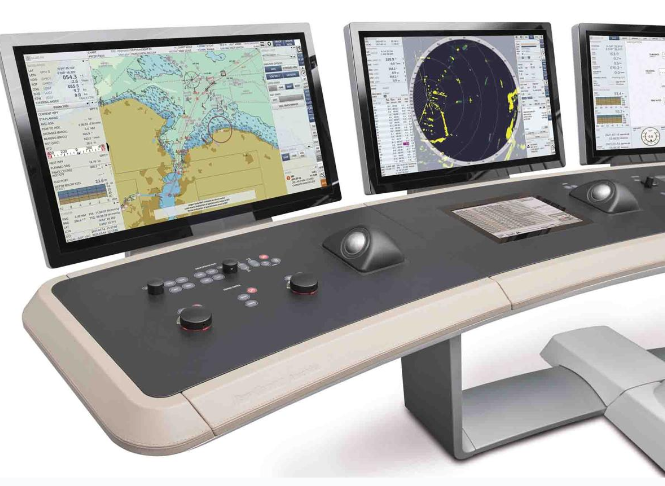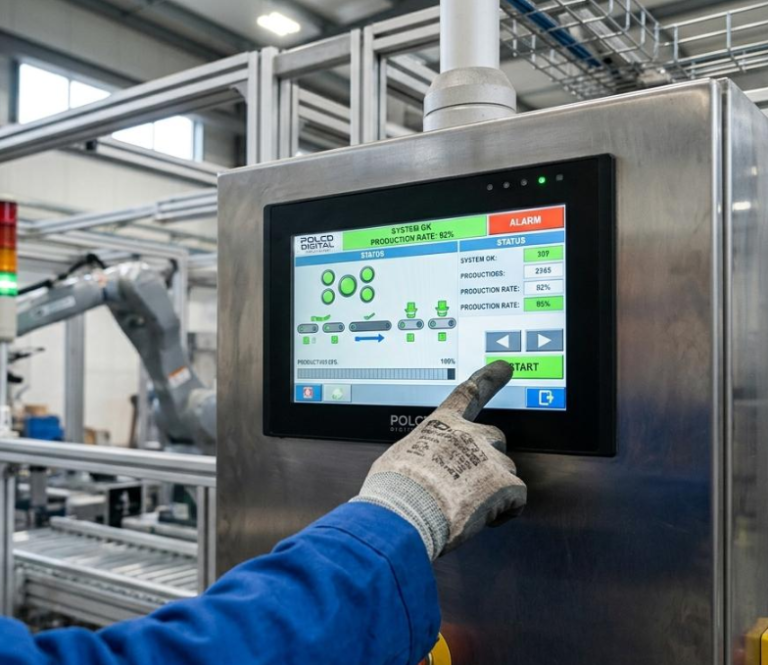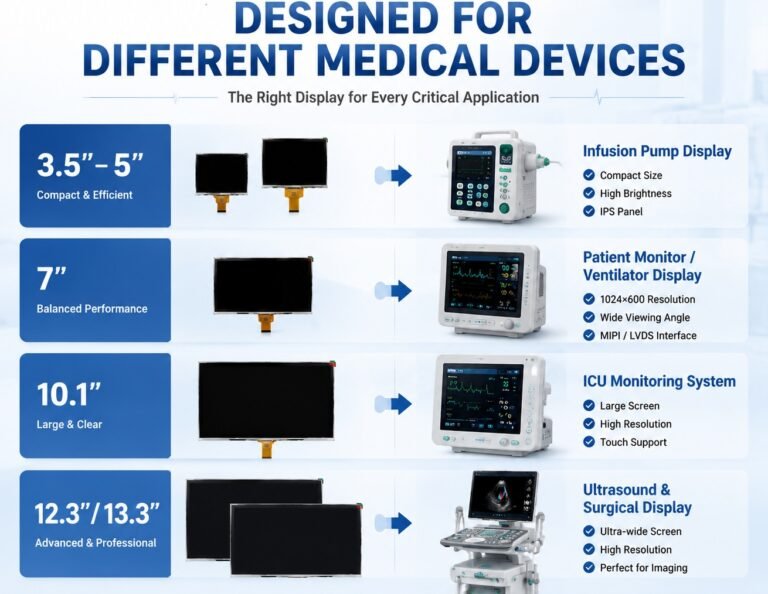
Les panneaux tactiles capacitifs étanches sont de plus en plus utilisés dans les systèmes industriels où l'exposition à l'eau, aux produits chimiques, aux impacts mécaniques et aux températures extrêmes fait partie du fonctionnement quotidien.
Des équipements de navigation maritime et dispositifs médicaux aux bornes de recharge pour véhicules électriques en extérieur et machines de transformation alimentaire, un écran tactile fiable doit faire plus que répondre à une entrée tactile. Il doit maintenir des performances stables dans des conditions environnementales exigeantes tout en répondant aux exigences mécaniques, électriques et opérationnelles de l'équipement final.
Pour les fabricants OEM industriels et les intégrateurs système, la sélection du bon panneau tactile capacitif étanche implique l'évaluation de l'indice de protection, de la durabilité du verre de couverture, du réglage du contrôleur tactile, des performances optiques et de la stabilité des matériaux à long terme.
Fort de plus de 15 ans d'expérience en R&D dans les technologies TFT LCD, OLED et tactile, Qihantech est spécialisé dans les solutions personnalisées d'affichage industriel et d'écrans tactiles capacitifs projetés (PCAP) pour les fabricants d'équipements spécialisés.
Cet article explore cinq environnements d'application exigeants, leurs défis d'ingénierie et les considérations pratiques de conception d'écrans tactiles pour les projets OEM/ODM.
1. Équipements marins et maritimes : écrans tactiles conçus pour l'eau salée, l'éblouissement et l'humidité constante
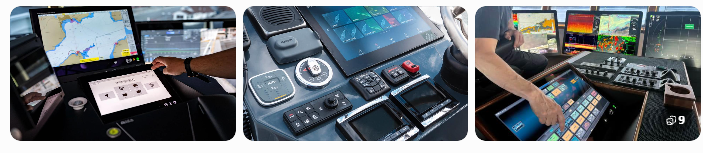
Les écrans tactiles marins fonctionnent dans des conditions combinant humidité, exposition au sel, vibrations, variations de température et fort ensoleillement.
Contrairement aux panneaux industriels intérieurs ordinaires, un écran tactile marin peut être exposé à des projections répétées d'eau salée, à la condensation et à des différences significatives d'éclairage entre le jour et la nuit.
Principaux défis d'ingénierie
Corrosion par l'eau salée
L'humidité contenant du sel peut accélérer la corrosion des composants métalliques exposés, des connecteurs, des pistes conductrices et des assemblages électroniques insuffisamment protégés.
Projections directes et exposition à l'eau
Les embruns, la pluie et les mains mouillées peuvent affecter à la fois l'intégrité du boîtier et la détection tactile capacitive.
Ensoleillement intense et reflets
Les écrans de navigation maritime doivent rester lisibles sous la lumière directe du soleil et les reflets des surfaces aquatiques environnantes.
Fonctionnement nocturne
Une luminosité excessive du rétroéclairage peut interférer avec l'adaptation visuelle lors de la navigation nocturne, rendant essentiel un fonctionnement à faible luminosité contrôlée.
Solutions d'ingénierie recommandées
- Construction résistante à la corrosion : sélectionner un verre de couverture, des joints, des connecteurs, des revêtements et des matériaux de boîtier adaptés aux environnements chargés en sel.
- Protection contre les infiltrations spécifique à l'application : envisager une protection IP65, IP66 ou IP67 selon l'exposition aux projections, au lavage ou à l'immersion.
- TFT LCD à haute luminosité: Évaluer des configurations d'affichage de classe 1 000 nits ou plus, ainsi que le collage optique et le contrôle des reflets.
- Traitements de surface AG/AR : réduire les reflets gênants et améliorer le contraste perçu de l'affichage.
- Gradation à large plage : prendre en charge le fonctionnement diurne et la faible luminance nocturne, avec une évaluation minutieuse des performances de gradation.
- Optimisation du toucher humide : régler la sensibilité du contrôleur et le rejet de l'eau pour les doigts mouillés et les gouttelettes d'eau.
Scénario d'application d'ingénierie : écran de contrôle de navigation maritime
Un fabricant OEM développe un écran tactile multifonction pour la console de navigation d'un navire.
L'écran doit fournir des cartes lisibles en plein jour, rester utilisable après exposition aux embruns marins et prendre en charge un fonctionnement à faible luminosité la nuit.
Exigences de conception illustratives
| Paramètre | Considération d'ingénierie |
|---|---|
| Technologie d'affichage | TFT LCD industriel à haute luminosité |
| Technologie tactile | Capacitif projeté (PCAP) |
| Protection | Objectif de conception IP66/IP67, selon l'installation |
| Verre de couverture | Verre chimiquement renforcé ou trempé |
| Structure optique | Collage optique complet avec traitement AR |
| Fonction tactile | Fonctionnement avec doigts mouillés, rejet de l'eau |
| Tests supplémentaires | Brouillard salin, vibrations, cycles thermiques, gradation |
Aperçu d'ingénierie : un écran scellé n'est pas automatiquement résistant à la corrosion par l'eau salée. La qualification marine doit évaluer l'assemblage complet, y compris le boîtier, les connecteurs, les pièces métalliques exposées et les interfaces d'étanchéité.
Pour les équipements de navigation et de radiocommunication, l'applicabilité de l'IEC 60945 et d'autres exigences spécifiques au secteur maritime doit être établie lors de la conception du système.
Considérations d'intégration OEM/ODM de Qihantech
Les capacités de Qihantech en matière de panneaux tactiles capacitifs personnalisés et de TFT LCD industriels peuvent soutenir des projets nécessitant un verre de couverture spécialisé, des dimensions de capteur personnalisées, un collage optique et une sélection de luminosité d'affichage.
Les performances environnementales finales doivent être vérifiées par rapport aux exigences de qualification de l'équipement marin assemblé.
2. Équipements médicaux et de santé : panneaux tactiles étanches pour l'hygiène et l'utilisation avec gants
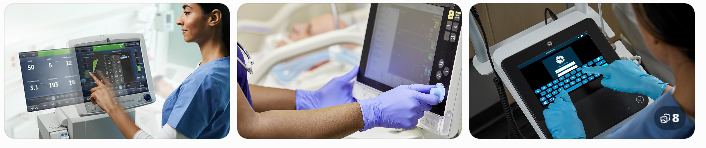
Les fabricants d'équipements médicaux sont confrontés à un ensemble d'exigences de conception d'écrans tactiles différentes.
Dans les environnements cliniques, les écrans tactiles peuvent être nettoyés de manière répétée avec des désinfectants, utilisés par des opérateurs portant des gants médicaux, et exposés à des gouttelettes ou à des déversements liquides occasionnels.
Un panneau tactile étanche de qualité médicale doit donc être évalué en termes de compatibilité chimique, de facilité de nettoyage, de stabilité tactile et d'intégration avec les exigences de sécurité des équipements médicaux.
Principaux défis d'ingénierie
Désinfection chimique fréquente
L'exposition répétée à des nettoyants à base d'alcool, à des désinfectants chlorés ou à d'autres agents de nettoyage approuvés peut affecter les revêtements, les adhésifs, l'impression et les joints.
Utilisation avec gants
Les gants en latex, en nitrile et autres gants médicaux peuvent réduire le couplage capacitif nécessaire à une détection tactile fiable.
Contamination liquide
L'eau, les résidus de désinfectant et d'autres liquides sur la surface du verre peuvent produire des signaux tactiles indésirables si le contrôleur n'est pas correctement configuré.
Conception mécanique hygiénique
Les bordures complexes et les joints exposés peuvent créer des surfaces difficiles à nettoyer.
Solutions d'ingénierie recommandées
- Verre de couverture chimiquement compatible : Évaluer les revêtements de surface et les décorations en verre par rapport aux agents de nettoyage prévus.
- Conception affleurante : Réduire les bords exposés, les crevasses et les espaces mécaniques inutiles.
- Réglage PCAP compatible avec les gants : Optimiser le capteur et le contrôleur pour les gants médicaux sélectionnés.
- Algorithmes de rejet des liquides : Réduire l'activation tactile involontaire causée par les gouttelettes et les fluides de nettoyage.
- Collage optique : Améliorer la clarté optique et éliminer l'espace d'air interne entre les couches d'affichage collées.
- Intégration de panneau frontal scellé : Définir la protection contre les infiltrations en fonction des conditions réelles de nettoyage et d'exposition.
Scénario d'application technique : Interface tactile pour équipement de diagnostic médical
Un fabricant d'équipements médicaux a besoin d'une interface tactile pour un instrument de diagnostic.
L'écran est utilisé par des professionnels de santé portant des gants en nitrile et doit tolérer un nettoyage répété avec des désinfectants approuvés.
Exigences de conception illustratives
| Paramètre | Considération d'ingénierie |
|---|---|
| Technologie d'affichage | TFT LCD industriel ou OLED approprié |
| Entrée tactile | PCAP avec fonctionnement avec gants |
| Conception de surface | Verre de couverture affleurant, joints minimisés |
| Protection contre l'eau | IP65 en façade ou objectif défini par l'application |
| Résistance chimique | Vérification par rapport aux désinfectants spécifiés |
| Contrôleur | Rejet des liquides et filtrage du bruit |
| Validation | Cycles de nettoyage, sensibilité avec gants, CEM |
Une partie essentielle du processus de validation consiste à tester l'écran tactile après des cycles de nettoyage répétés plutôt que de se fier uniquement aux données initiales de résistance chimique fournies par le fournisseur de matériaux.
Considérations de conformité médicale
L'IEC 60601-1 et les normes collatérales ou particulières applicables peuvent être pertinentes pour l'équipement électrique médical dans son ensemble. L'écran tactile doit être évalué dans le cadre des exigences de sécurité et de performance essentielle de l'appareil complet.
Un composant décrit comme de qualité médicale ne doit pas être interprété comme automatiquement certifié pour une application spécifique d'équipement médical.
Considérations d'intégration OEM/ODM de Qihantech
Pour les projets d'équipements médicaux, Qihantech peut aider avec le verre de couverture personnalisé, la sélection de capteurs PCAP, l'intégration d'affichage et la configuration du contrôleur en fonction des spécifications du client.
La résistance chimique, les procédures de nettoyage et les exigences réglementaires doivent être confirmées pour la configuration finale du produit.
3. Énergie intelligente en extérieur et recharge de véhicules électriques : Écrans tactiles étanches pour les infrastructures publiques
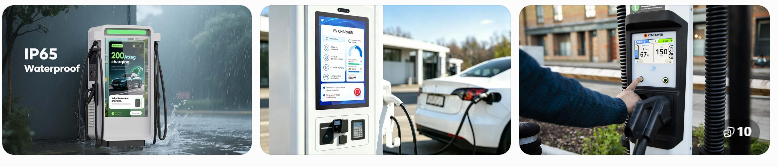
L'infrastructure de recharge de véhicules électriques présente une combinaison difficile d'exposition en extérieur, d'interaction publique, de bruit électrique et d'exigences de durabilité mécanique.
Un écran tactile capacitif de borne de recharge de véhicules électriques peut devoir rester réactif pendant la pluie, lisible en plein soleil et résistant aux impacts mécaniques accidentels ou délibérés.
Pour les fabricants de bornes de recharge, la fiabilité est particulièrement importante car une défaillance de l'écran tactile peut interrompre l'interaction de l'utilisateur et augmenter les coûts de maintenance sur le terrain.
Principaux défis d'ingénierie
Utilisation sous la pluie et avec les doigts mouillés
Les utilisateurs peuvent interagir avec les bornes de recharge de véhicules électriques pendant la pluie, laissant potentiellement des gouttelettes d'eau sur la surface de l'écran tactile.
Vandalisme et impacts mécaniques
Les bornes de recharge publiques sont vulnérables aux contacts physiques répétés et aux dommages délibérés occasionnels.
Exposition continue à la température
Outdoor charger enclosures can experience substantial solar heating, winter temperatures, and internal heat generated by power electronics.
Electromagnetic interference
Power conversion systems, switching components, and associated cables can create electrical noise that must be considered during touch controller design.
Solutions d'ingénierie recommandées
1. IP-Rated Front-Panel Design
Select an enclosure sealing strategy appropriate for outdoor rain, dust, and cleaning exposure.
IP65 or higher protection may be considered according to system-level requirements.
2. IK08 or IK10 Impact Protection
Industrial cover glass and enclosure construction may be engineered toward IK08 or IK10 protection targets.
| IK Rating | Impact Energy | Engineering Application |
|---|---|---|
| IK08 | 5 joules | Outdoor equipment with moderate impact exposure |
| IK10 | 20 joules | Public-access equipment requiring greater impact resistance |
IK levels are defined under IEC 62262. The rating applies to the tested enclosure or defined portion, not automatically to standalone cover glass.
3. Sunlight-Readable Display Integration
High-brightness TFT LCDs, AR coatings, and full optical bonding can improve contrast and readability in bright outdoor conditions.
4. Wide-Temperature Engineering
Depending on geographic deployment, an operating temperature target such as −30°C to +85°C may be considered, subject to complete module qualification.
5. EMC-Aware Touch Controller Design
Appropriate grounding, shielding, routing, filtering, and controller tuning can help reduce unwanted touch signals caused by electrical interference.
Engineering Application Scenario: Outdoor DC Fast Charger Interface
An EV charging equipment manufacturer is designing a public charging station with a touchscreen user interface.
The product is intended for outdoor installation, where drivers may operate it under strong sunlight or during rainfall.
Exigences de conception illustratives
| Paramètre | Considération d'ingénierie |
|---|---|
| Display | High-brightness industrial TFT LCD |
| Touch | Rain-tolerant PCAP |
| Ingress protection | IP65 or application-defined higher target |
| Impact resistance | IK08 or IK10 design target |
| Verre de couverture | Reinforced glass with optical treatments |
| Operating temperature | Site-specific extended range |
| Electrical design | EMC-aware grounding and controller tuning |
| Verification | Rain-touch, thermal, impact and EMC testing |
Engineering insight: Increasing glass thickness can improve mechanical protection, but it may also reduce capacitive touch sensitivity. A suitable electrode pattern and controller configuration must be validated with the final cover glass thickness.
Considérations d'intégration OEM/ODM de Qihantech
Qihantech can support custom touchscreen dimensions, cover glass designs, high-brightness display integration, and touch interfaces for outdoor EV charging equipment.
For public infrastructure projects, impact and ingress ratings should be supported by tests conducted on representative finished assemblies.
4. Food Processing and Industrial Automation: Touchscreens for High-Pressure Washdown Environments

Food processing facilities and industrial production lines often require equipment to withstand frequent cleaning, including exposure to water, detergents, grease, oils, and temperature variations.
For touchscreen-operated machinery, these environments create two interconnected challenges: protecting the electronics against liquid ingress and maintaining reliable touch operation when the glass surface becomes contaminated.
A standard indoor touchscreen may not be appropriate for equipment installed near high-pressure cleaning systems.
Principaux défis d'ingénierie
High-pressure, high-temperature cleaning
Some processing facilities use high-pressure water jets and elevated water temperatures to clean equipment surfaces.
Such cleaning methods can place significant stress on gaskets, bonding interfaces, and enclosure joints.
Oil and grease contamination
Grease, oils, and food residues can accumulate on the touchscreen surface, affecting visibility, cleanliness, and touch detection.
Repeated detergent exposure
Cleaning chemicals may degrade coatings, printed decorations, elastomeric seals, and adhesive interfaces over time.
Operation with protective gloves
Production workers frequently operate machinery while wearing gloves, creating additional capacitive sensing requirements.
Solutions d'ingénierie recommandées
1. High-Pressure Washdown Protection
For equipment directly exposed to high-pressure, high-temperature water jets, an IP69 or IP69K-class protection target may be considered.
The test designation must be specified correctly. IPX9 is addressed within IEC 60529, while IPX9K is defined in ISO 20653 for road-vehicle electrical equipment. The applicability of either standard to food processing equipment depends on the project specification.
A touchscreen module should never be described as IP69K-rated solely because it uses waterproof glass or optical bonding.
2. Hygienic Flush-Front Construction
A smooth front surface with appropriately designed seals and minimal exposed joints can help simplify cleaning.
3. Chemical-Resistant Surface Design
Cover glass coatings, ink layers, sealing materials, and adhesives should be evaluated against the actual detergents and cleaning procedures used in the facility.
4. Water and Oil Contamination Management
Touch controller tuning should be developed and verified for wet and contaminated glass surfaces.
5. Industrial TFT LCD Integration
Industrial TFT LCD modules can be selected according to the required operating temperature, brightness, interface, and expected duty cycle.
Engineering Application Scenario: Food Processing Machine HMI
A food processing equipment manufacturer requires a touchscreen control interface for a stainless steel production machine.
The equipment is exposed to regular cleaning, grease contamination, and operators wearing protective gloves.
Exigences de conception illustratives
| Paramètre | Considération d'ingénierie |
|---|---|
| Technologie tactile | Industrial PCAP with glove tuning |
| Display | Industrial TFT LCD |
| Protection | IP69/IP69K-class target where applicable |
| Front surface | Smooth, flush-mounted cover glass |
| Surface compatibility | Detergents, oils, and grease |
| Contrôleur | Liquid rejection and false-touch mitigation |
| Assembly | Sealed integration with stainless steel enclosure |
| Validation | Washdown, chemical exposure, and touch functionality |
Engineering insight: High-pressure cleaning performance depends on enclosure geometry, gasket compression, cable entry points, and assembly tolerances. Even a well-designed touchscreen can fail if the surrounding mechanical structure is inadequately sealed.
Considérations d'intégration OEM/ODM de Qihantech
Qihantech can assist industrial equipment manufacturers with custom cover glass layouts, PCAP sensor designs, display selection, and interface integration for washdown-oriented machinery.
High-pressure ingress protection must be demonstrated through appropriate testing of the finished assembly.
5. Portable Field Testing Instruments: Rugged Touchscreens for Battery-Powered Equipment

Portable industrial instruments are frequently used outdoors, in electrical installations, maintenance facilities, and remote inspection environments.
Unlike stationary industrial control panels, portable instruments must balance touchscreen reliability with weight, power consumption, compact dimensions, and resistance to accidental drops.
Typical applications include electrical measurement devices, portable diagnostic instruments, environmental data loggers, and industrial inspection equipment.
Principaux défis d'ingénierie
Battery efficiency
The display and touch controller contribute to the overall electrical power consumption of the instrument.
High display brightness, continuous touch scanning, and inefficient power management can reduce operating time.
Accidental drops and vibration
Portable instruments may be dropped during transport or field operation.
Outdoor readability
Technicians may need to read measurement results under direct sunlight.
Thick protective gloves
Field engineers may wear insulated or other protective gloves that significantly reduce capacitive coupling.
Rain, dust, and contamination
Outdoor instruments may be operated with wet hands or exposed to rain, dust, and dirt.
Solutions d'ingénierie recommandées
1. Low-Power Display Architecture
Choose a TFT LCD or OLED module based on the required display content, brightness, duty cycle, temperature range, and power budget.
For TFT LCDs, backlight power often represents a significant portion of display energy consumption.
OLED modules may offer advantages for certain low-average-picture-level interfaces, but power consumption depends strongly on image content and brightness.
2. Touch Controller Power Management
Consider controller sleep modes, interrupt-driven operation, and reduced scanning activity where compatible with response-time requirements.
3. Mechanical Reinforcement
Protect the touchscreen through suitable cover glass, housing support, edge design, shock-absorbing structures, and mechanical integration.
4. Sunlight Readability
Evaluate a high-efficiency TFT LCD, optical bonding, and AG/AR treatments to balance visibility and battery consumption.
5. Glove-Optimized Capacitive Touch
Validate the selected PCAP sensor and controller using the actual gloves required by the instrument’s intended users.
Thick or electrically insulating gloves may limit capacitive sensing performance. Alternative input methods may be necessary for some applications.
Engineering Application Scenario: Portable Electrical Testing Instrument
An OEM instrument manufacturer is developing a battery-operated electrical testing device for outdoor field technicians.
The touchscreen must support measurement navigation, maintain readability outdoors, and tolerate accidental drops and wet operating conditions.
Exigences de conception illustratives
| Paramètre | Considération d'ingénierie |
|---|---|
| Display | Low-power industrial TFT LCD |
| Touch | Compact PCAP sensor |
| Protection | IP65/IP67 target based on enclosure design |
| Verre de couverture | Mechanically reinforced glass |
| Surface | AG/AR treatment as appropriate |
| Power | Backlight control and touch sleep modes |
| Utilisation avec gants | Tested with specified field gloves |
| Validation | Drop, vibration, temperature, and runtime tests |
Engineering insight: A higher-brightness display does not automatically deliver a better portable instrument. Engineers must balance readability, thermal performance, battery capacity, and total system power consumption.
Considérations d'intégration OEM/ODM de Qihantech
Qihantech’s custom TFT LCD, OLED, and capacitive touch capabilities can support portable instruments requiring compact display dimensions, customized FPC layouts, controlled power consumption, and rugged mechanical integration.
Display efficiency and drop resistance should be assessed using actual product-level measurements and tests.
6. Comparing Touchscreen Requirements Across Five Extreme Environments
Different industries require different combinations of environmental protection, optical performance, mechanical durability, and user interaction.
The table below summarizes the primary engineering priorities for each application.
| Industry | Main Environmental Risks | Priority Touchscreen Requirements |
|---|---|---|
| Marine & Maritime | Saltwater, glare, vibration, moisture | Corrosion protection, wet touch, sunlight readability, night dimming |
| Medical & Healthcare | Disinfectants, liquids, frequent cleaning | Chemical compatibility, glove touch, hygienic surface |
| EV Charging & Smart Energy | Rain, impacts, temperature extremes | IP protection, IK08/IK10 targets, high brightness, EMC robustness |
| Food Processing | Washdown, detergents, grease | High-pressure ingress protection, chemical resistance, flush mounting |
| Portable Instruments | Drops, rain, battery limitations | Low power, shock resistance, sunlight readability, glove touch |
The required design should be determined by a documented environmental and functional risk assessment rather than by selecting the highest available specification in every category.
7. How Qihantech’s Material Selection Supports Industrial Touchscreen Reliability
In addition to enclosure protection, the materials used inside the capacitive touch sensor affect long-term electrical stability.
For demanding applications, engineers should evaluate ITO conductive glass, silver paste interconnections, and insulating materials.
High-Uniformity ITO Conductive Glass
ITO forms transparent conductive structures within the capacitive touch sensor.
Relevant material properties include sheet resistance uniformity, surface roughness, adhesion, and environmental stability.
Premium ITO material specifications may help reduce variation between sensor production batches.
Stable Conductive Silver Paste
Silver paste is used for electrical interconnections within the sensor assembly.
Appropriate material selection and process control help maintain contact stability under thermal and humidity exposure.
High-Resistance Insulation Materials
Insulation layers help maintain electrical isolation between conductive structures.
High volume resistivity and consistent coating coverage are relevant for touchscreens operating in humid or electrically demanding environments.
Why These Materials Matter
For industrial touchscreen programs, stable sensor materials support more predictable electrical behavior and help reduce material-related reliability risks.
However, high-quality materials alone cannot guarantee waterproof performance or long service life. Environmental sealing, process controls, firmware integration, and system-level validation remain essential.
8. Custom Industrial Touchscreen Solutions for OEM/ODM Manufacturers
Industrial equipment rarely shares identical mechanical and electrical requirements.
A marine navigation panel, EV charging touchscreen, and portable testing instrument may use the same fundamental PCAP technology while requiring entirely different cover glass, display, and controller configurations.
Qihantech provides customizable industrial display and touchscreen solutions for equipment manufacturers and system integrators.
Customization Capabilities

Custom PCAP Sensor and Cover Glass
Customized touch dimensions, sensor patterns, cover lens shapes, glass thickness, and decorative printing for specialized equipment.

TFT LCD and OLED Display Integration
Industrial display selection based on brightness, contrast, interface, power requirements, and environmental conditions.

Interface and Controller Configuration
USB, I²C, and selected alternative interfaces based on controller availability, host compatibility, and project requirements.

Optical and Surface Treatments
Application-specific optical bonding, AG, AR, and AF treatment selection to meet readability and surface performance requirements.
For high-reliability projects, early collaboration between the touchscreen supplier, mechanical engineering team, and system integrator can reduce integration problems before tooling and mass production.
9. OEM Buying Guide: What to Verify Before Selecting a Waterproof Touchscreen Supplier
Project engineers and procurement teams should define measurable requirements before requesting quotations or samples.
| Technical Requirement | Information to Request |
|---|---|
| Waterproof protection | Target IP rating and applicable test method |
| Impact resistance | IK target or defined drop test requirements |
| Verre de couverture | Thickness, strengthening process, surface treatment |
| Optical performance | Brightness, contrast, bonding method, reflectance |
| Touch functionality | Wet-touch, glove-touch, multi-touch performance |
| Environmental range | Operating/storage temperature, humidity |
| Chemical compatibility | Approved cleaning agents and exposure conditions |
| Electrical integration | Interface, controller, host OS, EMC requirements |
| Power consumption | Typical and maximum display/controller power |
| Quality documentation | Qualification reports, inspection criteria, traceability |
| OEM customization | Tooling, minimum order quantities, development schedule |
Recommended Validation Process
- Define the application environment. Document water exposure, chemicals, operating temperatures, impact risks, and user interaction conditions.
- Select the preliminary touchscreen architecture. Determine the display type, cover glass, PCAP controller, interface, bonding process, and sealing strategy.
- Evaluate engineering samples. Test optical performance, glove operation, water rejection, electrical compatibility, and basic functionality.
- Qualify the final assembly. Perform relevant ingress protection, impact, environmental, chemical, and EMC tests.
- Approve production controls. Confirm acceptance criteria, critical material specifications, supplier change management, and inspection processes before mass production.
10. Frequently Asked Questions About Waterproof Industrial Capacitive Touch Panels
1. Can capacitive touchscreens operate reliably in saltwater environments?
Yes, a properly engineered touchscreen assembly can be designed for marine use. However, saltwater exposure requires consideration of corrosion-resistant materials, enclosure sealing, electrical protection, and appropriate environmental qualification.
2. What is the best touchscreen technology for medical equipment?
Projected capacitive touchscreens are commonly considered for medical equipment because they offer smooth glass surfaces, multi-touch capabilities, and configurable glove operation. Suitability depends on cleaning requirements, touch performance, and system-level regulatory requirements.
3. What IP rating is recommended for outdoor EV charging station touchscreens?
IP65 is a common design consideration for protection against dust and water jets. More demanding installations may require additional protection. The correct rating must reflect actual exposure conditions and apply to the tested enclosure.
4. What is the difference between IP67 and IP69K touchscreens?
IP67 addresses temporary immersion under specified conditions, while IP69K addresses high-pressure, high-temperature water-jet exposure under a different test regime. Neither rating should be assumed to include every test covered by the other.
5. Can a waterproof capacitive touchscreen work with thick gloves?
Some PCAP solutions can be configured for glove operation, but performance depends on glove material and thickness, cover glass construction, sensor design, and controller configuration. Thick insulated gloves may require alternative input methods.
6. Are OLED displays suitable for outdoor industrial equipment?
OLED displays can be considered for selected industrial applications, but high ambient brightness, sustained static images, temperature exposure, and service-life requirements should be evaluated carefully. High-brightness TFT LCDs may be preferable in some continuous-use outdoor applications.
7. Does optical bonding make a touchscreen waterproof?
No. Optical bonding reduces internal optical interfaces and can improve display readability, but waterproof performance depends primarily on the enclosure, sealing design, cable interfaces, and validated assembly construction.
8. Can Qihantech provide custom capacitive touchscreens for extreme environments?
Qihantech provides OEM/ODM industrial touchscreen and display customization. Project-specific requirements such as wet touch, rugged cover glass, optical bonding, and environmental qualification should be evaluated during the engineering design process.
Conclusion: Engineering Reliable Touch Interfaces for Extreme Environments
Waterproof capacitive touch panels play an important role in modern industrial and specialized electronic equipment.
Marine navigation systems require corrosion-resistant designs and controlled display brightness. Medical equipment prioritizes hygiene, chemical compatibility, and glove operation. EV charging stations need outdoor durability and impact protection. Food processing machinery demands resistance to washdown conditions, while portable field instruments must balance ruggedness, readability, and power efficiency.
Although these applications share projected capacitive touch technology, their engineering requirements differ substantially.
For OEM manufacturers, selecting a touchscreen should therefore begin with environmental conditions, user interaction needs, integration constraints, and testable performance targets.
With over 15 years of R&D experience, Qihantech supports industrial display and capacitive touchscreen customization for equipment manufacturers developing products for demanding operating environments.
Looking for a custom waterproof capacitive touch panel or industrial TFT LCD display?
Contact Qihantech to discuss your application, display specifications, cover glass requirements, touch interface, and OEM/ODM development needs.