The most expensive display is not automatically the best display. In embedded design, the right choice is the one that fits the product’s duty cycle, user interface, lighting conditions, service life and processor budget.
That sounds obvious. Yet display selection is often reduced to one specification: power consumption, contrast ratio or price. The result may look convincing on a bench and fail in the field. A battery label that updates twice a day has little in common with a medical monitor that must show live waveforms, even when both use a similar diagonal size.
The short answer
- Choose TFT LCD for full-color interfaces, live data, video, long operating life and broad industrial availability.
- Choose OLED when deep blacks, a thin profile, wide viewing angles and a premium small-screen appearance matter most.
- Choose e-paper when content changes infrequently and sunlight readability or ultra-low average power is the dominant requirement.
The important word is average. OLED does not always consume less power than TFT, and e-paper is not “free” to refresh. Actual consumption depends on content, brightness, update frequency, controller and temperature.
TFT LCD, OLED and e-paper compared
| Decision factor | TFT LCD | OLED | E-paper |
|---|---|---|---|
| Light source | LED backlight | Self-emissive pixels | Reflected ambient light |
| Best visual strength | Bright, detailed color UI | High contrast and true black | Paper-like static content |
| Motion and animation | Excellent | Excellent | Limited; ghosting may occur |
| Sunlight use | Requires high-brightness, AR or transflective design | Varies; high brightness affects power and aging | Excellent |
| Power behavior | Backlight is a major, relatively steady load | Content-dependent | Very low between image updates |
| Viewing angle | Depends on panel mode; IPS is strong | Very wide | Very wide |
| Main design risk | Backlight power, optical reflections | Image retention and differential aging | Slow refresh and temperature sensitivity |
| Typical fit | Industrial HMI, medical, automotive, appliances | Wearables, smart controls, premium handhelds | Shelf labels, badges, low-update instruments |
When TFT LCD is the safer engineering choice
TFT LCD is the practical default for an interface with gauges, menus, camera images, charts or frequent transitions. Its mature supply base offers many combinations of size, resolution, brightness, panel mode and interface. That flexibility matters when the display must match an existing enclosure or processor.
For industrial and medical equipment, lifetime is often more important than headline contrast. A TFT backlight can be specified around a defined brightness target and operating schedule. IPS TFT panels also provide wide viewing angles for equipment viewed from the side or from standing and seated positions.
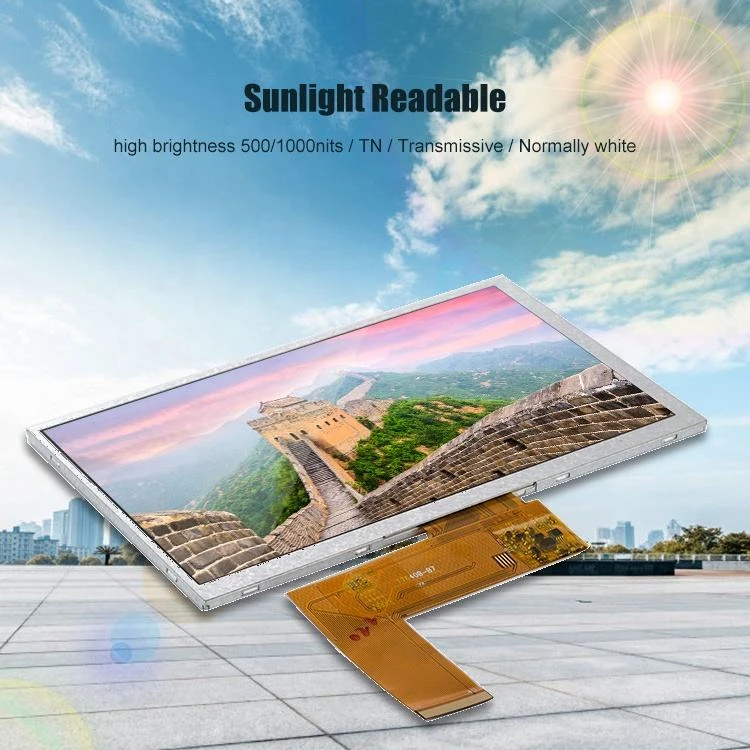
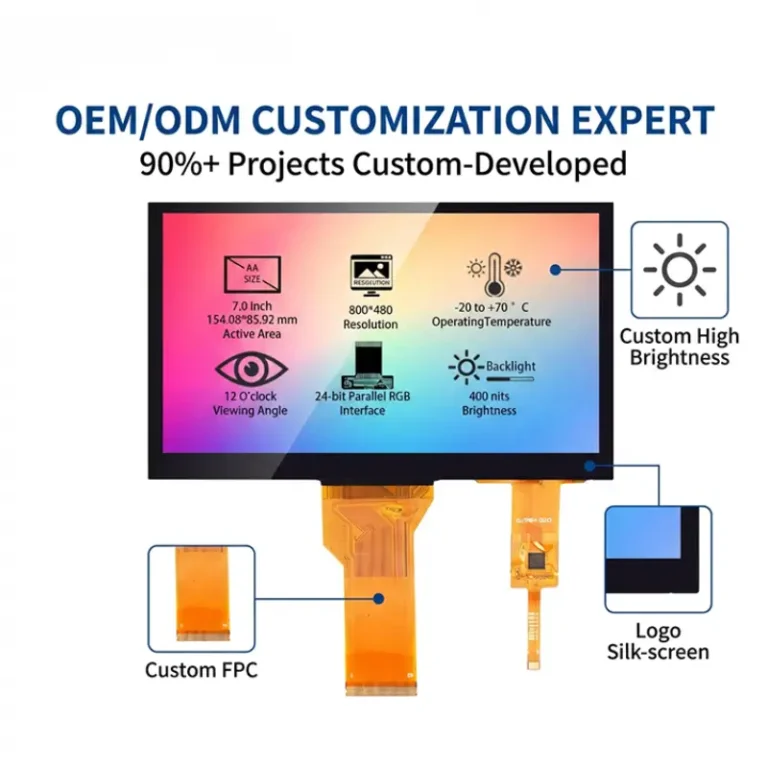
Outdoor use does not rule out TFT. It changes the optical stack. A high-brightness backlight, anti-reflection cover lens, optical bonding or a transflective panel may be required. QIHAN offers small and medium TFT modules from 0.96 to 15.6 inches, including high-brightness and wide-temperature options for embedded and HMI applications.
When OLED earns its place
OLED pixels emit their own light, so a black pixel is effectively off. This creates the deep black levels and high perceived contrast that make a compact interface feel crisp. There is no conventional backlight assembly, which can also help with thin product designs.
OLED is particularly effective for smart-home controls, wearables and handheld products that use dark themes with limited always-on content. It is less attractive when the same bright logo, status bar or navigation element remains visible for thousands of hours. Uneven pixel aging can create image retention, commonly called burn-in.
Mitigation is a system decision, not a marketing checkbox. Use screen dimming, timeouts, pixel shifting, dynamic layouts and carefully chosen brightness. Product teams should also test representative content at the intended temperature and duty cycle.
When e-paper wins decisively
E-paper is hard to beat for information that must remain visible while the system sleeps. Once an image is written, many e-paper technologies can hold it with little or no display power. The reflective surface remains readable in strong ambient light without fighting the sun with a backlight.
The trade-off is refresh behavior. Slow updates, flashing transitions and residual images make e-paper unsuitable for smooth animation, fast scrolling or live waveforms. Refresh time and image quality can also change at low temperature.
Good applications include equipment labels, warehouse tags, room signs and battery devices that update only a few times per hour or day.
A five-question selection method
- How often does the image change? Measure real updates, not an idealized standby condition.
- Where will the product be read? Record indoor lux levels, direct-sun exposure, viewing angles and whether the operator wears polarized glasses.
- What must move smoothly? A status icon and a live ECG trace create very different bandwidth requirements.
- How long is content displayed? Static content raises OLED aging concerns; long daily backlight operation affects TFT power and backlight-life targets.
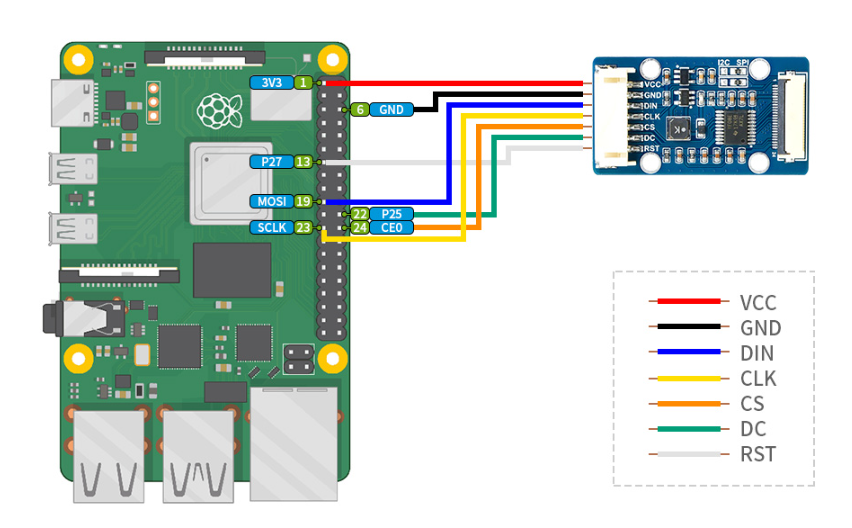
- What can the host processor support? Check frame-buffer memory, pixel clock, interface bandwidth, pin count and software support before freezing the panel.
Application recommendations
For a medical device or industrial instrument with live measurements, a TFT LCD is usually the balanced choice. It supports detailed color interfaces and can be engineered for long service, wide temperature operation and optical enhancement.
For a premium thermostat, wearable or compact smart-home controller, OLED can deliver a thinner, more distinctive interface—provided that content and brightness are managed to reduce uneven aging.
For a battery-powered sign, logistics label or sensor node that changes infrequently, e-paper may deliver the lowest average system power and the clearest outdoor reading.
Frequently asked questions
Is OLED always lower power than TFT LCD?
No. OLED power varies with pixel brightness and content. A bright, mostly white OLED interface can consume substantial power, while a well-dimmed TFT used intermittently may perform better than expected. Compare both with the actual UI and duty cycle.
Can a TFT LCD be readable in direct sunlight?
Yes, when the full optical stack is designed for it. High brightness, optical bonding, AR treatment and transflective technology are common tools. Simply increasing backlight power is not always the most efficient answer.
Which display lasts longest?
There is no universal winner. Panel construction, temperature, brightness, image content and hours of operation all matter. Ask for lifetime conditions and test the planned use case rather than comparing one headline number.
QIHAN is a manufacturer of small and medium industrial displays, with TFT LCD, OLED, LCD module, touch-panel and cover-glass customization. Share your target size, resolution, interface, brightness, environment, annual volume and expected service life. Our engineers can help compare a standard module, a semi-custom option and a fully customized display before tooling or PCB layout makes the decision expensive to change.