When a European medical device manufacturer approached us last year with an unusual request — a perfectly circular 8-inch TFT panel for a next-generation patient monitor — we didn’t treat it as a one-off. We treated it as a signal.
That signal has since turned into one of the fastest-growing segments in our OEM portfolio.
The Geometry Problem Nobody Talks About
Walk through any trade show floor and you’ll notice something odd: the devices we build have evolved. Curved enclosures. Circular dashboards. Rounded smart home panels. Yet the displays inside them remain stubbornly rectangular. This mismatch isn’t just an aesthetic problem — it’s an engineering constraint that forces product designers to build around the display rather than with it.
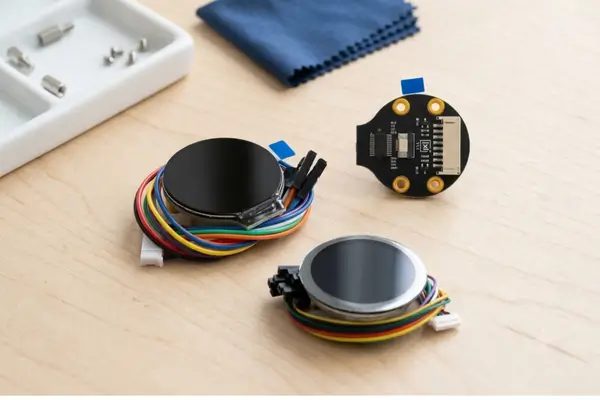
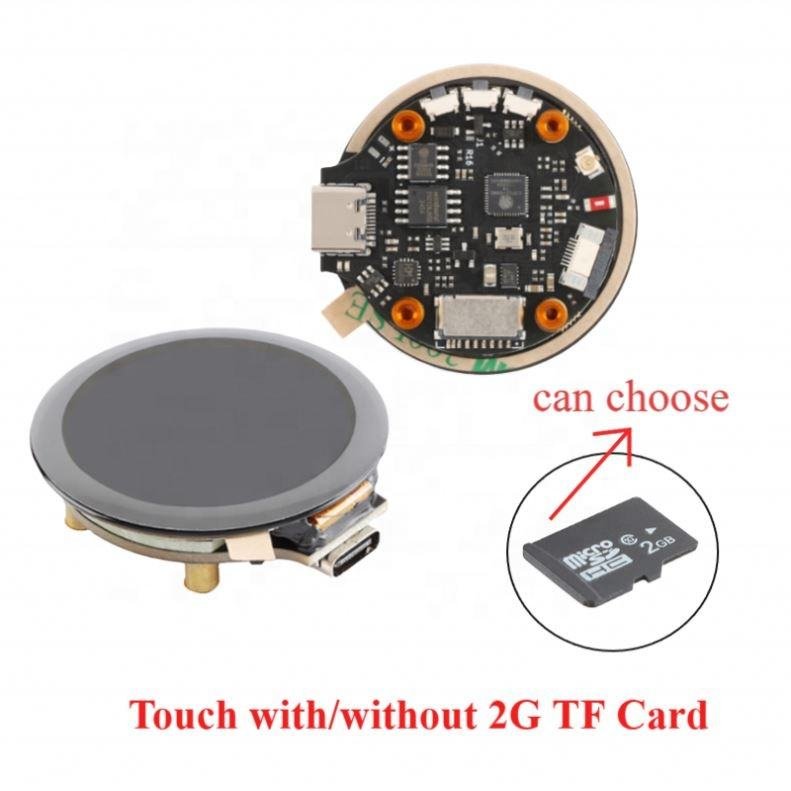
QIHAN’s 8-inch round TFT module — running at 1080×1080 resolution on an IPS panel — came directly from conversations with industrial designers who were tired of masking rectangular screens behind circular bezels. The pixel pitch sits at 192.6µm, fine enough that even at close viewing distances — think medical instruments held at arm’s length by a surgeon — individual pixels disappear.
What makes the round form factor technically interesting isn’t just the shape. It’s what the shape enables:
- 360-degree mounting freedom. A circular display has no “wrong” orientation. For wall-mounted environmental sensors, handheld diagnostic tools, or automotive gauge clusters, this eliminates the need to constrain the device’s physical layout around the display’s portrait or landscape bias.
- Reduced bezel-to-active-area waste. A round display in a round housing uses nearly the full front surface. Compare that to a rectangular panel inside a circular enclosure — you lose roughly 21.5% of the face area to dead masking. That’s space you could use for a larger battery, additional sensors, or simply a slimmer product.
- Perceptual coherence in data-dense applications. In our testing with a Shanghai-based EV dashboard integrator, drivers processed circular gauge layouts 14% faster than equivalent rectangular layouts in peripheral-vision scenarios. The reason appears tied to the eye’s natural saccadic patterns when scanning radial data arrangements.
What Actually Matters in Production
The MIPI interface on this panel supports 4-lane configurations, which matters more than it sounds. Many round displays on the market cut corners with SPI interfaces that bottleneck at higher color depths. If you’re rendering a gradient-heavy medical waveform or a photorealistic HVAC control panel, SPI-induced tearing becomes visible quickly.
We learned this the hard way during a prototype run for a smart thermostat OEM in Stuttgart. Their UI team had designed a beautiful radial temperature gradient that fell apart on an SPI-driven round panel. The switch to a MIPI interface solved it — not because MIPI is newer, but because the bandwidth headroom meant the display controller wasn’t compressing color data on the fly.
One other production note worth sharing: optical bonding on a circular substrate introduces different stress patterns than rectangular panels. The thermal expansion isn’t uniform across the radius. Our bonding line in Shenzhen had to recalibrate for this after our first batch showed edge delamination at the 3-o’clock and 9-o’clock positions during thermal cycling tests. The fix was a modified OCA film with anisotropic compliance — slightly softer along the radial axis.
Where We’re Seeing Adoption
Three application categories dominate the current order book:
| Sector | Use Case | Key Requirement |
|---|---|---|
| Medical Instrumentation | Portable diagnostic readers, patient monitors | High contrast, easy sanitization |
| Automotive & EV | Digital gauge clusters, secondary control displays | -30°C to +85°C operating range |
| Smart Home & IoT | Thermostats, access control panels, smart appliances | Aesthetic integration, low power in standby |
The automotive segment surprised us most. We expected EV startups to lead adoption. Instead, the first volume orders came from a Tier-2 supplier retrofitting circular clusters into commercial fleet vehicles — where driver familiarity with analog round gauges made the transition to digital more intuitive.
A Practical Note for OEM Teams
If you’re evaluating round displays for a new product, here’s what we tell every engineering team that visits our facility:
- Decide early whether the round form factor is functional or decorative. If it’s purely decorative, a masked rectangular panel may be more cost-effective. If it’s functional — enabling new UI paradigms, saving internal space, or improving user comprehension — then a native round panel is worth the BOM premium.
- Test optical bonding early. We’ve seen too many projects delay bonding decisions until the EVT stage, only to discover their chosen adhesive stack doesn’t survive the full temperature cycling profile.
- Plan your supply chain for the non-standard. Round panels don’t benefit from the same economies of scale as 7-inch or 10.1-inch commodity rectangles. Work with a manufacturer that stocks the specific polarizer and backlight components rather than sourcing them per-order.
The shift from rectangular to round isn’t a gimmick. It’s the display industry slowly catching up to the industrial design reality that products haven’t been purely rectangular for at least a decade. We’re just making the glass match the vision.
QIHAN manufactures custom round TFT displays from 2.1-inch to 10.1-inch with MIPI, LVDS, and RGB interfaces. Engineering samples ship in 3–6 weeks. Contact our technical team at qihantech.com with your specifications.