A screen can look excellent under office lighting and become a dark mirror outdoors. That failure is not usually caused by resolution. It is caused by the relationship between the display’s emitted light, the sun and every reflective surface in the optical stack.
Sunlight readability is therefore a system property. Backlight brightness matters, but so do the LCD, touch sensor, adhesive, cover glass, coatings, air gaps and enclosure geometry.
What makes an outdoor display readable?
Readable outdoor displays combine sufficient luminance with low reflection and good contrast. Four technologies do most of the work:
- high-brightness backlighting;
- optical bonding;
- anti-reflection or anti-glare cover treatment;
- transflective LCD construction.
The right design may use one, two or all four.
1. High brightness: useful, measurable and not free
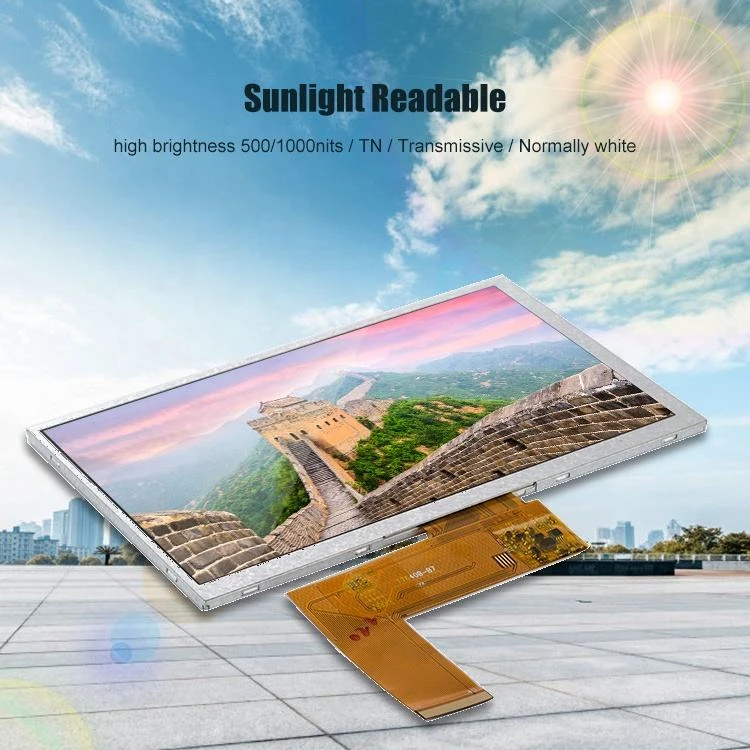
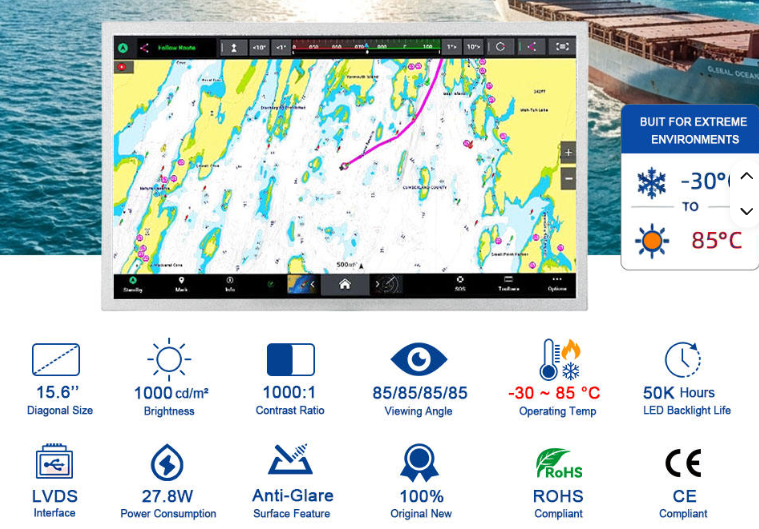
For many outdoor industrial products, 800 to 1,000 nits is a sensible evaluation range. Direct-sun applications may need more. QIHAN offers high-brightness configurations up to 1,800 nits on selected displays.
More luminance helps the image compete with ambient light, but it also increases power, heat and backlight stress. In a sealed charging station or handheld instrument, those secondary effects can become the real design limit.
Do not specify “1,000 nits” without stating where it is measured. Panel luminance is not the same as luminance through a touch panel and cover lens. Ask for the finished assembly value and define the acceptable uniformity, dimming range and operating temperature.
2. Optical bonding: remove the reflective air gap
Air bonding leaves a small gap between the display and touch or cover lens. Each air-to-material boundary can reflect part of the incoming light. In bright surroundings, those internal reflections wash out dark areas and reduce perceived contrast.
Optical bonding fills the gap with a transparent adhesive whose refractive index is closer to the surrounding materials. It reduces internal reflections and gives the image a more direct, high-contrast appearance. It also prevents moisture-laden air from occupying that cavity, which helps reduce condensation risk.
Optical bonding is especially valuable for:
- marine electronics and outdoor navigation;
- medical equipment that is cleaned frequently;
- construction and surveying handhelds;
- vehicle and charging-station displays;
- equipment exposed to vibration or impact.
The process must be matched to panel size, cover structure and temperature range. Adhesive selection, curing, bubble control and mura inspection all matter.
3. AR and AG cover glass solve different problems
“Anti-reflective” and “anti-glare” are often treated as synonyms. They are not.
AR (anti-reflection) treatment reduces specular reflection at the surface. It is useful when mirror-like images of the sky, operator or nearby objects make the content hard to see.
AG (anti-glare) treatment diffuses reflected light. It softens sharp reflections and can improve comfort, but aggressive haze may reduce image sharpness or create sparkle over high-resolution pixels.
An AF (anti-fingerprint) surface may be added when touch use, oils and cleanability matter. The final stack should be assessed for reflectance, haze, clarity, color shift and touch feel—not merely by checking a coating name on a drawing.
QIHAN supports custom cover glass with AR, AG and AF treatments, silk-screen printing, thickness and shape customization.
4. Transflective LCD: make sunlight part of the solution
A transflective LCD combines transmissive operation from a backlight with reflective use of ambient light. In strong sun, part of the incoming light is redirected through the display instead of becoming only a source of glare.
This approach can improve outdoor readability without relying entirely on a high-power backlight. It is attractive for battery products and instruments used across indoor and outdoor conditions.
There are trade-offs. Color saturation, contrast, cost and available sizes may differ from a conventional transmissive TFT. A transflective panel should be evaluated with the real UI in sunlight, shade and low light.
How to combine the four technologies
| Project condition | Practical starting point |
|---|---|
| Mostly indoors, occasional outdoor use | Moderate-high brightness plus AR cover lens |
| Fixed outdoor equipment with available power | High brightness, optical bonding and AR |
| Battery handheld used in sun | Efficient high brightness or transflective TFT, plus optical bonding |
| High humidity or large temperature swings | Optical bonding, sealed mechanical design and environmental validation |
| Touch display exposed to fingerprints | AR or balanced AG treatment with AF top coating |
| Tight budget | Improve reflections first, then add only the brightness needed |
Budget decisions should be based on total ownership cost. A cheaper air-bonded assembly may require a stronger backlight, larger battery, more thermal design and more field service.
A useful outdoor-display specification
Send suppliers more than a diagonal size. A strong RFQ includes:
- active area, outline and viewing direction;
- required luminance at the outer cover surface;
- ambient light and direct-sun exposure;
- operating and storage temperatures;
- touch requirement and glove/water conditions;
- cover thickness, printed border and coating;
- target interface and host processor;
- enclosure sealing and impact requirements;
- expected annual volume and project lifetime.
This information allows an engineer to balance optical performance, power and cost rather than overdesigning one number.
Frequently asked questions
Is 1,000 nits always sunlight readable?
No. A highly reflective stack can remain difficult to read even with a strong backlight. Readability depends on contrast under ambient light, not luminance alone.
Is optical bonding the same as waterproofing?
No. Bonding removes the internal air gap between optical layers. The enclosure, seals, connectors and pressure design still determine the product’s ingress protection.
Should I choose AR or AG?
Choose AR when mirror-like reflection is the main problem. Choose AG when scattered glare and viewing comfort dominate. For many products, a carefully balanced combination is best and should be validated with the actual pixel density and lighting.
Build the optical stack as one system
QIHAN provides high-brightness TFT LCDs, transflective options, optical bonding, touch integration and custom AR/AG/AF cover glass for small and medium industrial displays. Send your outdoor environment, mechanical drawing and brightness target for a stack-level recommendation.