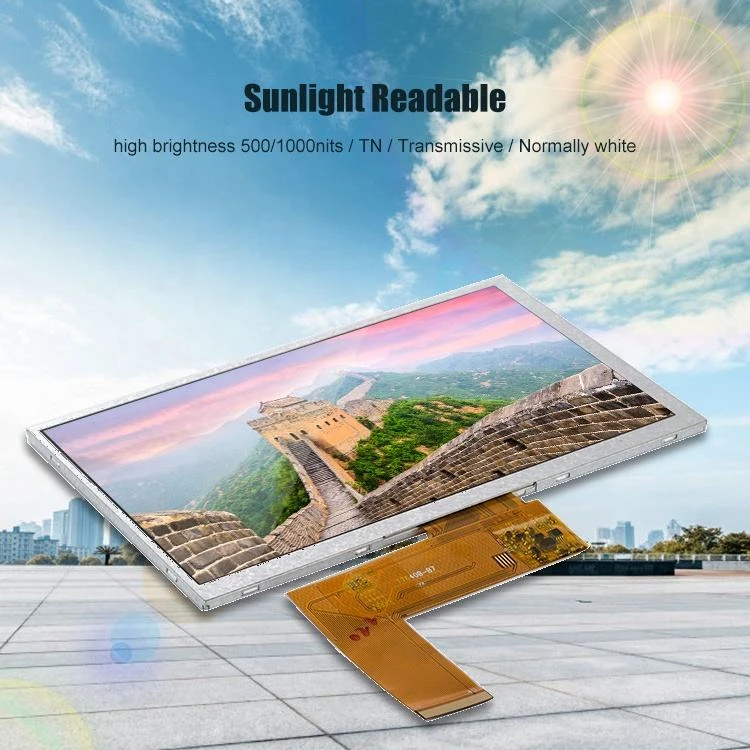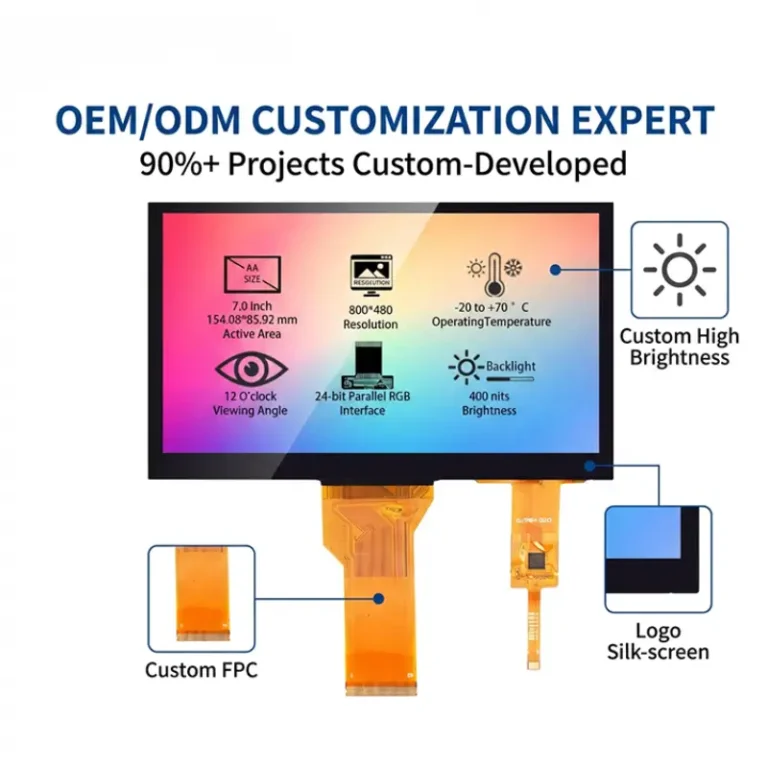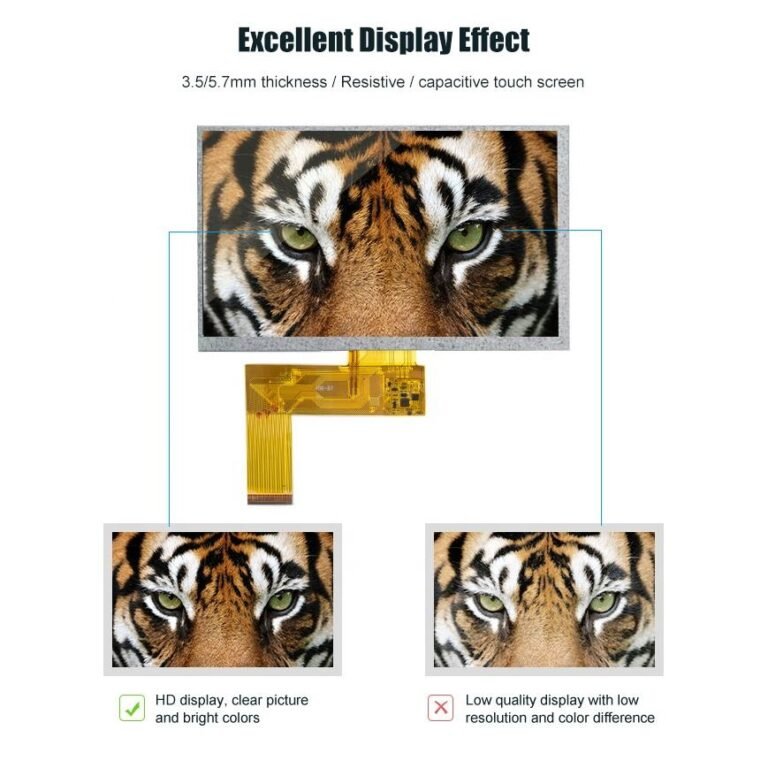
TFT LCD and OLED can both produce excellent product interfaces. The useful question is not which technology looks better in a dark showroom. It is which one will meet the product’s visual, electrical and supply requirements after thousands of hours in its real environment.
The answer often depends on the screen content.
A dark interface that wakes briefly to show changing information presents a favorable workload for OLED. A machine HMI that displays the same toolbar, status area and warning icons throughout a long shift presents a different aging pattern. A bright outdoor terminal places different demands on both technologies than a bedside controller used at low luminance.
This guide compares TFT LCD vs. OLED from the perspective of industrial and commercial product design: content duty cycle, ambient light, power, lifetime, thermal behavior, size availability, cost and supply continuity.
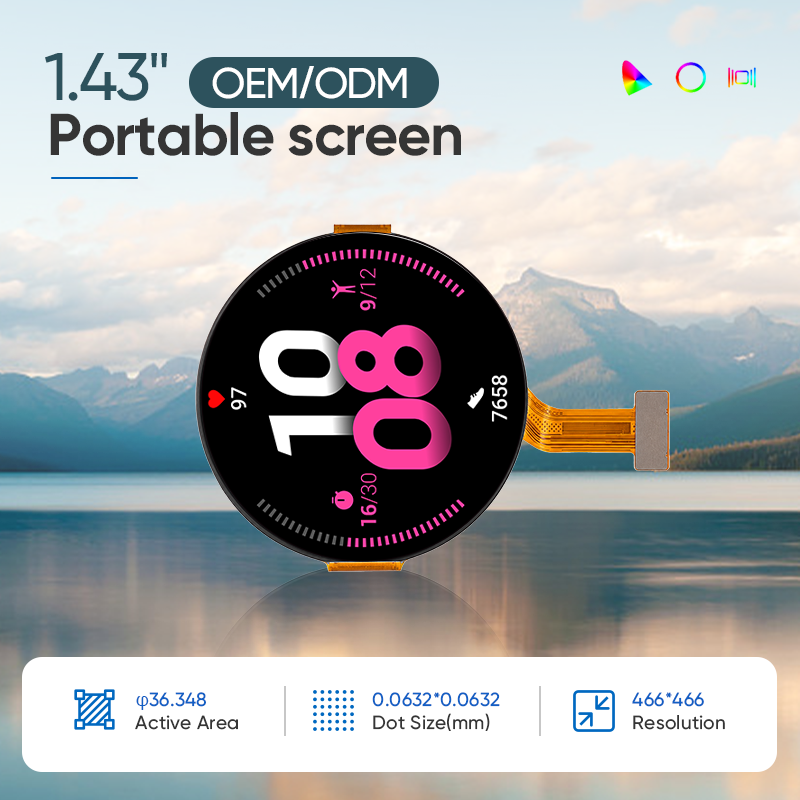
The Short Answer
Choose OLED when the product benefits from very deep blacks, high perceived contrast, wide viewing angles, fast pixel response and a thin self-emissive structure—and when the user interface and duty cycle can be managed for differential pixel aging.
Choose TFT LCD when the product needs a broad choice of sizes, resolutions, interfaces, brightness configurations and suppliers, or when static content will remain on screen for long operating periods.
Neither technology is automatically more reliable or more energy efficient. Compare both using the actual user interface, luminance, temperature and hours of operation.
Start with a Content and Duty-Cycle Profile
Before reviewing display samples, describe what the screen will show over time.
Record:
- Daily powered-on hours
- Percentage of time the screen is active
- Average and maximum luminance
- Percentage of white or bright pixels in typical screens
- Static elements such as logos, navigation bars and warning areas
- Frequency of full-screen changes
- Video, animation and waveform requirements
- Expected product service life
- Indoor, outdoor and night-use conditions
This profile reveals risks that a diagonal size and resolution cannot.
For OLED, bright pixels do more work than dark pixels, and repeated static patterns can age regions unevenly. For TFT LCD, the backlight consumes power whenever it is on, regardless of whether the image is mostly black or mostly white. The same user interface can therefore produce very different power and aging behavior on the two technologies.
How TFT LCD Technology Works
A TFT LCD uses a backlight to produce light. Liquid-crystal cells control how much of that light passes through color filters and polarizers at each pixel. Thin-film transistors address the pixels and hold the required image state.
The display assembly normally includes:
- TFT glass and liquid-crystal layer
- Color filters and polarizers
- LED backlight
- Light guide and optical films
- Driver IC and FPC
- Metal or plastic frame
Because the backlight illuminates the panel as a system, TFT power is strongly influenced by backlight brightness and operating time. A dark user interface does not turn individual backlight zones off on a typical small edge-lit TFT.
TFT LCD is available in several panel modes. IPS generally provides more stable color and contrast across viewing directions. TN can remain practical when the viewing position is controlled and cost or availability is important.
How OLED Technology Works
OLED pixels emit their own light when driven. No conventional LED backlight or liquid-crystal shutter is required.
When an OLED pixel displays black, it emits little or no light. This creates the deep black level and high perceived contrast associated with OLED. The self-emissive structure can also support thin modules and wide viewing angles.
OLED power depends heavily on image content and luminance. A mostly black screen with limited bright information can be efficient. A bright, mostly white interface drives many pixels simultaneously and may use substantially more power.
OLED materials age as they emit light. Because pixels do not always receive the same workload, repeated bright static elements can create uneven aging that becomes visible as image retention or burn-in.
TFT LCD vs. OLED at a Glance
| Decision factor | TFT LCD | OLED |
|---|---|---|
| Light source | LED backlight behind the panel | Each pixel emits light |
| Black level | Limited by backlight leakage and optical stack | Very deep black because dark pixels are off |
| Contrast in dark conditions | Good to very good, depending on panel and backlight | Typically excellent |
| Viewing angle | Depends on panel mode; IPS is strong | Generally wide |
| Pixel response | Suitable for most industrial motion and video | Very fast |
| Power behavior | Strongly linked to backlight level and on-time | Strongly linked to image content and luminance |
| Static-image concern | No OLED-type differential emissive aging | Uneven pixel aging requires consideration |
| Outdoor approach | High brightness, AR, optical bonding or transflective design | Requires sufficient output and reflection control; high output affects power and aging |
| Mechanical stack | Includes backlight and optical films | Can be thinner without a conventional backlight |
| Supply choice | Broad in many small and medium sizes | More dependent on OLED type, size and supplier platform |
| Common industrial strength | Static HMI content, long on-time, platform variety | Dark UI, premium contrast, compact or thin design |
This table identifies tendencies, not guaranteed values. Compare exact modules rather than technology names alone.
Brightness and Contrast
OLED has a clear advantage in black level. A dark pixel does not need to block a backlight, so black areas can appear close to the unlit front surface.
TFT LCD black level depends on how effectively the liquid crystal and polarizers block the backlight. IPS and TN panels have different optical behavior, and the final result also depends on the cover lens, bonding and viewing angle.
High contrast in a dark room does not automatically mean better visibility in daylight. Reflected ambient light can lift the apparent black level of both technologies.
Specify Contrast Where the Product Is Used
Indoor contrast ratio is measured under controlled conditions. Outdoor or high-ambient performance depends on the ratio between useful screen light and reflected light from the complete optical stack.
Ask:
- Is luminance measured at the bare panel or finished cover surface?
- What is the front-surface reflection?
- Is the touch panel air bonded or optically bonded?
- Does the cover use AR or AG treatment?
- What happens at the actual viewing angle?
- What is the internal temperature at maximum luminance?
A bright display behind reflective glass can be less readable than a lower-luminance display with a better optical stack.
Outdoor Visibility
TFT LCD has several established routes to outdoor readability:
- Higher-output LED backlight
- Low-reflection cover treatment
- Optical bonding
- Transflective panel construction
- Mechanical shading in the enclosure
Each route has trade-offs. A stronger backlight adds power and heat. Aggressive AG treatment can soften fine pixels. Optical bonding affects cost and repair. Transflective TFT may trade some indoor color performance for ambient-light use.
OLED can also be readable outdoors when it produces sufficient luminance and the front surface controls reflection. However, high full-screen output can increase electrical and thermal load and may accelerate emissive aging. The exact module, content and duty cycle must be tested.
Do not choose between industrial LCD vs. OLED using peak brightness alone. Use a production-intent sample with the real cover, UI and enclosure under representative sun and temperature.
Viewing Angle and Image Behavior
OLED generally maintains strong contrast across wide viewing angles, although color or luminance can still change with angle depending on construction.
IPS TFT LCD can also provide wide, stable viewing suitable for shared HMIs and devices viewed from standing and seated positions. TN may show stronger directional changes and should be matched to a known viewing position.
For either technology, verify:
- Landscape or portrait orientation
- Primary and worst viewing positions
- Color and gray-scale shift
- Black-state appearance
- Polarized-sunglasses compatibility
- Reflections from the cover stack
Test real interface screens. A colorful image is a poor substitute for small text, dark menus and status colors.
Pixel Response and Motion
OLED pixels switch quickly, which can produce clear motion and rapid transitions.
TFT LCD response depends on liquid-crystal mode and temperature. Most industrial interfaces, graphs and video can be served well by a suitable TFT, but low temperature can slow transitions and create smearing.
Products displaying camera images, fast waveforms or moving pointers should define an acceptable response time at the temperature limits. Do not assume room-temperature behavior represents cold operation.
For static or slowly changing information, the practical value of OLED’s faster response may be small.
Power Consumption: The UI Decides
Statements such as “OLED uses less power” or “LCD is more efficient” are incomplete.
TFT LCD Power Pattern
The LED backlight is normally the dominant load in a small TFT module. Power changes with brightness and dimming duty but only slightly with image content.
This makes consumption relatively predictable. A white screen and a black screen may use similar display power when the backlight setting is unchanged.
OLED Power Pattern
OLED pixels consume power according to emitted light. Dark pixels require little display power, while bright pixels require more. Full-screen white at high luminance can create a very different load from a dark status interface.
How to Compare Fairly
Measure or estimate power using:
- The same physical display area
- The same perceived brightness
- The production user interface
- Typical, maximum and standby screens
- Real duty cycle
- Expected temperature
- Display and controller electronics
Average power over a complete task is more useful than one pattern on a datasheet.
Lifetime and the Meaning of Failure
Display life should be connected to an end-of-life criterion.
A display may still produce an image after years of use but no longer meet required brightness, uniformity, color or touch performance.
Define:
- Required powered-on hours
- Minimum end-of-life luminance
- Allowed color or uniformity change
- Maximum static-content exposure
- Operating temperature and brightness profile
- Service and replacement strategy
TFT LCD Aging
TFT modules can experience LED lumen depreciation, polarizer aging, adhesive changes and other material effects. Backlight lifetime is often specified as the time until luminance falls to a defined fraction of its initial value under stated current and temperature conditions.
Confirm the endpoint, drive current, temperature and whether the figure is typical or minimum.
OLED Aging
OLED materials lose output with use. Aging depends on brightness, temperature, color and content. Regions showing bright static elements receive a different workload from dark or changing regions.
This does not mean every OLED will quickly burn in. It means the UI and duty cycle belong in the reliability assessment.
Burn-In and Image Retention
Burn-in is the visible result of uneven, persistent OLED pixel aging. Temporary image retention and permanent differential aging should not be treated as identical, but both require a defined evaluation method.
Common risk patterns include:
- A fixed logo
- A permanent navigation bar
- Static machine-state labels
- Bright warning zones in the same location
- A clock or numeric field that changes only partly
- Repeated menu screens during long shifts
Mitigation may include:
- Automatic screen timeout
- Lower average luminance
- Moving or rotating static elements
- Full-screen content changes
- Dark themes designed around the OLED workload
- Pixel-shift or compensation functions supported by the selected platform
- Task-based life testing with representative screens
Do not hide essential controls or move safety-relevant information merely to protect the display. Product usability and system requirements remain the priority.
Why TFT Avoids This Specific Risk
TFT pixels control a shared backlight rather than emitting their own light. They do not experience OLED’s pattern-dependent emissive aging.
TFT has other aging mechanisms, including backlight depreciation and possible image-sticking behavior under some conditions. The advantage is not that TFT never ages; it is that long-lived static layouts do not create the same OLED burn-in mechanism.
Reliability at Temperature
Temperature affects both technologies, but the failure mechanisms differ.
TFT liquid-crystal response can slow at low temperature. High temperature can affect contrast, backlight, polarizers and adhesives.
OLED luminance, efficiency, color balance and aging rate can change with temperature. Module construction, driver behavior and material system determine the exact response.
For either technology, distinguish:
- Operating temperature
- Storage temperature
- Survival limit
- Startup requirement
- Optical performance at the endpoints
- Recovery after exposure
A range on a datasheet does not guarantee that image quality remains unchanged throughout that range.
Test the finished touch and cover assembly because adhesives, sensors and cover materials also respond to temperature cycling.
Cost: Compare the Complete Product
Panel price is only one part of display cost.
TFT LCD often benefits from a broad platform base, mature tooling and many standard configurations. OLED may reduce thickness or remove the backlight assembly, which can create value elsewhere in the product.
Compare:
- Module and controller price
- Tooling and NRE
- Touch and cover integration
- Backlight or power-supply design
- Thermal management
- Host processor and interface cost
- Qualification and life testing
- Expected yield
- Service and replacement cost
- Supply-risk mitigation
A more expensive display can lower total product cost if it eliminates mechanical parts or solves a critical user requirement. A cheaper panel can become expensive if it forces redesign or repeated qualification.
Size, Resolution and Form-Factor Availability
TFT LCD is widely available across small and medium sizes, standard aspect ratios, round formats, bar displays and multiple interface families.
OLED availability depends on technology and platform. Small monochrome PMOLED modules are common for status displays. Color AMOLED provides a different set of sizes, resolutions and commercial conditions.
Do not treat all OLED as one category. A 0.96-inch monochrome PMOLED and a color AMOLED use different supply chains and address different product needs.
Before committing to a mechanical design, confirm:
- Active area and module outline
- Resolution and orientation
- FPC and connector location
- Display controller
- Touch availability
- Minimum order and tooling
- Supplier roadmap
- Expected production and service period
Interfaces and Host Integration
Small TFT and OLED modules may use SPI or MCU-style interfaces. Higher-resolution modules may use RGB, MIPI DSI, LVDS, eDP or a driver-board conversion.
Interface availability is tied to the exact module, not the display technology alone.
Check:
- Host processor peripheral
- Resolution, color depth and frame rate
- Frame-buffer memory
- Initialization sequence
- Logic and power rails
- Backlight control for TFT
- Display-current behavior for OLED
- Cable length and signal integrity
- Driver and operating-system support
Changing from TFT to OLED is rarely a drop-in optical decision. Power, initialization, timing, mechanical fit and thermal behavior may all change.
Supply and Lifecycle Considerations
Industrial and commercial products may remain in production longer than the consumer device that originally drove a display platform.
TFT LCD often offers more choices within common sizes and resolutions, but similar-looking modules are not automatically interchangeable. OLED may have fewer qualified platform alternatives in a particular size.
For either technology, create a display passport containing:
- Full part number and revision
- Drawing and controlled dimensions
- Connector and pinout
- Timing and initialization files
- Optical acceptance criteria
- Touch firmware
- Cover and bonding stack
- Approved sample record
- Change-notification contact
Ask how panel, driver IC and material changes are communicated. Discuss alternate platforms before the original part approaches end of life.
Market availability changes over time. Industry research firms such as Omdia track TFT LCD and OLED supply, pricing and capacity, but a market trend does not guarantee continuity for one module. Use current project-specific commitments and documented change processes.
Which Technology Is Better for Industrial Applications?
TFT LCD is often the practical default for industrial HMIs, medical instruments, automation controls and outdoor equipment. Common reasons include long static-content periods, broad module availability, predictable backlight power and numerous size, brightness and interface options.
OLED can be the better choice for an industrial product when:
- The interface is primarily dark
- Information changes regularly
- Deep black and high perceived contrast matter
- The module must be thin
- Users view it from extreme angles
- Fast response is important
- The duty cycle and luminance can be controlled
The term “industrial” does not automatically favor TFT. The application profile does.
Industrial LCD vs. OLED Decision Table
| Product behavior | Likely starting point | Reason to validate |
|---|---|---|
| Static HMI shown throughout a long shift | TFT LCD | Avoids OLED differential emissive aging; check backlight life |
| Dark handheld interface used briefly | OLED | Deep black and content-dependent power can be valuable |
| Outdoor terminal with continuous operation | High-brightness or transflective TFT | Broad optical options; verify thermal load and reflections |
| Premium compact controller | OLED or IPS TFT | Compare depth, black appearance, cost and static UI |
| Live waveform or camera image | OLED or suitable TFT | Check response, bandwidth, temperature and latency |
| Long-support industrial product | TFT LCD often offers more platform choice | Confirm exact lifecycle and alternate strategy |
| Always-on bright white interface | TFT LCD is often easier to manage | Compare OLED power and aging with real content |
These are starting points, not final selections.
When TFT LCD Remains the Practical Choice
Static Interfaces
Industrial screens frequently keep menus, labels, scales and status areas in fixed positions. TFT avoids OLED’s pattern-dependent emissive aging risk.
Broad Platform Choice
TFT LCD is available in many combinations of size, aspect ratio, resolution, panel mode, brightness and interface. This increases the chance of finding a standard or semi-custom base.
High and Adjustable Brightness
TFT backlights can be configured for indoor, high-brightness or selected sunlight-readable applications. The power and heat must still be engineered.
Predictable Power for Mixed Content
When screen content varies between dark and bright pages, TFT backlight power remains comparatively stable at a fixed brightness setting.
Long Production Programs
A broader ecosystem can provide more options for adaptation or replacement, though no supplier should promise unlimited availability without a program-specific agreement.
Cost-Sensitive Full-Color Products
For many standard sizes, TFT provides a competitive path to a full-color interface. Total cost should still include touch, cover, bonding, electronics and qualification.
When OLED Is Worth the Trade-Off
OLED is not merely a premium alternative. It can solve real product constraints.
Choose it deliberately when the user experience depends on deep black, dark-room viewing, fast response, wide viewing or a thin structure. Compact monochrome OLED can also be effective for simple text and status information.
The project should then manage content, temperature, luminance and lifetime as one system. A well-matched OLED application can be more appropriate than a conventional TFT even if TFT is easier to source.
Prototype Both with the Real Interface
A fair comparison requires production-intent conditions.
Use:
- The same physical image area
- Equivalent perceived brightness
- The actual UI and content sequence
- Intended cover lens and bonding
- Typical and maximum temperature
- Real operating hours and sleep behavior
- Host processor and interface
Measure:
- Average and peak display power
- Finished-surface luminance
- Day and night readability
- Viewing-angle behavior
- Image response at temperature
- Housing temperature
- Uniformity after an accelerated representative-content test
Document the test conditions. A photo of two samples without exposure, camera and brightness information is not reliable evidence.
Questions to Ask a Display Supplier
- Which exact TFT or OLED technology is being proposed?
- Where is luminance measured?
- How is lifetime defined, and under which content, current and temperature?
- What static-content limits or mitigation are recommended?
- Does the temperature range include startup and optical performance?
- Which sizes, resolutions and interfaces are standard?
- Which elements can be customized without changing the core panel?
- How are controller, panel and material changes communicated?
- What evidence applies to the exact touch and cover stack?
- What should be validated in the finished product?
Answers should be tied to a part number and revision, not only to a technology category.
How QIHAN Supports TFT LCD and OLED Selection
QIHAN manufactures and supplies small and medium-sized TFT LCD, OLED, LCD module and touch-display solutions.
QIHAN’s published TFT range extends from 0.96 to 15.6 inches for industrial, embedded and HMI applications. Available project options include selected high-brightness, transflective and wide-temperature TFT configurations, touch integration, cover glass, optical bonding, FPC customization, interfaces and driver boards.
QIHAN also supplies OLED display solutions, including compact modules for applications where self-emissive contrast and small size are useful.
Available lifetime, temperature, brightness, MOQ and supply terms depend on the exact TFT or OLED platform. They should be confirmed in the project specification and quotation.
Frequently Asked Questions
Is OLED always better than TFT LCD?
No. OLED offers deep black, high perceived contrast, wide viewing and fast response. TFT often offers broader platform availability, predictable backlight behavior and lower risk for long-lived static interfaces. The better choice depends on the product.
Does OLED always use less power?
No. OLED power depends on content and luminance. A dark interface may be efficient, while a bright white screen can use substantially more power. TFT consumption is driven mainly by backlight brightness and on-time.
Can OLED burn-in occur in an industrial HMI?
Yes, uneven pixel aging can become visible when bright static content remains in the same location for long periods. Risk depends on content, luminance, temperature and duration. Test representative screens and use suitable mitigation.
Does TFT LCD suffer from burn-in?
TFT does not have the same differential emissive aging mechanism as OLED. It can have other aging effects, including backlight depreciation and possible temporary image sticking under some conditions.
Which technology is better outdoors?
Neither technology wins automatically. TFT offers high-brightness, AR, optical-bonding and transflective options. OLED can also be visible outdoors, but reflection, power, heat and aging must be assessed. Test the finished stack in representative sunlight.
Which display has a longer lifetime?
There is no universal answer. Lifetime depends on the definition of failure, brightness, temperature, image content, operating hours and module design. Compare conditions rather than headline hour values.
Is TFT LCD cheaper than OLED?
TFT is often cost-effective in common sizes, but the result varies by module and volume. Compare the complete assembly, electronics, tooling, qualification and service cost.
Can QIHAN help replace OLED with a TFT display?
QIHAN can evaluate available TFT platforms and project adaptations such as FPC, interface, backlight, touch, cover and mechanical changes. A replacement is not automatically drop-in because power, timing, optics and dimensions may differ.
Choose the Workload, Not the Showroom Winner
TFT LCD vs. OLED is not a contest with one permanent winner.
OLED is compelling when the product uses dark, changing content and benefits from deep black, wide viewing or a thin structure. TFT LCD remains practical when static content, long operating periods, platform choice, high-brightness options and supply flexibility carry more weight.
Build a content and duty-cycle profile before selecting either technology. Then test the actual interface at the required brightness, temperature and viewing conditions.
QIHAN can help compare a small TFT LCD or OLED module and define the touch, cover, bonding, interface and mechanical adaptations required for your product.